
A scale is subject to calibration if it provides a measurement value relevant to billing. As soon as a weight is used in commercial transactions with third parties to determine a fee, its use falls within the scope of measurement and calibration law. This is exactly how the calibration authorities explain it in their guidelines for business practice. Purely internal control weighings with no connection to price, postage, or freight calculations, on the other hand, are not subject to calibration.
For companies in shipping, retail, and logistics, this means that not every scale used in business operations must be calibrated. The decisive factor is the specific function of the measured value in external transactions. This can apply to a small package scale just as much as to a large floor scale or a dynamic checkweighing station.
Since 2015, the Measurement Act (MessEG) and the Measurement Ordinance (MessEV) have formed the central legal framework. In addition, for new non-automatic scales, the EU-level conformity assessment under Directive 2014/31/EU applies. Also relevant are the calibration intervals, the user notification required within six weeks of commissioning, and the distinction between calibration and simple adjustment.
The following sections explain when companies must have a scale verified, what deadlines apply, how the verification process works in practice, and what to look for when purchasing a new verified scale or a conformity-assessed solution. For shipping processes involving weight and dimensions, the guide also explains when a volume measuring device is required in addition to a calibrated package scale.
Table of Contents
- When is a scale subject to calibration?
- Calibration Requirements by Application: Typical Practical Examples
- Legal Basis for the Calibration of Scales
- Overview of calibration intervals for scales
- Buying a new scale: Conformity assessment instead of initial calibration
- Obligations of scale users
- How the calibration of a scale works
- How much does it cost to have a scale calibrated?
- Distinguishing Between Verification, Conformity Assessment, and Calibration
- Special Case: Volume and Dimension Measurement in Shipping
- Suitable Systems for Shipping with PackageHERO®
- FAQ
When is a scale subject to calibration?

Whether a scale must be calibrated depends on its intended use. Measurement and calibration laws do not apply across the board to “commercial” use, but rather to the purpose for which the measurement value is used. As soon as the result of a weighing is used in billing, pricing, or other fee calculations involving a third party, it falls within a regulated scope of use.
The only use exempt from the calibration requirement is purely internal use within the company. This includes, for example, internal inventory checks, production controls, comparisons of incoming goods, or technical process monitoring—provided that the respective result is not later used as the basis for an external claim.
For operational assessment, therefore, a simple guiding question suffices: Which scale ultimately provides the exact value on the basis of which a customer, client, or contractual partner is to pay? This specific scale is the relevant point of reference for the assessment under calibration law.
Classification should be device-specific. Consequently, a business may have multiple scales in use simultaneously, only some of which are subject to legal metrology requirements. The decisive factor is always the function of the individual measured value within the respective process.
Calibration Requirements Following an Incident: Typical Real-World Examples

For borderline cases, a case matrix is usually more helpful than simply reiterating general principles. It shows at which specific points companies must calibrate a scale and when they do not:
- Shipping costs based on a rate tier rather than an exact price per kilogram: The weight remains relevant for billing, even if only one shipping class is triggered. Result: Calibration required.
- Internal preliminary weighing, followed by final weighing for billing or freight charges: Only the scale used to determine the binding billing value is relevant. Result: Preliminary weighing—no; final weighing—yes.
- Measurement value is stored and invoiced only later: The time lag in invoicing does not change the legal nature of the transaction. Result: Calibration required.
- Service provider determines weight for the client, who then issues an invoice: The decisive factor is the subsequent use of the measured value in external transactions. Result: subject to calibration.
- Goods receipt solely for inventory or quality control purposes: The value remains within the company and does not trigger a receivable. Result: Not subject to calibration.
- The goods receipt value is later used for credit memos, complaints, or charges against suppliers: In this case, the same data record has an economic impact externally. Result: Generally subject to calibration.
- A device is used alternately for internal purposes and for billing purposes: For regulated use, this specific device must meet the legal metrology requirements. Result: subject to legal metrology requirements for the relevant use.
This also answers the common practical question of whether multiple scales at a single location should be treated differently: yes, if only some of the devices provide measurement values for price, postage, or freight to third parties.
Sold by weight in the store

In brick-and-mortar retail, the calibration requirement is generally clear because the measured value is directly factored into the purchase price. In addition, Section 23(3) of the Measurement and Calibration Ordinance (MessEV) stipulates that measuring instruments falling within the scope of the Measurement and Calibration Act must be set up and used in such a way that the buyer can observe the measurement process.
For store scales, therefore, it is not only the valid calibration that matters, but also the transparent execution of the actual sales transaction.
Logistics service provider with weight-based billing

For logistics service providers, the unique aspect often lies in third-party billing. The weight is not always billed by the party performing the measurement itself, but is instead passed on to the shipper, carrier, or billing partner. This is irrelevant for legal classification as long as this exact value serves as the basis for the subsequent determination of fees.
Transparent process documentation is particularly important here: Companies should clearly document which measurement point is used to calculate the tariff-based or contractual charge.
Mail-Order Business: Billing for Postage and Freight Based on Weight

In mail-order business, the legally decisive factor is often not the kilogram itself, but the threshold that triggers a shipping rate. Even if a store system only uses shipping tiers such as “up to 5 kg” or “up to 10 kg,” the pricing logic is based on a measured value. That is precisely why this scale must be suitable for regulated use.
Anyone who invoices shipments or passes on freight costs on this basis therefore needs not just any package scale, but a solution that is approved for this purpose. Technically, this often leads to the selection of a calibrated package scale.
Incoming Goods Inspection and Internal Check Weighing

When it comes to goods receipts, the key issue is the change in the purpose of the data record. As long as a weighing is used solely for internal verification of delivery quantities, inventory levels, or quality deviations, it is not subject to calibration requirements.
The same process takes on a different legal status if the recorded weight is later used as evidence for a reduction, additional charge, or credit note issued to the supplier. Companies should therefore consider not only the “goods receipt” workstation but also how the stored weight will be used subsequently.
Legal Basis for the Calibration of Scales

For businesses, the most important consideration is which legal source addresses which specific practical question. The following classification provides a concise framework for this purpose:
- Question: Is my use even covered by metrology law?
Legal source: the German Measurement Act (MessEG) in conjunction with the guidelines issued by the calibration authorities.
Practical benefit: Distinction between regulated use and internal control weighing. - Question: When do I have to report the scale’s commissioning?
Legal source: § 32 MessEG.
Practical benefit: User notification within six weeks of commissioning. - Question: What calibration interval applies to my scale?
Legal basis: § 34 MessEV in conjunction with Annex 7.
Practical benefit: Classification by scale type and maximum load. - Question: What specific usage requirements apply in retail sales?
Legal basis: Section 23(3) of the MessEV.
Practical benefit: The buyer must be able to observe the measurement process. - Question: How should a new non-automatic scale be classified legally?
Legal source: Directive 2014/31/EU.
Practical benefit: Verification of CE marking, “M” marking, annual marking, and the notified body’s identification number instead of the previous initial calibration. - Question: What factors determine the fees when I want to have a scale calibrated?
Legal basis: Section 59 of the German Measurement Act (MessEG) in conjunction with state law.
Practical benefit: Scale calibration costs are not uniform across Germany but are governed by the fee regulations of the individual states and depend in particular on the type of scale and its maximum capacity.
This classification helps avoid many misconceptions in practice: Not every question is answered directly in the same law, and—especially when it comes to deadlines, reporting requirements, and fees—the precise legal provision is crucial.
The MessEG and MessEV since 2015
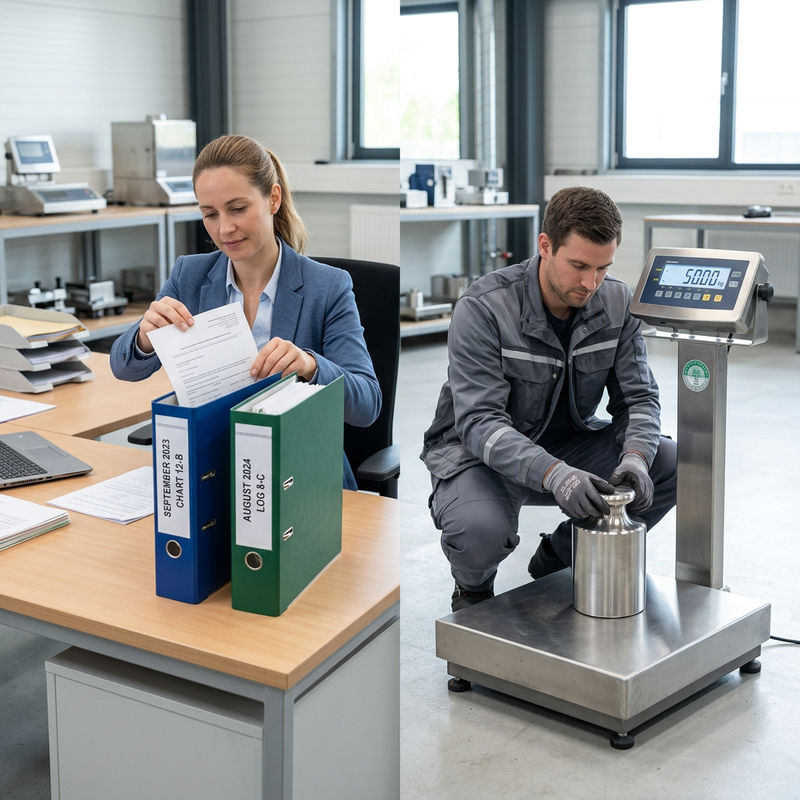
The reformed Measurement and Calibration Act, comprising the Measurement Act (MessEG) and the Measurement Ordinance (MessEV), has been in effect since January 1, 2015. In day-to-day practice, the division of responsibilities is clear: The MessEG primarily addresses the fundamental questions regarding the regulated use of measuring instruments and the obligations of the user; the MessEV provides the detailed operational regulations for this.
So, anyone looking for information on commissioning, documentation, installation, deadlines, or specific usage requirements will usually find the answer in the ordinance or its annexes.
EU Directive 2014/31/EU on new non-automatic weighing instruments

For new devices, a different question is key compared to those already in operation: Is it even lawful to place the scale on the market? Under EU law, the placing on the market of non-automatic scales is governed by Directive 2014/31/EU.
In practical terms, this means that users should not look for a previous national initial verification when purchasing a scale, but rather for a proper conformity assessment with the required marking and the manufacturer’s documentation.
Uncalibrated use in commercial transactions constitutes an administrative offense

To put it in legally precise terms: Not just any uncalibrated scale is problematic in and of itself, but its unauthorized use in a regulated context certainly is. Similarly, violations of obligations under the Measurement Act (MessEG) and the Measurement Ordinance (MessEV) may constitute administrative offenses, such as when a measuring instrument is used for billing purposes despite the lack of legal requirements, or when statutory user obligations are disregarded.
For companies, this has a simple implication: Not only must the measurement technology be in order, but the display, deadlines, labeling, and intended use must also be consistent.
Overview of Calibration Intervals for Scales
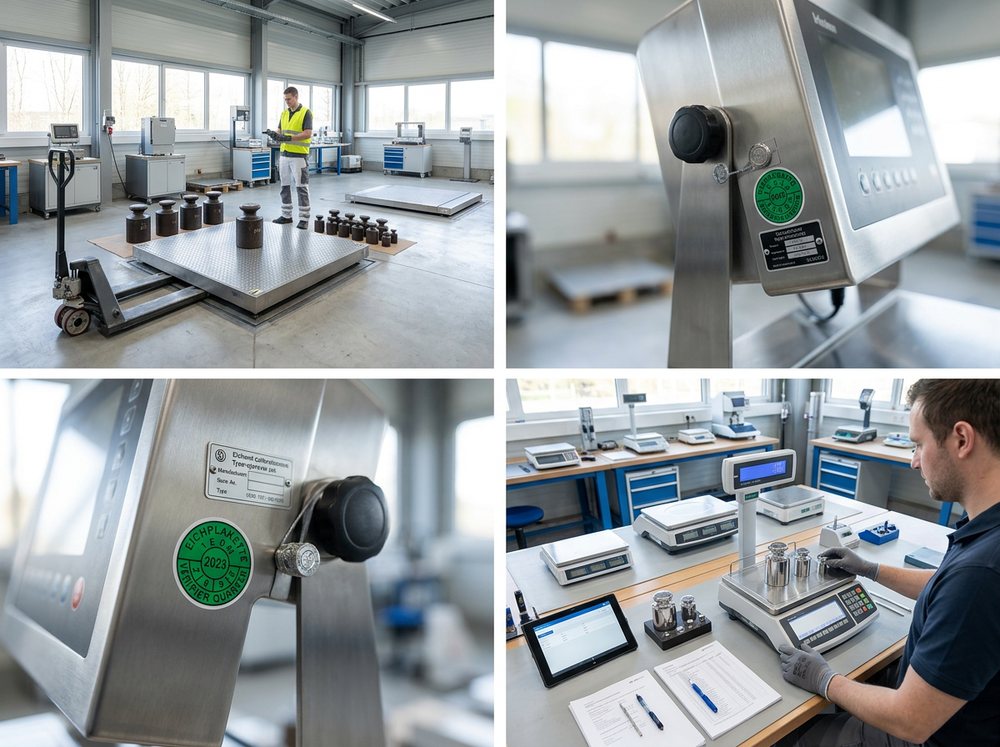
The calibration intervals are specified in § 34 of the MessEV in conjunction with Annex 7. For typical applications in shipping, retail, and logistics, this results in the following overview:
- Counter scales – 2 years
- Industrial scales with a maximum capacity of less than 3 metric tons – 2 years
- Industrial scales with a maximum capacity of 3 metric tons or more – 3 years
Example: large industrial scale. - Vehicle scales with a maximum capacity of 3 metric tons or more – 3 years
- Automatic checkweighers (dynamic scales) – 1 year
- Non-self-calibrating (mechanical) scales – 4 years
The calibration period begins when the measuring instrument is placed on the market; during the current calibration period, the measuring instrument is considered calibrated and does not require recalibration. For periods of one year or longer, the calibration period ends at the close of the calendar year in which the period is scheduled to expire.
Calibration Interval Table by Scale Type
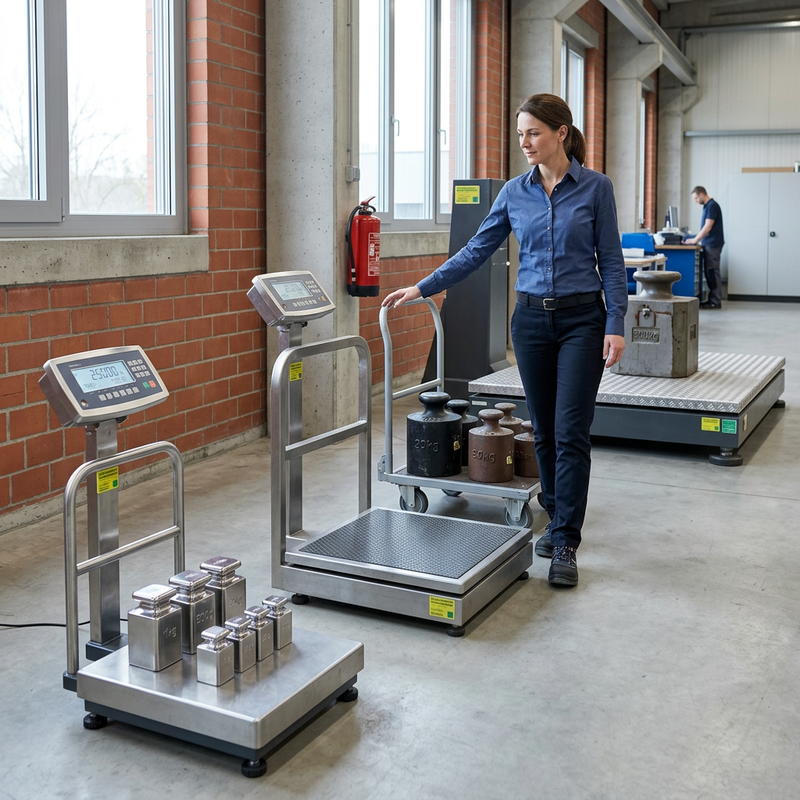
In terms of the table entries in Annex 7 of the MessEV, the following categories are particularly relevant for practical use in business: Counter scales have a calibration period of 2 years. Industrial scales with a maximum capacity of less than 3 t also have a calibration period of 2 years. Industrial scales with a maximum load of 3 metric tons or more have a calibration period of 3 years. Vehicle scales with a maximum load of 3 metric tons or more also have a calibration period of 3 years. Automatic checkweighers (dynamic scales) have a calibration period of 1 year. Non-self-calibrating (mechanical) scales have a calibration period of 4 years.
If the classification of a specific device is not immediately clear, the model designation in the device documentation should be cross-referenced with the calibration period regulations in Appendix 7.
Determine the Start and End Dates of the Calibration Period Correctly

In practice, errors arise less from the calibration period values themselves than from their temporal interpretation. For new devices, one should not simply focus on the date of commissioning: The year indicated on the measuring instrument is the primary factor, as the year on the marking serves as the temporal reference for calculating the calibration period.
- Common misconception 1: The inspection mark on a new scale is equivalent to a separate official initial calibration. In fact, for new devices, the conformity assessment is decisive.
- Common misconception 2: Validity ends on the exact day of the inspection month. For periods of one year or more, the end of the calendar year is the determining factor.
- Common misconception 3: Older devices always follow the current standard scheme. For older type approvals, different time limits may still apply.
- Common Misconception 4: Technical modifications are irrelevant to the validity period. Repairs or alterations may separately affect the device’s continued permissible use.
To ensure reliable deadline management, companies should document the labeling, equipment documentation, expiration dates, and any modifications together.
Deviations in Older Type Approvals

Older scales should not be hastily classified according to the current standard scheme. If a type approval issued for a device by December 31, 2014—which includes its own deadline provisions—is still relevant, that approval may take precedence.
Therefore, especially for existing systems that have been in use for many years, it is worth reviewing the device documentation or consulting the responsible calibration authority.
Buying a New Scale: Conformity Assessment Instead of Initial Calibration

When purchasing a new scale, one point is particularly important: The former national initial calibration has been replaced by conformity assessment for new devices. The legal basis for placing the product on the market is Section 6 of the German Measurement Act (MessEG); for new non-automatic scales, Directive 2014/31/EU also applies.
For users, this means that a new scale must already meet the prescribed requirements when it is made available on the market. For operational use, therefore, one should not look for a separate initial inspection by the authorities, but rather for proper marking and complete manufacturer documentation. After that, the regular re-calibration intervals apply.
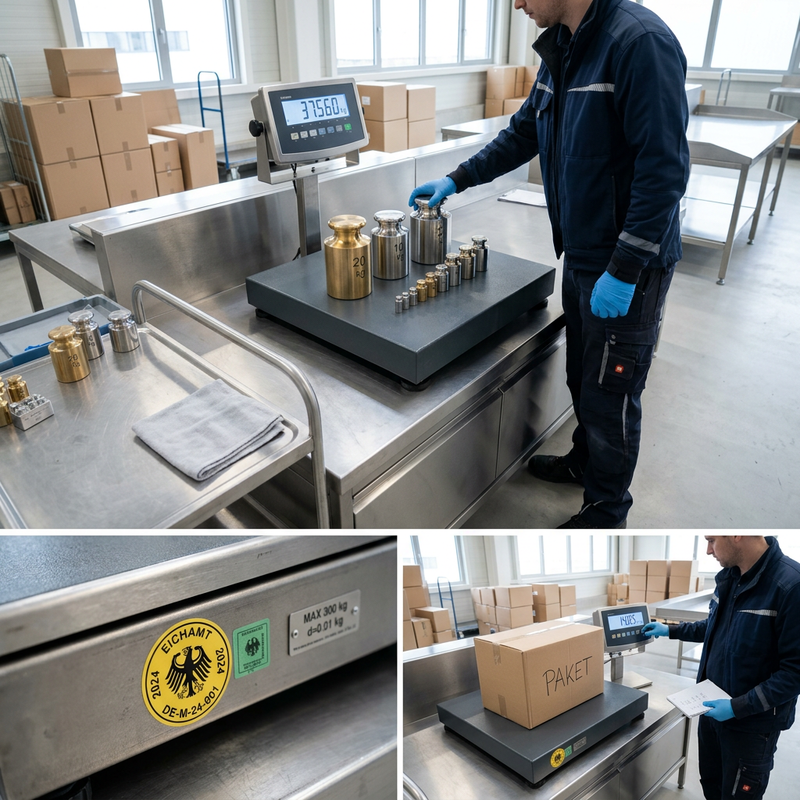
A non-automatic scale that has been properly assessed for conformity can be identified by the required combination of the CE marking, the metrology mark “M” with the last two digits of the year of affixing, and the identification number of the conformity assessment body. This marking should be checked upon receipt of the goods together with the manufacturer’s documentation.
Technical modifications made after procurement must be considered separately. Repairs, modifications, or interventions in relevant components may affect the instrument’s continued permissible use and must therefore be assessed separately.
How to Identify a Conformity-Assessed Scale

During the procurement process, it is important to verify not only the model designation but also the formal marking on the device. For new non-automatic scales, the CE marking, the metrology mark “M” followed by the last two digits of the year, and the identification number of the notified body are the key indicators that the procedure has been properly completed.
If this information is missing or if the markings and documentation do not match, the device should not be used without inspection before being put into service in a regulated area.
What Legal Effect Does Conformity Assessment Have?

Conformity assessment applies during the phase prior to initial use: It replaces the previous initial calibration required when a new device is placed on the market. For users, this means there is no additional step of applying for a national initial inspection before the scale is used for the first time.
However, the obligations following commissioning—in particular, display requirements, deadline monitoring, and compliance with usage requirements during ongoing operation—remain unaffected.
When the calibration period ends early

The calendar-based time limit is not the only criterion for continued usability. According to Section 37(2) of the German Measurement Act (MessEG), the calibration period ends prematurely if the permissible error limits are not met, the essential requirements are no longer fulfilled, a modification has been made that could affect the metrological properties, or if unauthorized modifications, modifications, or affected markings call into question the device’s continued lawful use.
After repairs, software changes, modifications, or the replacement of relevant components, it should therefore be verified whether continued use remains permissible without change.
Obligations of Scale Users
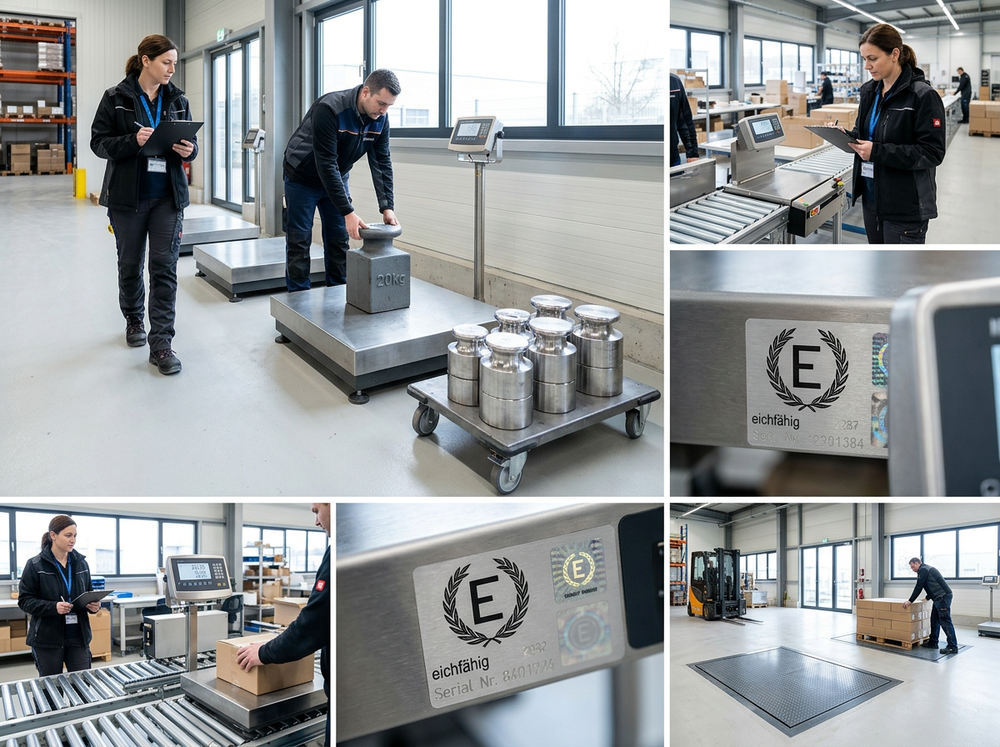
Once the equipment is put into service, the user’s actual organizational work begins. It is advisable to use a checklist that covers the entire equipment lifecycle:
- Upon commissioning: Notify the relevant authority within six weeks.
- During ongoing operation: Keep documentation available and use the device only in accordance with legal requirements.
- In the event of changes: Check for any implications under calibration regulationsin the event of a change of location, repairs, or modifications.
- Before the deadline expires: Apply for re-calibration in a timely manner to avoid any interruption in use.
These obligations are not merely formalities. They determine whether a scale may still be used legally in regulated applications even after months or years.
Use the scale properly, appropriately, and without modification

During ongoing operation, the main focus is on managing changes. Relocating the equipment to an unsuitable surface, connecting additional components, performing repairs on load-bearing parts, or making software modifications can affect the equipment’s continued lawful use.
Companies should therefore document every technical change and, before reusing the equipment in a regulated environment, verify whether additional steps are required.
Keep the required information and documents available

According to Section 17 of the MessEV, the information required to accompany the measuring instrument must be available. Depending on the instrument, this may include operating instructions, manufacturer’s documentation, conformity information, and other instrument-specific details.
In practice, it is helpful to maintain a device-specific filing system—whether digital or physical—so that documents are readily available during internal audits, maintenance, or regulatory inspections without the need for a time-consuming search.
User notification within 6 weeks

According to Section 32 of the German Measurement Act (MessEG), the commissioning of a new measuring instrument subject to calibration—or one being used for the first time—must be reported to the competent calibration authority within six weeks. The decisive factor is the start of actual use, not merely the order, delivery, or storage of the instrument.
For practical purposes, it is therefore important to establish clear internal responsibilities: The person who sets up the scale should document the start date and not defer the notification to a later administrative process. The notification can be prepared centrally via eichamt.de.
Arrange for recalibration well in advance of the deadline

The authority does not automatically monitor every single deadline for the user. Companies should therefore maintain their own deadline register, ideally including the equipment type, location, deadline, and responsible contact person. The user is responsible for submitting the application for re-verification in a timely manner before the deadline expires.
Planning ahead is particularly important for companies with multiple branches or shipping locations that experience high seasonal volume. This helps prevent scheduling bottlenecks and unplanned downtime in operations relevant to billing.
Here's How a Scale Is Calibrated

Delays in re-calibration usually arise not because of the actual inspection, but because of unclear responsibilities or insufficient preparation. The process is essentially simple: The user submits the application to the responsible state calibration authority; depending on the type of scale, the inspection takes place on-site or at the calibration office; and if the result is successful, the valid calibration is marked on the device.
Missed appointments can be avoided above all by clarifying early on where the inspection will take place, what documents must be provided, and whether the scale will be accessible and operational by the appointment date. Especially in the case of stationary systems, multiple devices, or special installation situations, coordination with the authority should not begin only shortly before the deadline.
Inspection on site or at the calibration office

Whether a scale is inspected at the site of use or at the calibration office depends primarily on its design, size, and portability. Small, portable devices are more likely to be brought in for inspection; stationary or difficult-to-move systems are typically considered for on-site inspection.
For companies, this distinction is also relevant from an organizational standpoint, as it can result in varying costs associated with transportation, downtime, and scheduling.
Calibration mark after passing the inspection

If the inspection is successful, the valid calibration is indicated on the device in the prescribed form, typically by means of a calibration mark or a sticker. This mark should then be protected and must not be damaged, removed, or rendered illegible during normal operation.
If the inspection is not passed, the scale may not simply continue to be used for the corresponding regulated application. In such cases, the identified defects or deviations must first be addressed.
Application to the competent calibration authority

The application is submitted by the user, not automatically by the manufacturer, dealer, or service provider. The competent authority is generally the calibration authority of the federal state in which the device is used.
For stationary large-capacity scales, chain stores, or centrally procured devices, it should be clearly defined internally who is actually responsible for initiating the application. Unclear responsibility is a common cause of delays in the process.
Preparing the Scale for the Calibration Appointment

Before the appointment, the scale should be in working order, easily accessible, and in good condition. The relevant documentation should also be readily available. For built-in or hard-to-access systems, it should be determined in advance whether additional organizational measures are necessary.
Practical errors often arise because equipment has not yet been fully installed, connection components are missing, or the test area is unavailable at the time of the appointment. Such issues can usually be avoided through advance coordination.
How much does it cost to have a scale calibrated?
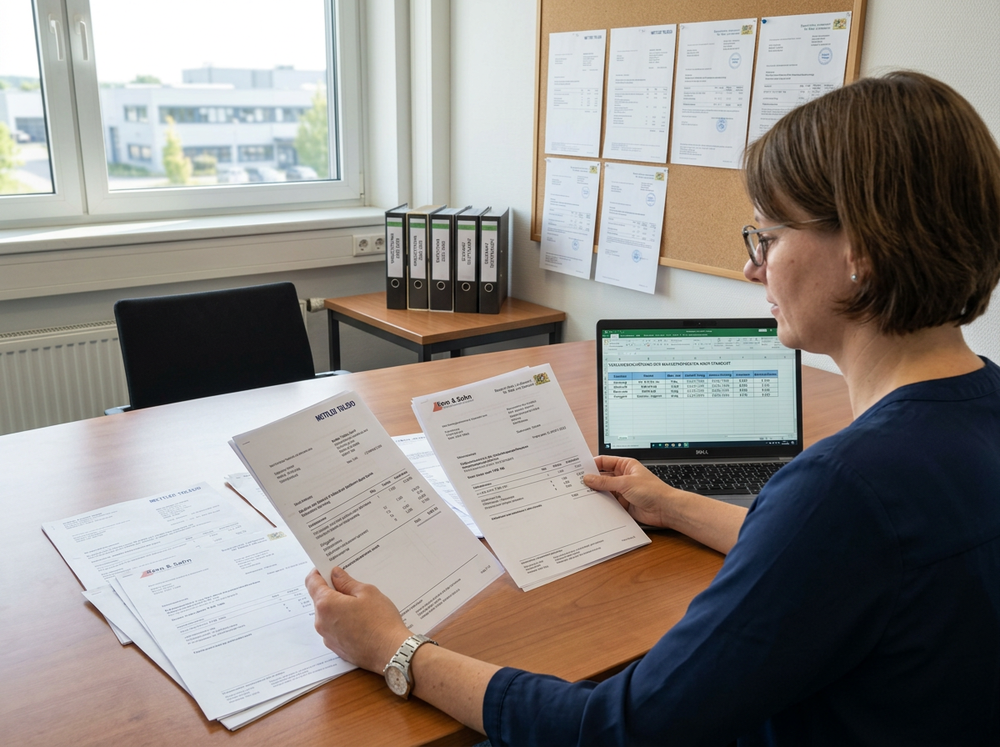
Anyone searching for “scale calibration costs” will rarely find a uniform answer across the country. There is a legal reason for this: According to Section 59 of the German Measurement Act (MessEG), fees are governed by state law. As a result, the same type of scale may be priced differently depending on the state and the specific calibration scenario.
The following factors are particularly relevant to how fees are determined:
- State and its applicable fee regulations
- Type of scale, such as a non-automatic scale, checkweigher, or special design
- Maximum capacity and size
- Inspection location, i.e., calibration office or on-site visit
- Number of devices to be inspected during the same visit
- Additional effort required for stationary systems, difficult access, or special testing conditions
It is important to manage expectations realistically: Even for similar devices, costs can vary significantly if one device is demonstrated while the other can only be tested at the site of use. Reliable information can therefore be obtained from the fee schedule of the relevant state calibration authority or by submitting a specific inquiry for each individual case.
Distinguishing Between Verification, Conformity Assessment, and Calibration

These three terms refer to different legal and technical processes:
- Calibration: a legally regulated test within a regulated scope of use; relevant for scales when the measured value is used for billing purposes.
- Conformity assessment: A procedure conducted before a new measuring instrument is placed on the market; for new instruments, it replaces the former initial verification.
- Calibration: Voluntary determination and documentation of measurement deviation, for example, for quality management or audit purposes.
The most important practical rule is: Calibration does not replace verification. Even a DAkkS calibration certificate does not fulfill the legal function of verification when a scale is used in a regulated area.
Similarly, conformity assessment must not be confused with subsequent re-verification. The former concerns the placing on the market of a new device, while the latter concerns its continued lawful use in operation after the initial period has expired.
Calibration: a legally required test in a regulated field
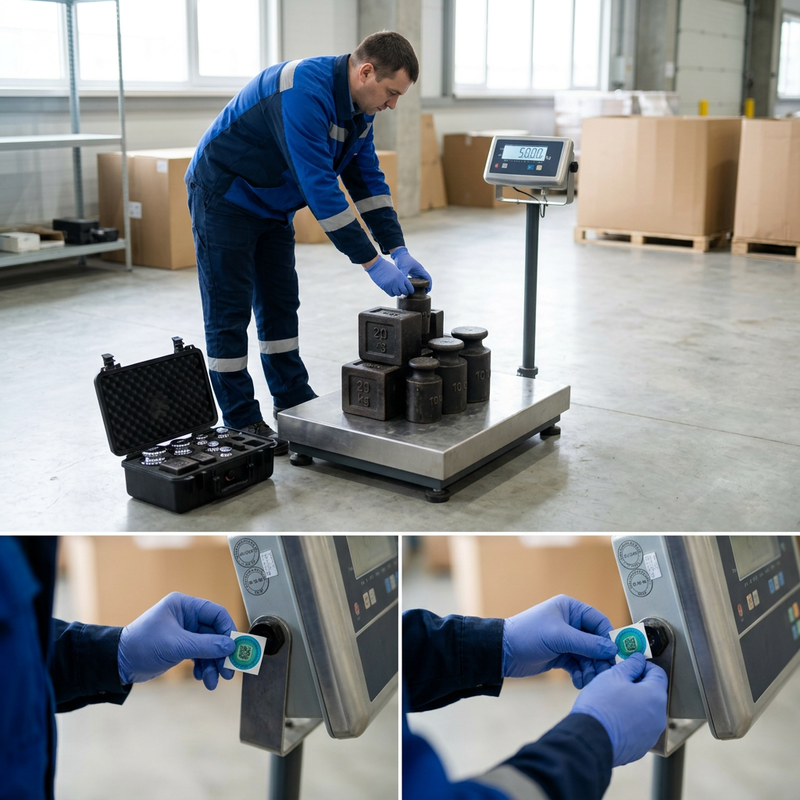
Calibration ensures that a measuring instrument is used in accordance with the law for its intended applications. It is therefore not a general quality control tool, but rather part of the public metrology system for legally relevant measurements.
In day-to-day business operations, it is therefore always an issue whenever a measured value is intended not only to provide internal information but also to be legally binding in dealings with third parties.
Conformity Assessment: Demonstration of Compliance Before New Devices Are Placed on the Market
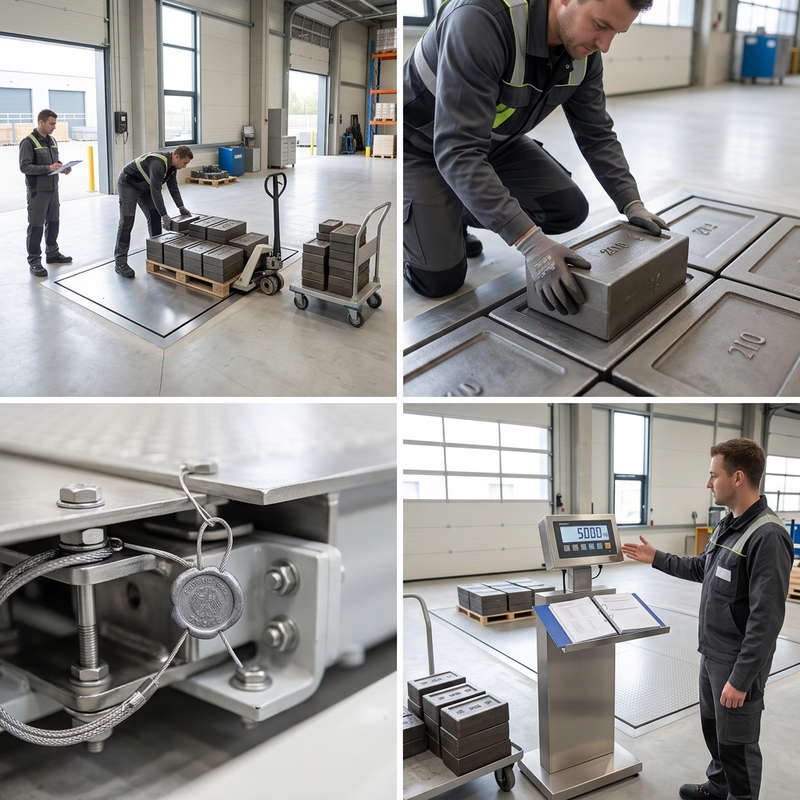
Conformity assessment takes place prior to the device’s first use in a clinical setting. It confirms that a new device meets the relevant requirements for placing it on the market and has been provided with proper labeling.
For the buyer, therefore, it is primarily a procurement issue: the labeling and documentation must be in order before the device is incorporated into a regulated process.
Calibration: Voluntary Verification of Measurement Accuracy

Calibration documents the deviation of a measuring instrument under specified conditions. It is particularly useful when measurement capability, traceability, or test equipment management must be verified internally.
Technically, this can be very valuable. Legally, however, it does not replace the requirements of measurement and calibration law.
Special Case: Volume and Dimension Measurement in Shipping

For shipping processes that use volumetric weight or a DIM factor, weight measurement alone is not sufficient. The reason is simple: The scale provides only the mass; for dimension-dependent pricing components, additional measurements are required, namely length, width, and height. Anyone who bills based on mass—for example, using volumetric weight or a DIM factor—needs a conformity-assessed volume measuring device in accordance with MID Annex MI-009, equipped with an alibi memory, to determine the dimensions relevant for billing. Further information on this can be found on the Volume Measuring Device page.
When a scale alone Isn't Enough

A calibrated scale covers only the portion of the billing that is based on weight. As soon as the pricing logic also takes external dimensions into account, the basis for calculation comes from two different measurement processes.
This is precisely why, in volume-weight-based shipping models, measuring mass alone is not sufficient. For combined applications, a volumetric scale may be the appropriate technical solution, provided that the system used meets the relevant requirements.
What equipment is required for billing based on measurements?

For dimension data relevant to billing, not just any camera or scanning application is sufficient; rather, a system that has been legally approved as a measuring instrument for this purpose is required. The relevant standard is MID Annex MI-009.
In addition to the actual measurement, the assignment of each individual measurement to a specific shipping transaction is practically crucial. Therefore, the documentable traceability of the measurement process plays a central role in such systems.
Systems Suitable for Shipping with PackageHERO®
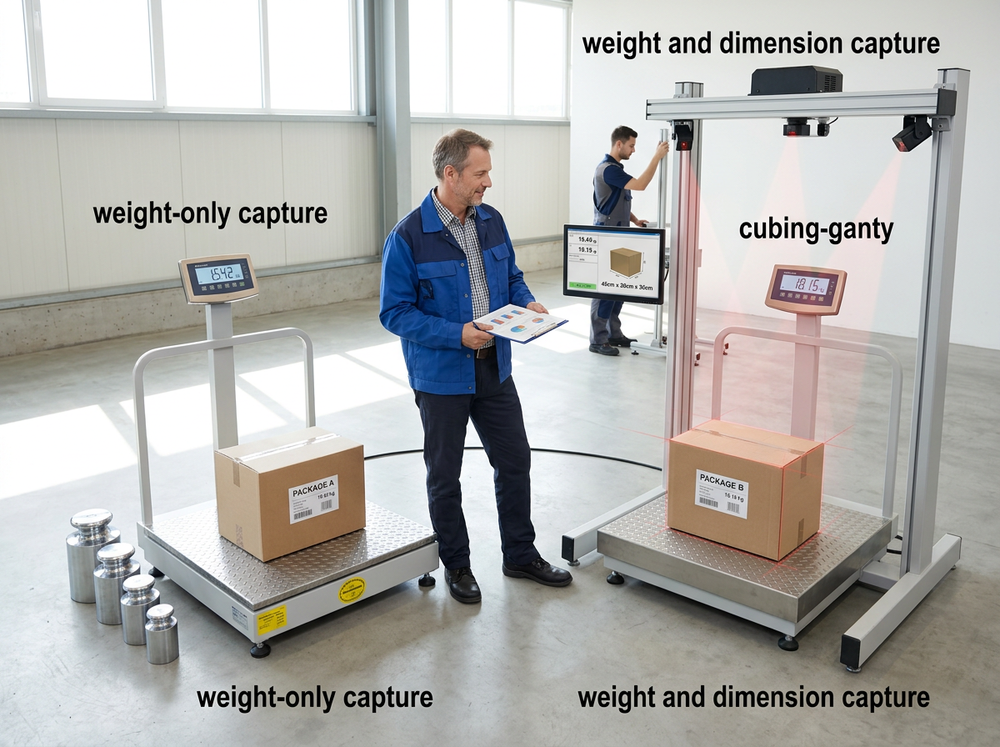
When selecting a system for shipping, the billing-related process should be determined first. If only weight is used for billing third parties, a suitable scale is sufficient. If length, width, and height are also factored into the pricing logic, dimensional measurement must also be implemented in a legally compliant manner. For stationary packing stations, different solutions are appropriate than for integrated conveyor lines with high throughput.
- If only weight is relevant for billing, a calibrated package scale designed for this purpose is suitable.
- Weight plus dimensions are relevant for billing: a system concept with weight and dimensional measurement is required, implemented as a volumetric scale depending on the application.
- Heavy loads or specialized industrial applications: classification by scale type, maximum load, and installation situation is also relevant.
Anyone looking for a calibratable or pre-configured solution for shipping, retail, or logistics will find the right entry points at PackageHERO® through calibrated package scales and volumetric scales.
For weight-based shipping charges
If weight is the only factor considered for postage, freight, or cost allocation, the system selection should focus on a legally compliant and process-appropriate method of weight determination. PackageHERO® offers a compact introduction to this use case on its page for calibrated package scales.
For dimension-based shipping processes

If shipping rates also depend on package dimensions, a standard weight scale alone is not sufficient. PackageHERO® offers a compact introduction to this system on its "Volume Scale" page.
Who is legally responsible for ensuring that a calibrated scale is recalibrated on time?
The user of the scale—that is, the company or individual who actually uses the measuring instrument in commercial transactions—is legally responsible. The user must ensure that the calibration period does not expire and must either schedule the scale for recalibration in a timely manner or take it out of service once the period has expired. This means that the manufacturer, dealer, service company, or rental company is not automatically responsible. Even if third parties handle maintenance or schedule appointments, responsibility generally remains with the user. Important in practice: Clearly define responsibilities internally and continuously document and monitor calibration periods as well as the markings on the scales in use.
Is a scale in logistics subject to calibration if billing to customers is based on the measured weight?
Yes. In logistics, a scale is subject to calibration whenever the measured weight forms the basis for billing customers or other third parties. This may involve, for example, freight costs, shipping charges, warehouse billing, or payments upon receipt of goods. The decisive factor, therefore, is the function of the measured value within the specific business process. As soon as the weight is used externally for pricing or contractual purposes, a mere internal check scale may not be used for this purpose. It is irrelevant whether the scale is located in a warehouse, a transshipment center, or a shipping area. Purely internal process and check weighings with no external impact must be distinguished from this and, on their own, do not generally trigger a calibration requirement.
Does a scale in a brick-and-mortar store require calibration if merchandise is sold by weight?
Yes. If goods are sold by weight in brick-and-mortar retail stores, the scale used for this purpose must be approved for this legally relevant application. In this case, the displayed weight directly determines the sales price charged to the customer. Typical examples include loose goods such as fruits, vegetables, cheese, meat, confectionery, or baked goods, which are priced by kilogram or gram. For such sales, you cannot simply use just any store scale or checkweigher. It is crucial that the measuring device used meets the requirements for selling by weight. This is the only way to ensure that pricing is based on a legally valid measurement result.
Does a mail-order company have to have its package scale calibrated if postage or shipping costs are calculated based on weight?
Yes, generally speaking. If a mail-order company uses the weight determined by a package scale to calculate postage, freight charges, or other weight-based fees payable to third parties, this use is legally relevant. In that case, the scale used for this purpose must meet the requirements for such use. What matters, therefore, is not that it is a package scale, but that its measurement is included in the calculation of prices or costs. A simple check scale is not sufficient for this purpose. The situation is different only if the weighing is used exclusively for internal purposes—such as process control—without the result being factored into billing, pricing, or cost allocation.
Is a scale used solely for internal control weighings that are not related to billing subject to calibration requirements?
No. There is generally no calibration requirement for purely internal control weighings that are not related to billing third parties. The decisive factor is that the weighing result is used exclusively for internal purposes, such as production control, inventory control, quality monitoring, or verifying the plausibility of processes. As long as the determined weight is not used to calculate prices, fees, postage, or freight costs for customers, suppliers, or other external parties, the use generally does not require calibration. However, companies should clearly distinguish the purposes for which a scale is used. As soon as the same measurement value is later used for a legally or economically relevant external purpose, the calibration requirement may be triggered.
Which scales are subject to calibration requirements if a company charges third parties based on weight?
A scale is subject to calibration if its measurement directly serves as the basis for charging a fee to third parties based on weight. The decisive factor, therefore, is the specific use of the weighing result for billing purposes. This applies, for example, to shipping and freight invoices, goods receipts with weight-based compensation, or sales transactions in which the price is determined by the measured weight. For such purposes, the scale used must be suitable for the legally relevant application. An internal control or warehouse scale is not sufficient if its measurement is later used in invoices, price calculations, or other fee-related transactions with contractual partners.
When must a scale used for commercial purposes be calibrated?
In commercial use, a scale must be calibrated or, in the case of new devices, have a valid conformity assessment as soon as its measurement results are used in a legally relevant manner in business or official transactions. This typically applies when billing, selling, calculating, or documenting transactions based on weight for third parties in a manner that requires proof. What matters, therefore, is not whether the scale is used “commercially,” but rather the purpose for which the weighing result is used. If weighing is performed solely for internal control purposes with no external impact, there is generally no calibration requirement. For scales, the requirements are set forth in the Measurement Act (MessEG) and the Measurement Ordinance (MessEV); for new scales, conformity assessment has generally replaced the former initial calibration since 2015.
What is the difference between verification and calibration for a commercial scale?
Verification and calibration are not the same thing: Verification is a legally regulated process under measurement law. It involves checking whether the scale meets the legal requirements for official use; only then may it be used in relevant commercial applications. Calibration, on the other hand, is a metrological check that documents the measurement deviation compared to a reference standard. It improves transparency and quality assurance but does not replace verification. In short: Verification = legal authorization for regulated uses; calibration = technical determination of accuracy without legal approval implications.
How does the calibration or recalibration of a scale work in practice?
In practice, calibration or recalibration begins with ensuring that the scale is clean, complete, and ready for operation by the time of the inspection. Among other things, the inspection covers the general condition of the scale, the markings present, any unauthorized modifications, and measurement accuracy across the intended weighing range. Depending on the device, the inspection takes place either at the installation site or at a testing facility. If the scale passes the inspection, it receives a new calibration mark and may continue to be used in the area subject to calibration requirements. If defects are found, the scale may not be used there until it has been repaired and has passed another inspection. For businesses, early scheduling is therefore particularly important.
By when must the user notification be submitted to the competent calibration authority?
The user notification must generally be submitted to the competent calibration authority no later than six weeks after the scale is put into service. The decisive factor is therefore not the date of purchase, but the actual start of use. The notification is the user’s responsibility and applies even to new scales that have already undergone conformity assessment. If the scale is not put into service until a later date, the deadline does not begin until that time. In practice, companies should submit the notification immediately after installation and commencement of operation to ensure that deadlines are met. Anyone who submits the notification late or fails to submit it at all risks violations of calibration regulations.
When does the calibration period begin for a new scale?
For a new scale, the first calibration period generally begins when the scale is placed on the market. Therefore, the decisive factor is not merely when the device was purchased, delivered, or installed, but when it was legally placed on the market. The year indicated on the conformity marking usually serves as a reference point for this. If the device is placed on the market after the year indicated on the marking, this later date should be verifiable. In practice, this means that companies should carefully retain documentation regarding the actual start date so that the end of the period can be traced. This allows for timely planning of when the next calibration-related inspection or organizational preparation will be required.
How can you tell if a new scale has undergone a conformity assessment in accordance with EU law?
Whether a new scale has undergone a conformity assessment in accordance with EU law can be determined by the required markings. Typical markings include the CE marking, the additional metrology marking “M,” the two-digit year, and the identification number of the relevant notified body. This information must be correctly affixed to the device and match the type plate and accompanying documentation. It is important for the user to check the markings not only for presence but also for plausibility. If markings are missing, appear incomplete, or have been altered after the fact, the scale should undergo a legal review before use to ensure that it is not used in an unauthorized manner.
Does a new scale still require an initial calibration, or does the manufacturer's conformity assessment replace this step?
As a rule, a new scale no longer requires a traditional initial calibration. What matters most is that it has been properly assessed for conformity and placed on the market with the appropriate markings. In such cases, it may generally be used without prior separate initial calibration. It is therefore important for the user to verify that the required markings and documentation are present and that the device is intended for the intended use. The previous requirement for initial calibration as a separate step is thus generally no longer necessary for new scales. A different legal assessment may be necessary only in older special or transitional cases; in such cases, the specific history of the device should be reviewed.
What is the calibration interval for non-self-recording mechanical scales?
For mechanical scales that do not record readings automatically, a calibration period of 2 years generally applies. Section 34 of the Measurement Ordinance (MessEV) applies unless a more specific provision takes precedence. The period generally begins with the annual marking of the measuring instrument; for periods of one year or longer, it generally ends at the close of the calendar year in which the period is scheduled to expire. However, it is important to note that different periods may apply to older devices if the scale is still subject to a type approval issued on or before December 31, 2014. Therefore, the specific marking and device history should always be checked for existing mechanical scales.
Is the use of an uncalibrated scale in commercial transactions an administrative offense?
Yes, that could be an administrative offense. The key factor is whether the scale is used in an area where a legally valid measurement result is required. If a weight is used in business transactions with third parties for pricing, billing, or other legally relevant purposes, the scale may not be used for that purpose without a valid calibration certificate. In such cases, you risk receiving a complaint from the competent authority and, if applicable, a fine. However, not every uncalibrated scale is automatically prohibited: if the scale is used exclusively internally and has no external impact, this does not necessarily constitute a violation. The specific intended use of the measurement value is always the determining factor.