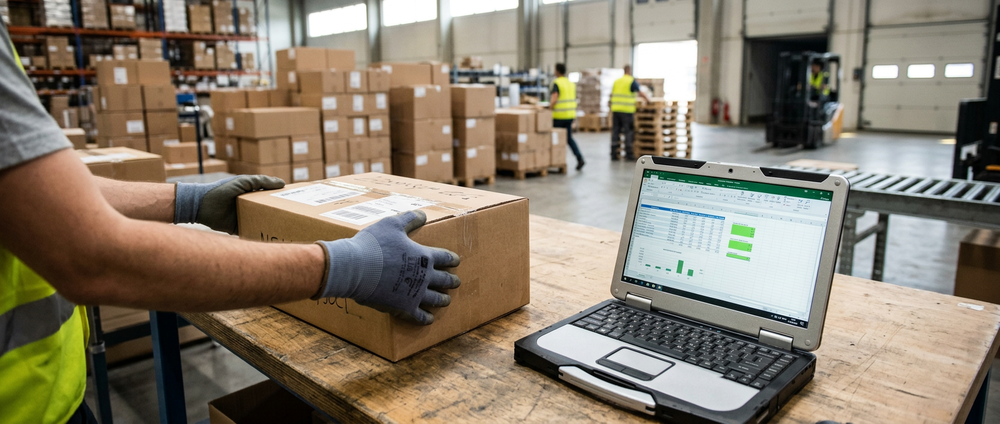
Want to calculate your package volume and find out right away what matters most when shipping? Whether you’re calculating individual shipments or processing many packages every day—what ultimately counts is the weight your shipping provider actually charges you for. And this is exactly where a few centimeters can often make a noticeable difference in cost.
Use the calculator right above to get your result in seconds. Instead of wading through endless definitions, simply enter the length, width, and height—and see immediately what applies to your shipment.
You’ll come across terms like volumetric weight, carrier-specific divisors, and package dimensions time and again. We’ll show you, in a concise and easy-to-understand way, how these factors relate to each other and which value really matters in the end. This way, you’ll avoid unpleasant surprises on your bill and calculate correctly from the start.
Parcel Volume & Volumetric Weight Calculator
Enter the dimensions – the calculator determines volume and volumetric weight and shows which weight your carrier will charge. Weight is optional, but required for the chargeable weight.
Volumetric weight by conversion factor
No guarantee. Carrier factors as of July 2026 – if in doubt, check the current shipping terms of the respective carrier.
What is the package volume?
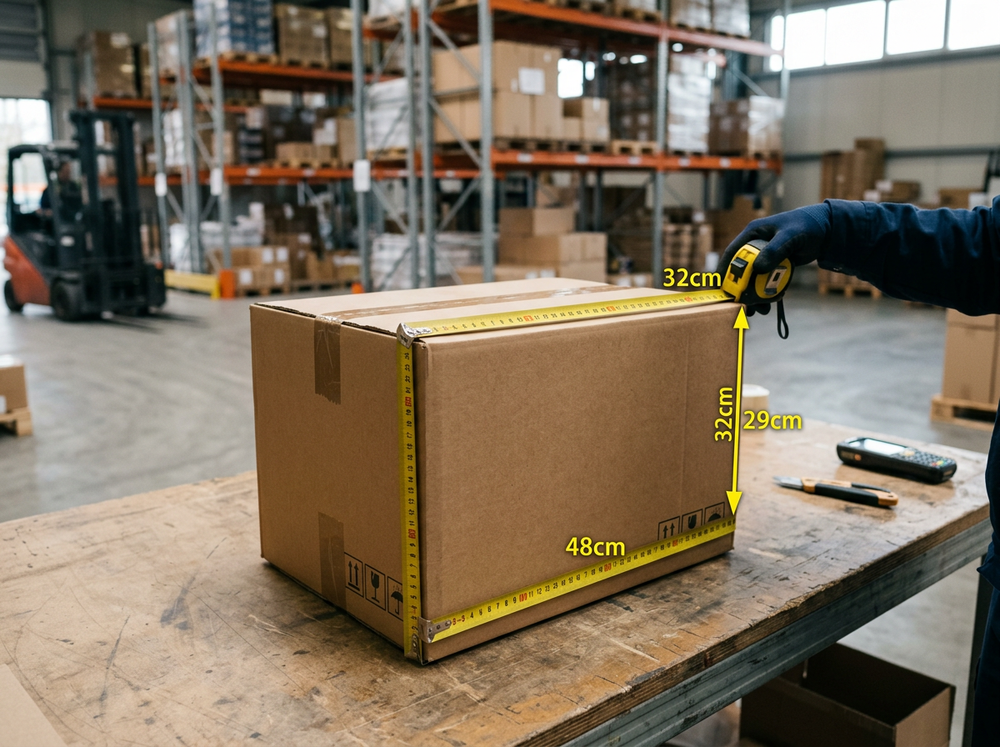
Package volume refers to the three-dimensional volume of a package ready for shipment, measured based on its external dimensions—length, width, and height. It indicates how much space a shipment occupies in the mode of transport—regardless of the actual weight of the contents.
The reason this factor affects shipping costs lies in the logic of transportation: it is not weight, but the available cargo space per vehicle or container that is the truly scarce resource. A delivery van is usually full long before it reaches its maximum payload capacity. In order for a carrier to use its loading capacity economically, it must charge for the space occupied—otherwise, large, lightweight shipments would take up space without paying for it.
This means that volume quickly becomes a factor in shipping costs, especially for bulky but lightweight goods. Choosing boxes that fit the contents perfectly reduces the volume of space occupied and thus lowers costs. Volume should not be confused with the girth, which describes a separate, combined measurement and serves to limit the size of bulky shipments.
Calculating Package Volume: Formula and Examples
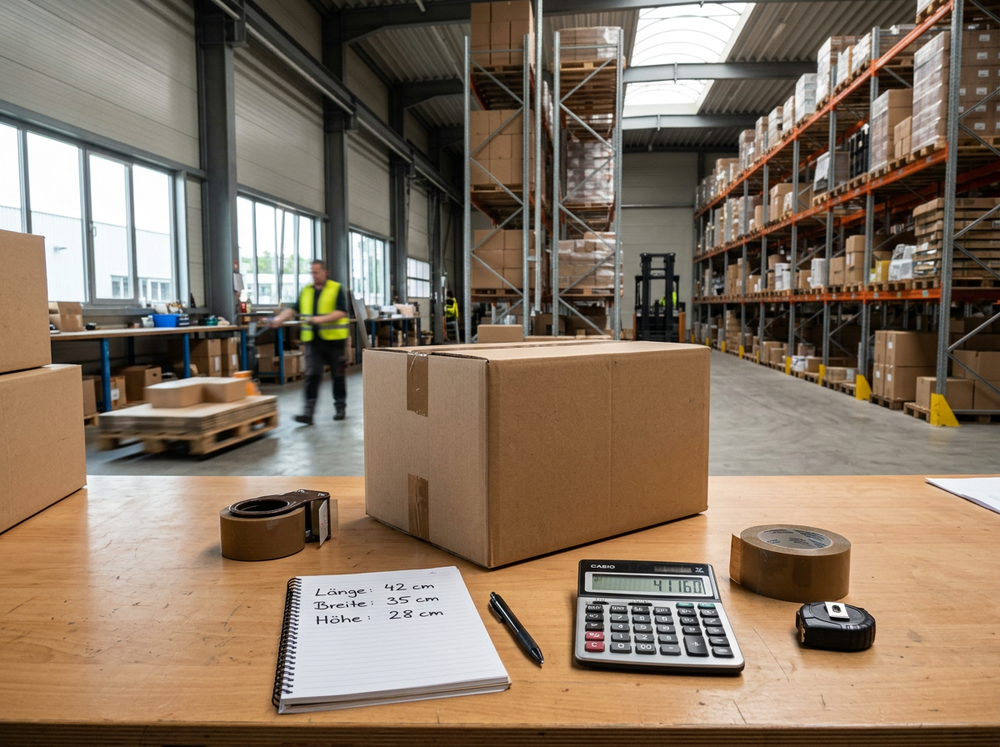
The package volume is calculated based on the three external dimensions of the package ready for shipment. The formula is: Volume (cm³) = Length × Width × Height, where all measurements must be in centimeters and always represent external dimensions. To convert to liters, use the following: 1,000 cm³ = 1 liter. It is crucial that you use the outer edges—not the internal dimensions or the product dimensions—since only the external dimensions reflect the actual space occupied during transport. The article “Measuring Packages” shows you how to determine the correct basis for this.
Calculation Example: Our Reference Package
For all the following steps, we’ll consistently use an example package with external dimensions of 60 × 40 × 30 cm. This equals 60 × 40 × 30 = 72,000 cm³, or 72 liters. This value describes how much cargo space the shipment occupies in the transport vehicle—the first of three key metrics we’ll examine for this package.
Example: Standard Package
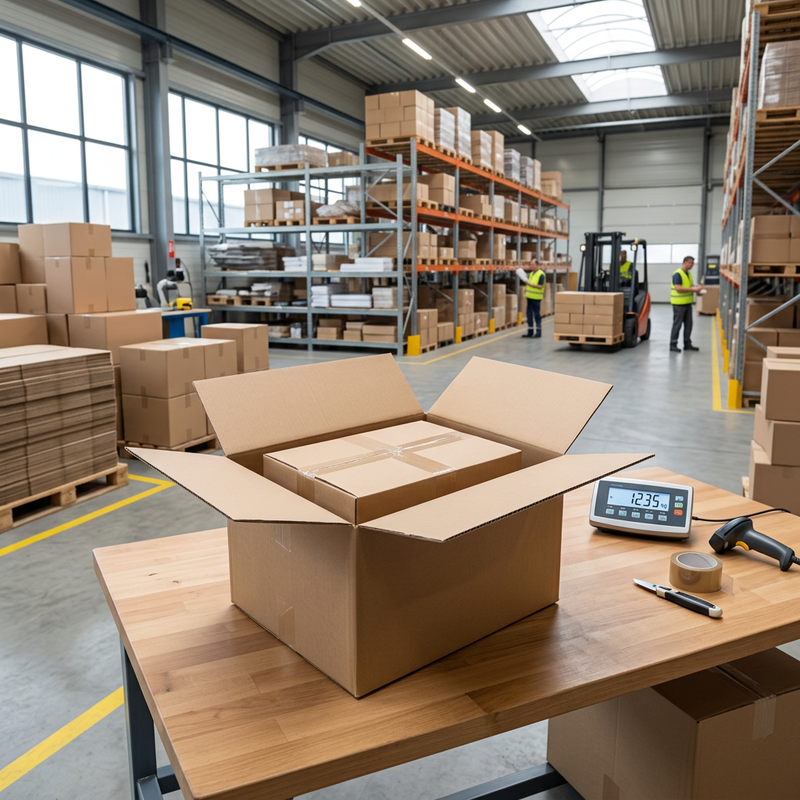
The same carton may be billed differently depending on the service, because carriers use different divisors. For our reference package with a volume of 72,000 cm³, using the air freight (IATA) divisor results in a volumetric weight of 72,000 ÷ 6,000 = 12 kg. With FedEx Regional Economy, however, the calculation is 72,000 ÷ 4,000 = 18 kg. The standard divisor used by most package services falls between these values. This results in a range of 12 kg, 14.4 kg, and 18 kg for the very same box—depending on which service is transporting the shipment. If you know the appropriate divisor, you can tailor your choice of service specifically to the package’s dimensions.
Example: Bulky shipment
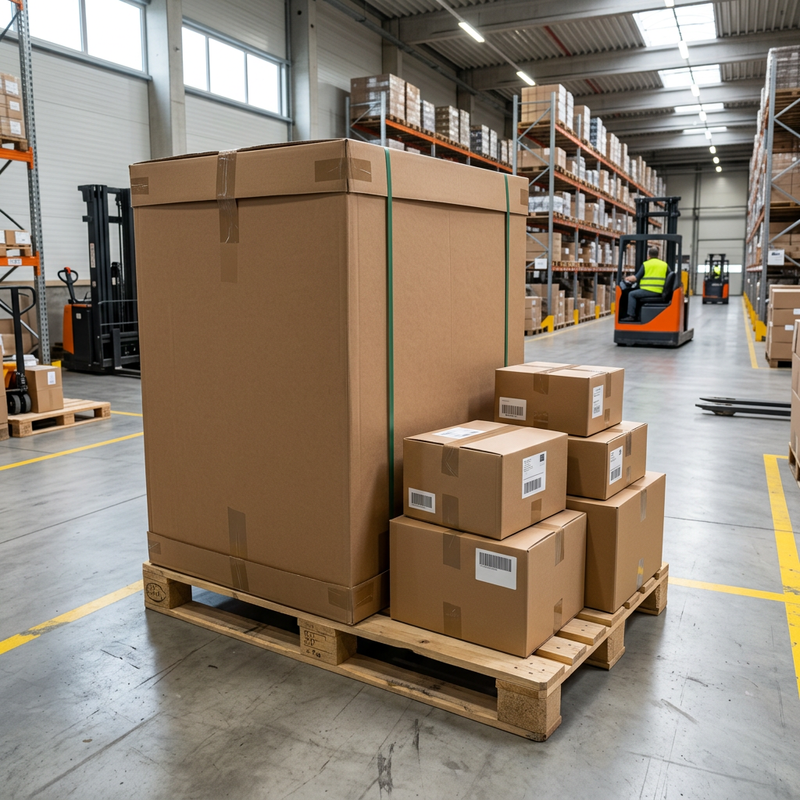
A lightweight but bulky package with external dimensions of 80 × 60 × 50 cm = 240,000 cm³ illustrates just how much volume factors into the calculation: When divided by 5,000, this results in a volumetric weight of 48 kg, even though the contents weigh only a few kilograms. If the maximum dimensions defined by the girth are exceeded, additional bulky goods surcharges may apply.
Volume Weight and Billing Weight

In addition to the actual weight, carriers also calculate the volumetric weight, which converts the space occupied during transport into a calculated weight value. The formula is: Volumetric weight (kg) = (length × width × height in cm) ÷ divisor. The divisor used varies by carrier: For most standard services, the divisor is 5,000; however, FedEx Regional Economy and air freight follow IATA guidelines, while DHL Paket National does not apply volumetric weight at all. Read the follow-up article to learn how to calculate and optimize volumetric weight in detail. You’ll find a complete overview in the divisor table below.
Calculating Volume Weight: Example
Let’s revisit our example package from above with a volume of 72,000 cm³ and divide this value by the standard divisor of 5,000: 72,000 ÷ 5,000 = 14.4 kg. The volumetric weight of this package is therefore 14.4 kg—the second metric, this time in kilograms instead of liters.
Formula and Carrier Divisors

For quick reference, the following table summarizes the relevant divisors for each service:
| Carrier / Service | Divisor |
| DHL Express | 5000 |
| DPD | 5,000 |
| GLS | 5,000 |
| UPS | 5,000 |
| FedEx Standard | 5000 |
| FedEx Regional Economy | 4,000 |
| Air Freight (IATA) | 6,000 |
| DHL Domestic Parcel | No volumetric weight (weight classes) |
Billing Weight: From Volume to Billed Value
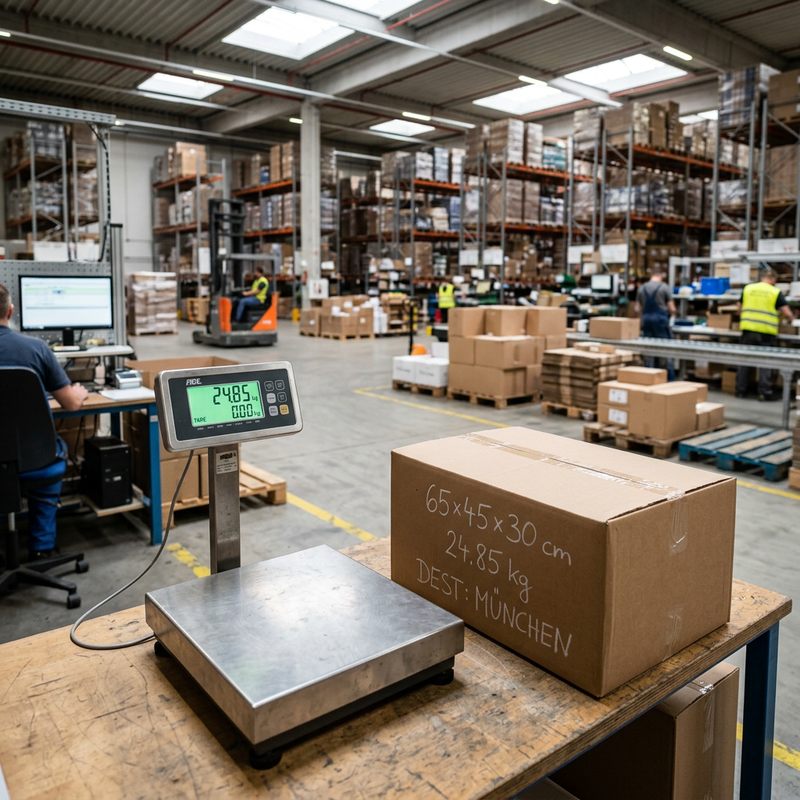
In practice, only one value matters in the end: the billing weight. It is calculated as follows: billing weight = max(actual weight, volumetric weight)—so the higher of the two values is always used.
If our reference package weighs 8 kg on the scale, the volumetric weight calculated above is higher and becomes the basis for the calculation. For cost calculations, this means that weighing alone is not enough, because a box that is too large will inadvertently drive up the cost. For light but bulky shipments, this effect can exceed the actual weight by a factor of several times, making the choice of the right box size a critical cost driver.
Automatically Track Package Volumes with PackageHERO®
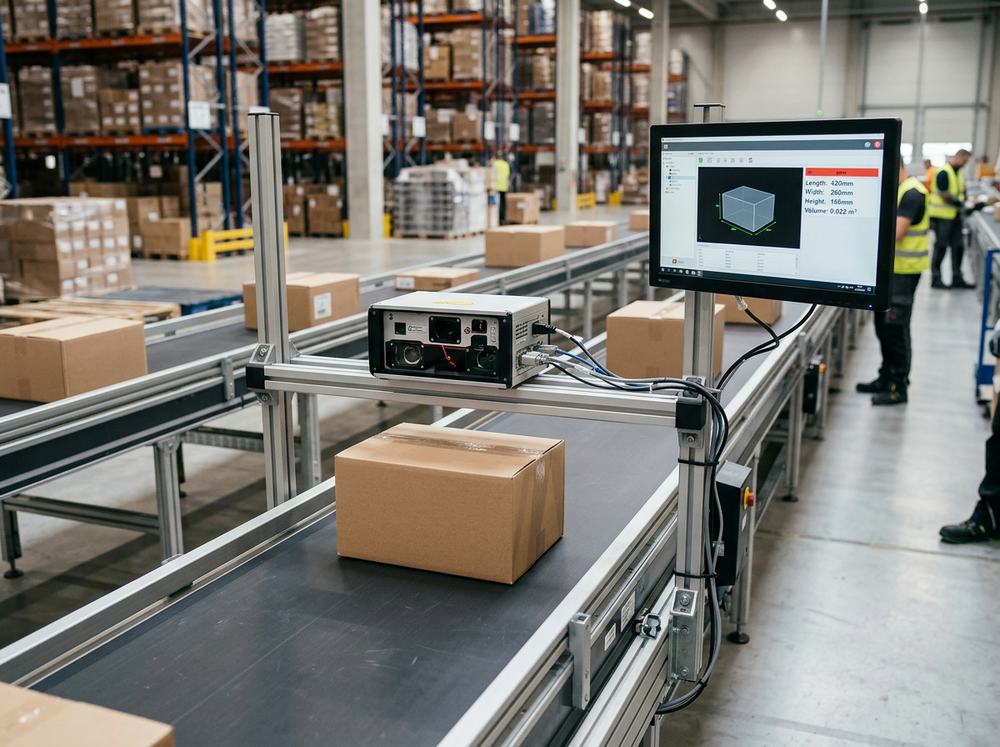
At the packing station, PackageHERO® automatically records the dimensions and weight of each shipment—without the need to manually measure with a folding rule or perform subsequent calculations during the shipping process. Based on this data, the system immediately calculates the volume and the relevant billing weight, thereby preventing incorrect entries and unexpected additional charges from the carrier. Especially for e-commerce businesses with high shipping volumes and widely varying package sizes, automatic data capture shortens processing times and ensures transparent billing. The necessary hardware consists of a volume measuring device for dimensioning alone and a volumetric scale that combines measurements and weight in a single step.
Does DHL Parcel (domestic) calculate volumetric weight?
DHL Parcel (domestic) does not calculate volumetric weight. Instead of calculating weight based on volume, DHL Parcel uses weight classes for domestic shipping: Only the actual weight of the package is taken into account—volume has no impact on the price calculation. For bulky, lightweight shipments—such as pillows, Styrofoam packaging, or air-cushioned items—this can be a real cost advantage for domestic shipping, because the billing weight isn’t inflated by the external dimensions.
What divisor does the IATA recommend for air freight?
IATA recommends a divisor of 6,000 for air freight. This means that the volumetric weight is calculated as length × width × height (in cm) divided by 6,000. This divisor is higher than the standard divisor of 5,000 used by most package delivery services, which results in a lower calculated weight for the same volume. The higher divisor reflects the comparatively large cargo hold capacities of cargo aircraft: Air freight can generally accommodate more volume per unit of weight than a package delivery vehicle. The higher of the actual weight and the volumetric weight is always used for billing.
Why does FedEx Regional Economy use a different divisor than FedEx Standard?
FedEx Regional Economy uses a divisor of 4,000 instead of the divisor of 5,000 typically used by most package carriers. As a result, the same package results in a higher volumetric weight with FedEx Regional Economy—and thus potentially higher shipping costs. The reason lies in the capacity logic of the respective service: A lower divisor prices the occupied transport space more aggressively. Specifically, this means that for the same volume, the dimensional weight for Regional Economy is 25% higher than for the standard rate. Anyone who regularly ships light, bulky packages via FedEx should factor this difference into their choice of service.
What divisor do DHL Express, DPD, GLS, UPS, and FedEx Standard use to calculate volumetric weight?
DHL Express, DPD, GLS, UPS, and FedEx Standard all use the same divisor of 5,000 to calculate volumetric weight. The formula is: Volume weight (kg) = (length × width × height in cm) ÷ 5,000. If the actual weight is less than the volume weight calculated this way, the latter is used as the basis for billing. FedEx Regional Economy deviates from this standard by using a lower divisor, while IATA air freight uses a higher divisor. DHL National Parcel is another exception: This service generally does not calculate volumetric weight but instead uses weight classes—only the actual weight is taken into account.
What measurements do I need to calculate the package volume?
To calculate the package volume, you need exactly three measurements: length, width, and height of the package—all in centimeters. It is crucial that you always use the external dimensions of the package ready for shipping, not the internal dimensions or the dimensions of the contents. Only the external dimensions reflect the actual space occupied during transport. Therefore, measure the fully packed and sealed box along its outer edges. Additional information—such as weight or contents—is not required for the volume calculation alone.
What is the difference between package volume and volumetric weight?
The package volume describes the physical volume of a shipment in cm³ or liters—calculated as the length × width × height of the external dimensions. It is a purely dimensional measurement without a unit of weight. Volume weight, on the other hand, converts this volume into a calculated value in kilograms: volume weight (kg) = volume (cm³) ÷ divisor. The divisor varies by carrier—most standard services use 5,000. In short: Package volume measures the space occupied, while volumetric weight makes this space comparable to the actual weight—and thus helps determine what is ultimately billed. The higher of the actual weight and the volumetric weight is always used for billing.
In what unit is the package volume measured—cm³ or liters?
By default, package volume is specified in cubic centimeters (cm³), since the dimensions—length, width, and height—are measured in centimeters. The formula is: Volume (cm³) = Length × Width × Height. It is also common to express volume in liters: 1,000 cm³ equals exactly 1 liter. Both units describe the same volume and can be converted to one another at any time. In practice, carriers and shipping software usually prefer the cm³ value because it can be directly used as the dividend in the volumetric weight formula.
How do I calculate the package volume?
The package volume is calculated based on the three external dimensions of a package ready for shipment using the following formula: Volume (cm³) = Length × Width × Height All measurements are entered in centimeters—the external dimensions are always what matter, not the internal dimensions or product dimensions, since only the external dimensions reflect the actual space occupied during transport. Calculation example: A package measuring 60 × 40 × 30 cm results in: 60 × 40 × 30 = 72,000 cm³ or 72 liters (Conversion: 1,000 cm³ = 1 liter) This value indicates how much cargo space your shipment occupies in the transport vehicle—and serves as the basis for the subsequent calculation of the volumetric weight.
What are the maximum package dimensions allowed by major carriers?
The maximum package dimensions vary by carrier. Typical limits for standard packages are as follows (as of July 2026—always check current carrier specifications directly with the service provider): - DHL Domestic Parcel: max. 120 × 60 × 60 cm, max. girth 300 cm - DPD: max. 175 × 78 × 78 cm - GLS: max. 200 × 80 × 80 cm - UPS: max. 270 cm in length, max. girth 400 cm - FedEx: max. 274 cm in length, max. girth 419 cm Shipments that exceed these limits are classified as oversized cargo or rejected—and often incur additional fees.
How does PackageHERO® automatically measure package volume at the packing station?
PackageHERO® automatically records package dimensions and weight at the packing station—without the need to manually measure with a folding rule and without the need for subsequent calculations in the shipping process. Based on this data, the system immediately calculates the volume and the relevant billing weight. This prevents incorrect entries and unexpected additional charges from the carrier. For e-commerce businesses with high shipping volumes and widely varying package sizes, automatic tracking significantly reduces processing times. The hardware options include a volume measuring device for dimensions only and a volumetric scale that combines measurements and weight in a single step.
What is a volume meter, and when is it worth using one?
A volume measuring device automatically records the three external dimensions of a package—length, width, and height—using sensors or a camera system, eliminating the need for manual measurements. The results are available in a fraction of a second and can be transferred directly to the shipping software. This is particularly beneficial for businesses with high shipping volumes and varying package sizes: Manual measurements take time, are prone to errors, and can lead to additional charges from carriers if incorrect data is entered. Those who process many shipments daily will quickly recoup the investment through saved labor time and avoided costs resulting from errors. When combined with a volumetric scale that records dimensions and weight in a single step, the billing weight can be documented seamlessly and transparently.
Can I reduce the volumetric weight by using smaller packaging?
Yes, using smaller packaging directly reduces the volumetric weight. Since volumetric weight is calculated as length × width × height ÷ divisor, it decreases proportionally with the external dimensions of the box. Avoiding unnecessary empty space and choosing boxes that fit the contents more precisely can significantly lower the billed weight. Since the billed weight is always the higher of the actual weight and the volumetric weight, the box size makes a decisive difference in cost for light, bulky shipments. Packing material can help protect the contents without unnecessarily increasing the box dimensions.
How do I measure an irregularly shaped package correctly?
For irregularly shaped packages, use the so-called enveloping cuboid method: Measure the longest length, widest width, and greatest height of the package—that is, the outermost points in each direction. These three values define the imaginary rectangular prism into which the package just barely fits. Carriers always use these external dimensions, as they reflect the actual space occupied during transport. Bulges, protrusions, or uneven sides are included in the measurement. Internal edges or product dimensions are irrelevant. The volume formula applies as usual: Length × Width × Height (in cm) = Volume in cm³.
What is the girth, and how does it relate to the package volume?
The girth is a combined measurement that carriers use to limit bulky shipments. It is typically calculated as the longest side plus twice the circumference of the cross-sectional area—that is, not as a pure volume measurement, but as a combination of length and external circumference. The girth is indirectly related to the package volume: Both measurements increase when a package is very large in at least one dimension. While volume describes the total internal space, the girth specifically captures bulkiness. If a defined maximum girth is exceeded, carriers may charge oversize surcharges—in addition to any volumetric weight charges.
What happens if I enter the wrong package volume?
Incorrect information regarding the package’s volume can lead to unexpected additional charges: If the carrier determines during weighing and measurement that the dimensions provided are incorrect, the shipment will be billed retroactively based on the actual external dimensions. Anyone who reports dimensions that are too small is systematically underestimating the volumetric weight. In addition, processing fees or corrected invoices may apply. To avoid such surprises, it is recommended to precisely measure the external dimensions of the package ready for shipment—or to use automatic measurement directly at the packing station.
What is the billing weight, and how is it calculated?
The billing weight is the value that a carrier actually uses to calculate shipping costs. It is determined by the following formula: Billing weight = max(actual weight, volumetric weight) The higher of the two values is always used. The actual weight alone is therefore not sufficient for an accurate calculation. Especially for light, bulky shipments, the billing weight can significantly exceed the actual weight—making the choice of the right box size a key factor in controlling costs.

