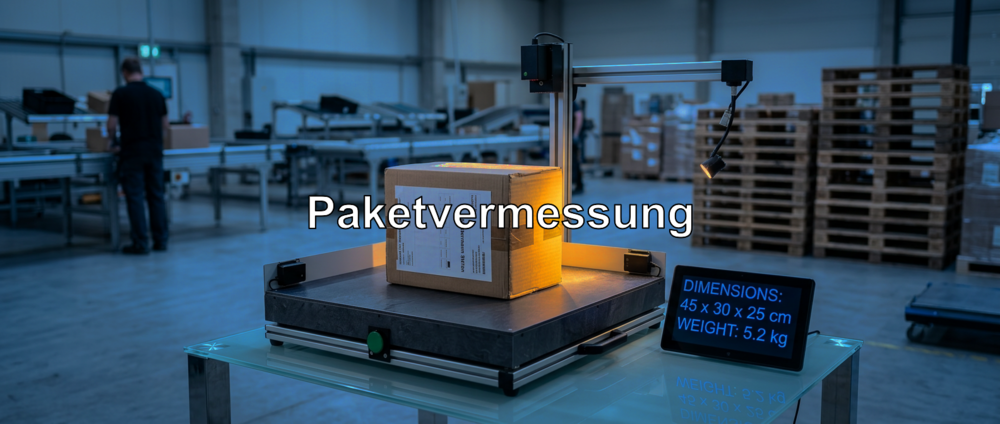
In package shipping, it’s not just the weight of a shipment that matters, but also the space it occupies. That’s exactly why package measurement is a key part of the shipping process for many companies. Typically, the length, width, height, and actual weight of a package are recorded so that the volume, volumetric weight, and ultimately the shipping basis used for billing can be reliably determined.
This issue is by no means limited to large package sorting centers. Even in smaller shipping warehouses, inaccurate measurements lead to incorrect shipping costs, unnecessarily large boxes, erroneous master data, and avoidable rework. A structured solution can prevent this—ranging from a simple stationary measuring station to a fully automated inline system on the conveyor line.
This page explains what package measurement entails, how static and dynamic methods differ, how volumetric weight is calculated, and which technology is suitable for which operation. It also covers integration with WMS, ERP, and shipping software, as well as typical applications ranging from fulfillment to returns management.
Table of Contents
- What is package measurement?
- What are the benefits of package measurement in shipping?
- Static vs. dynamic package measurement
- Calculating volumetric weight and actual weight
- Technologies for package measurement
- Key Technical Specifications and Selection Criteria
- Integrating package measurement into WMS and ERP
- Applications of Package Measurement
- How Companies Select the Right Volume Measurement System
- Real-World Example: From Measurement to Shipping Label
- Frequently Asked Questions About Package Measurement
- Conclusion: Package Measurement as the Foundation for Efficient Shipping
- FAQ


What is package measurement?
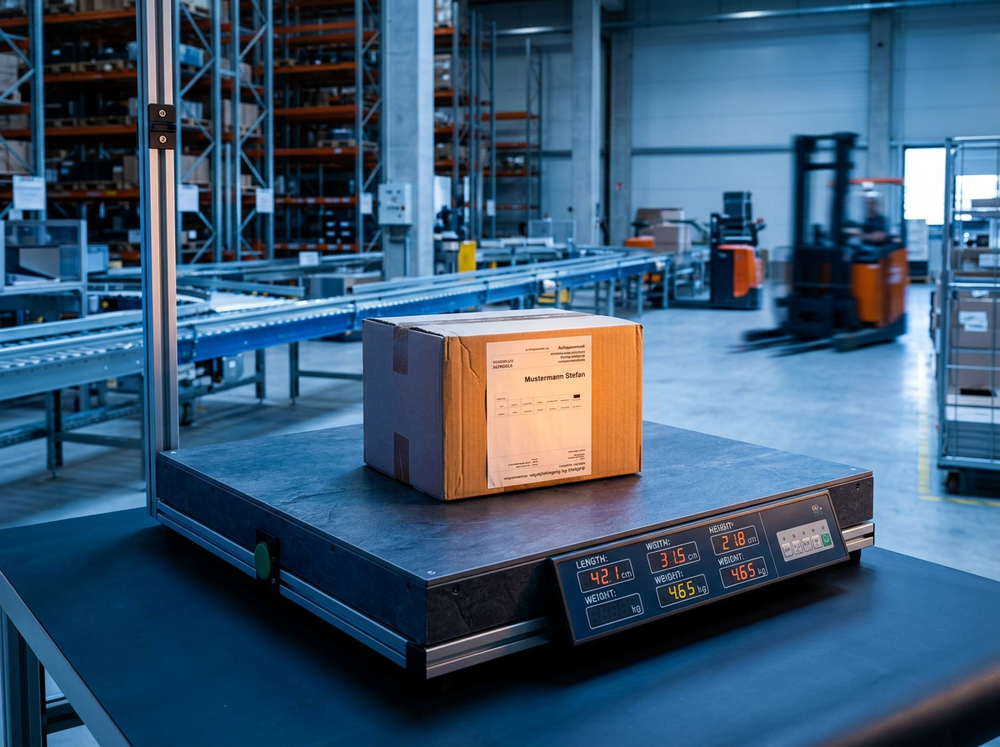
Parcel measurement refers to the standardized recording of a parcel’s relevant shipment data. This primarily includes length, width, height, and actual weight. From these values, volume, volumetric weight, and the freight weight used for billing can be calculated.
Thus, package measurement goes beyond simply determining dimensions. Shipping requires not only external dimensions but also reliable data for rate calculations, warehouse processes, and documentation. This is precisely why dimensions and weight are often recorded together in a single system today. In a commercial context, this process is also referred to as freight measurement.
In practice, measurement forms the basis for accurate shipping costs, clean master data, and reproducible processes. If dimensions are merely estimated or recorded inconsistently, discrepancies between internal data and carrier measurements can quickly arise. A standardized solution ensures reliability in this regard.
Which metrics are relevant in practice
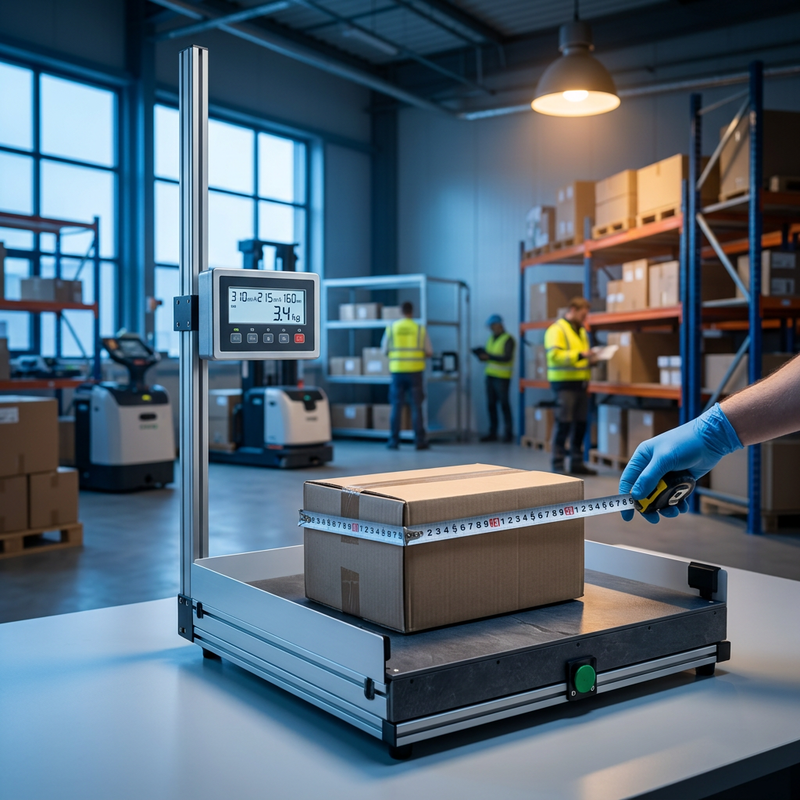
In everyday operations, four basic values are particularly important: length, width, height, and actual weight. Volume is calculated from these three dimensions. Together with the weight, these values form the key metrics needed for shipping rates and process control.
Volume weight is particularly important. It describes the calculated weight derived from the space a shipment occupies. Carriers compare this value with the actual weight and generally charge based on the higher value. For many shipping processes, the freight weight —that is, this very comparison value used for billing—is also relevant.
Depending on the service provider, the girth may also play a role. It is primarily used for surcharges on large shipments. Therefore, accurately recording package dimensions not only allows you to determine volume and weight but also to identify special cases relevant to rates early on.
Why Package Delivery Services Track Dimensions and Weight
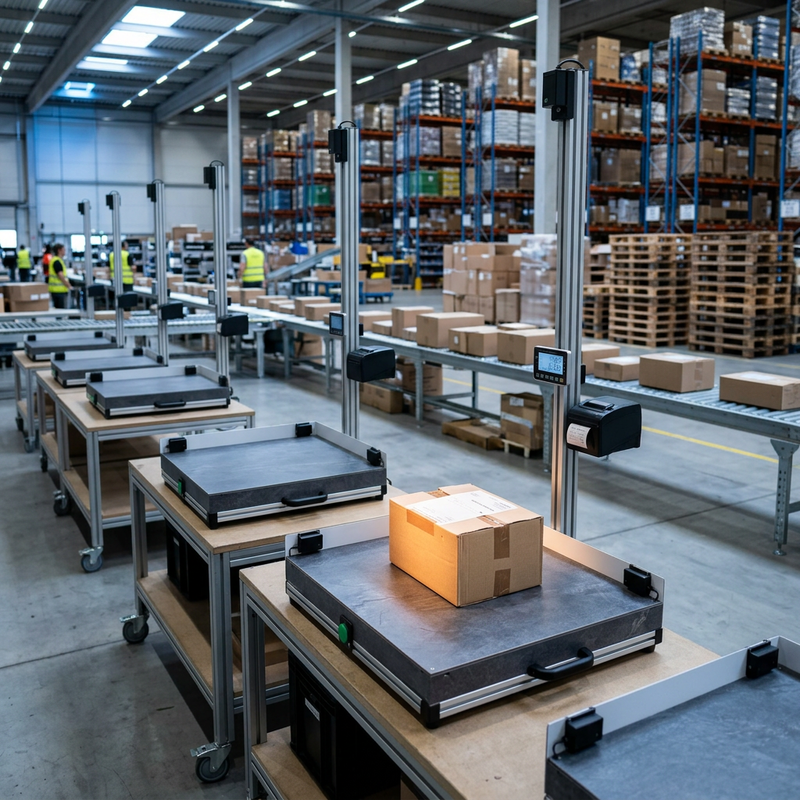
Parcel services and CEP providers need accurate shipment data because their pricing and sorting logic is based on it. Whether a package is treated as a standard package, an oversized item, or a volume-sensitive shipment depends directly on the recorded dimensions and weight.
Added to this is the planning of available cargo space. Large, lightweight packages often take up more space than small, heavy shipments. That’s why volume is just as relevant for route planning, vehicle utilization, and sorting as the weight on the scale.
Measurement data is also important for documentation purposes. If a carrier finds different values during its own remeasurement, claims can only be properly investigated with documented dimensions and weights. Companies that systematically measure their shipments thereby create transparency for billing, statistics, and quality control.
What are the benefits of package measurement in shipping?
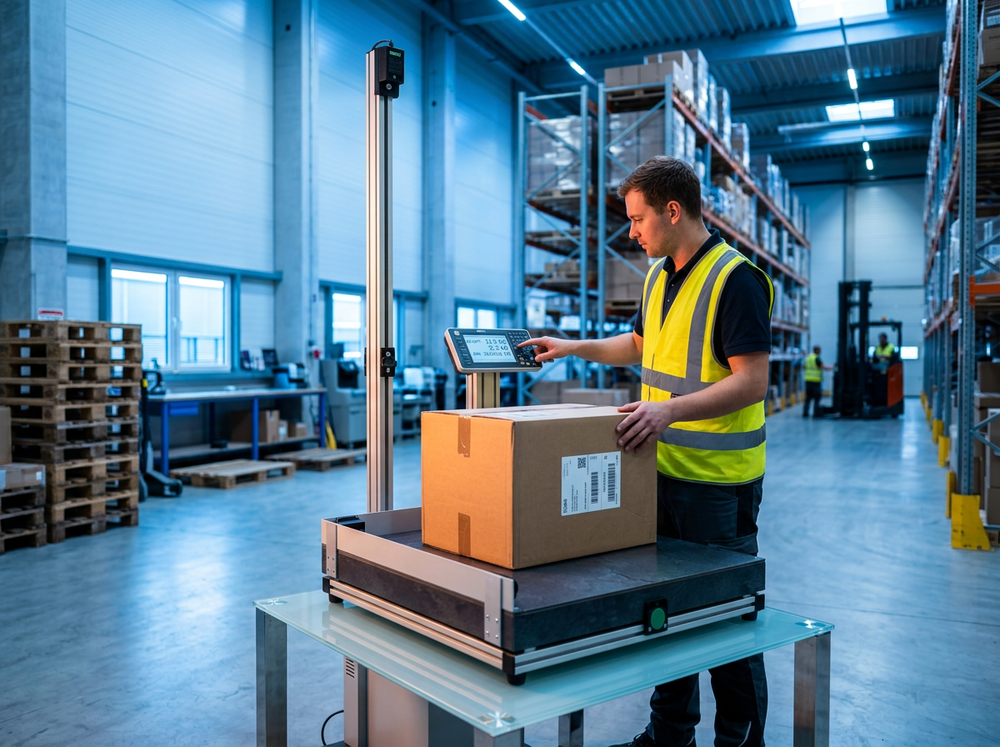
Package measurement offers four key advantages in shipping: better cost control, less empty space in the box, higher data quality, and faster outbound processing. The benefits aren’t limited to very large volumes; they often become apparent even when working regularly with multiple carriers, different package sizes, or shipments subject to rate schedules.
Cost control: Precise measurements prevent shipping costs from being based on incomplete or estimated information. Companies can determine before shipping whether actual weight or volumetric weight applies.
Packaging optimization: By systematically analyzing dimensions, you can quickly identify which boxes are regularly chosen to be too large. This reduces material usage, fill volume, and often the billed weight class as well.
Master Data Quality: Reliable measurement data improves the data foundation in WMS and ERP systems. This aids in bin assignment logic, shipping rules, and the maintenance of product dimensions.
Throughput: Standardized measurement processes shorten processing time at the packing station and reduce the need for subsequent corrections.
Evaluating the ROI of Package Measurement
The economic benefits of package measurement can usually be attributed to a few key factors:
- fewer rework issues due to accurate measurements,
- less time spent on shipment processing,
- better packaging selection with lower volumetric weight,
- less correction work in shipping, billing, and master data maintenance.
A simple ROI calculation goes like this: monthly savings from fewer errors and reduced effort minus the costs for the system, integration, and service. Especially with regular shipping volumes, measurement systems often pay for themselves not through a single benefit, but through the sum of many small improvements.
Improving Master Data Quality in WMS and ERP
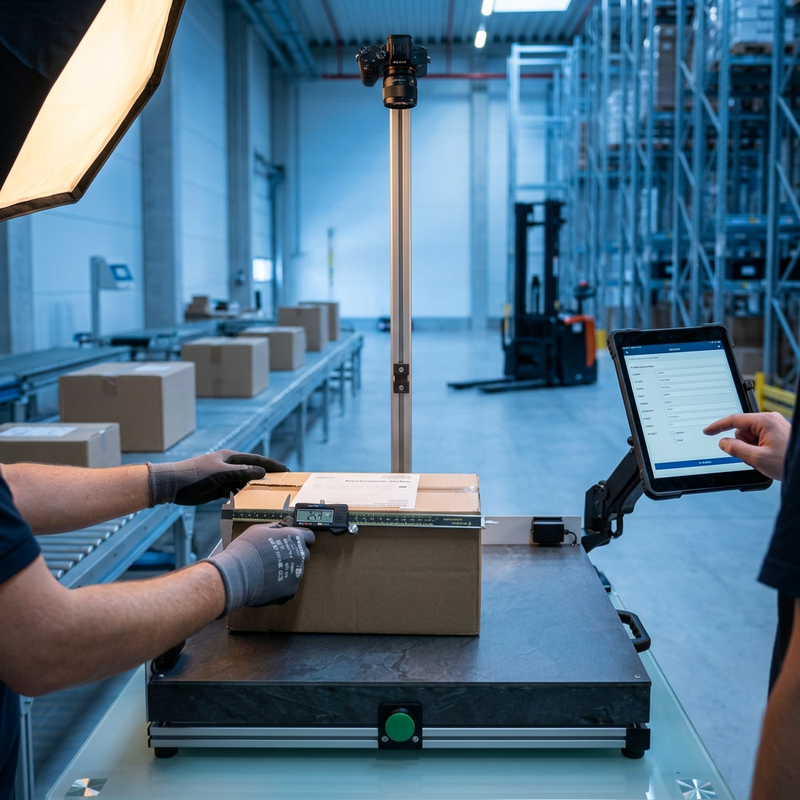
Accurate dimensional data has an impact far beyond the packing station. When length, width, height, and weight are recorded consistently, the quality of information in the WMS and ERP systems improves noticeably. This applies not only to shipping orders but also to product master data, storage location logic, and automatic shipping rules.
Many subsequent errors result from inconsistent data entry. If the same item is recorded differently at various workstations, conflicting master data is created. Standardized package measurement reduces this variation and ensures traceable values in the system.
In addition, plausibility checks can be incorporated. Unusual dimensions, unrealistic volumes, or deviations from reference values can be flagged before they lead to errors in downstream processes.
Reduce Costs and Calculate Freight Weight Accurately
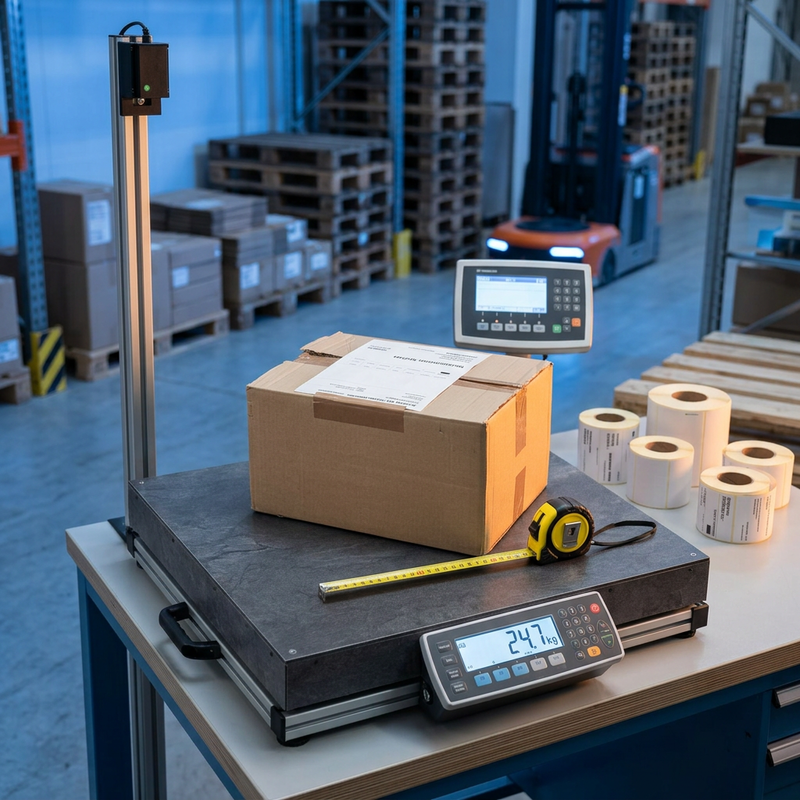
In shipping, additional costs usually arise not from obvious errors, but from minor discrepancies in dimensions and weights. If a package is packed too large or its volumetric weight is miscalculated, the carrier will often issue a surcharge. This is exactly where package measurement comes in.
By checking every shipment with reliable measurement data, you can calculate the freight weight before the package leaves the facility. This reveals which packages are unnecessarily expensive and for which items volume—rather than actual weight—is driving up costs.
Rate thresholds can also be managed more precisely. Even slight differences in edge lengths or girth can determine whether a surcharge applies. Precise measurements provide a significantly better basis for this than general estimates.
Static vs. Dynamic Package Measurement

The most important fundamental decision in package measurement is this: Will the shipment be measured while stationary or as part of a moving material flow? This is precisely what distinguishes static measurement from dynamic measurement.
In the static method, the package is placed on a designated measuring station. This is typical for packing stations, shipping stations, or separate offline measuring stations. The process is controlled, the technology is relatively compact, and the measurements are usually very precise.
Dynamic systems, on the other hand, operate in a continuous flow. The package travels along conveyor systems or sorting lines while sensors and software capture its dimensions in motion. Such systems are designed for high throughput rates and are integrated into automated logistics processes.
Additionally, a distinction can be made between manually triggered and fully automated processes. This results in four typical scenarios: manual measuring station, static automated station, dynamic offline line, and fully automated inline system.
Static systems for individual packages
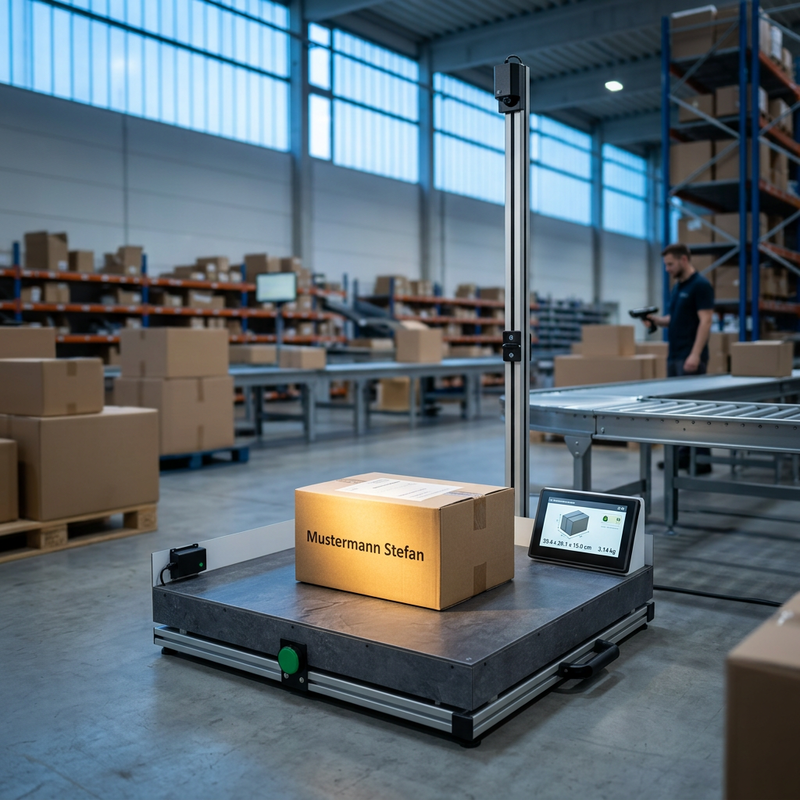
Static measurement systems are the typical solution for packing stations and shipping stations with moderate shipment volumes. The package is briefly placed on a measurement surface; sensors capture its external dimensions, and in the case of combined devices, the weight is determined at the same time.
The advantage lies in the controlled measurement environment. Because the package does not move during the measurement process, stable and highly reproducible results can be achieved. Such systems are particularly well-suited for shipping warehouses, fulfillment workstations, and freight receiving areas without continuous conveyor systems.
The achievable throughput depends less on the sensor technology than on the handling process. The measurement technology itself usually operates in fractions of a second; the main limiting factor is the manual placement and removal of the shipments.
Manual package measurement at the packing station
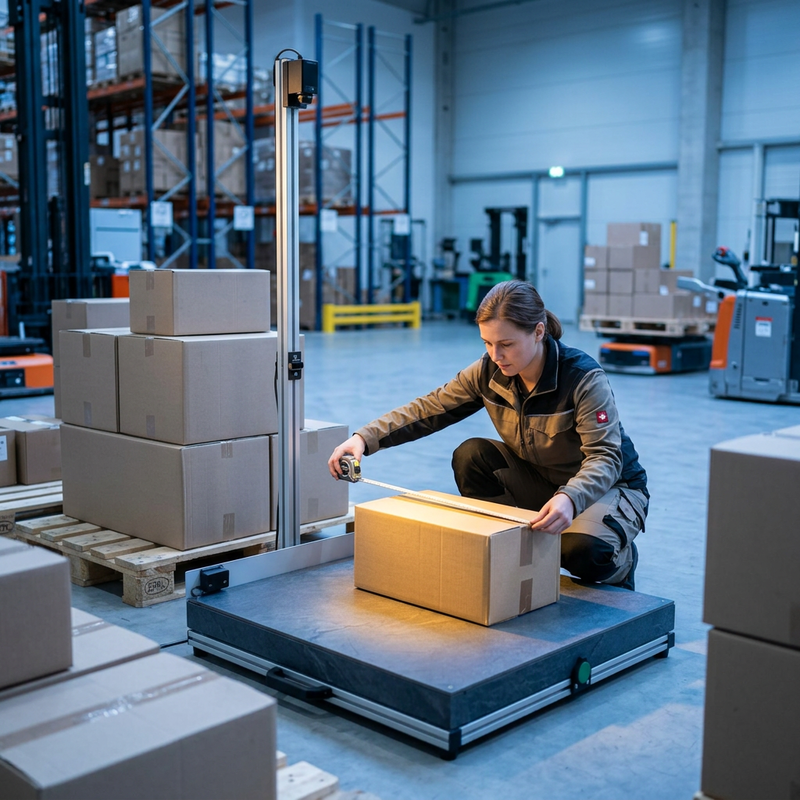
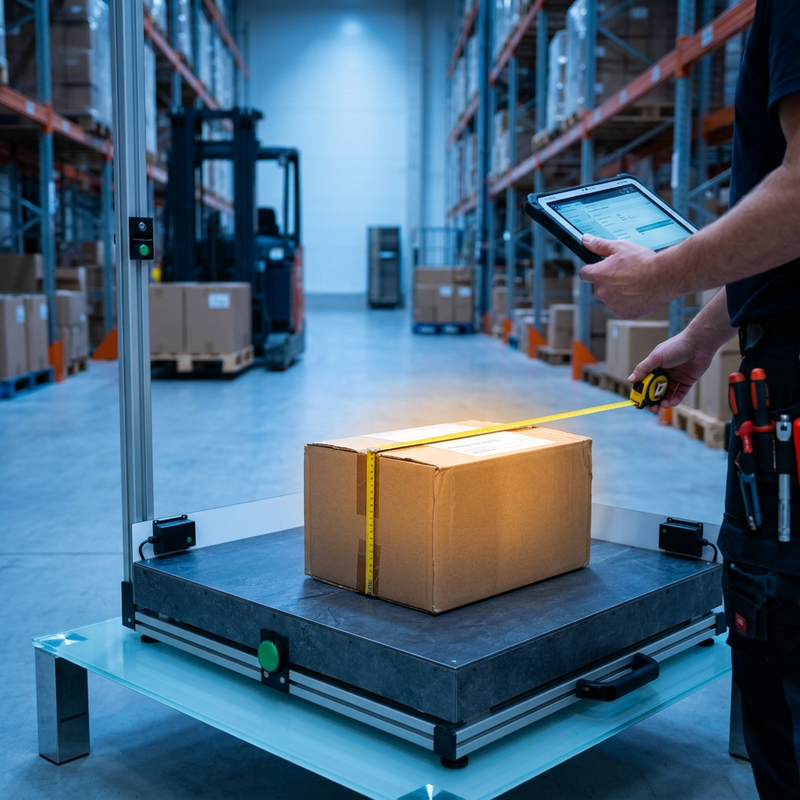
The simplest way to measure packages is to do it manually with a tape measure and a scale. This may be sufficient for very small shipping volumes, such as in start-up e-commerce businesses or for occasional individual shipments.
However, as volume grows, the limitations of this approach become apparent. The time required per package increases, measurements vary depending on the employee, and entering the data into the system is prone to errors. Even small rounding errors can affect the volumetric weight and, consequently, shipping costs.
Manual methods are therefore best suited as a temporary solution or for exceptional cases. As soon as speed, comparability, and data quality become more important, a standardized measuring station is usually the more sensible choice.
Inline or offline: Which process logic is right?
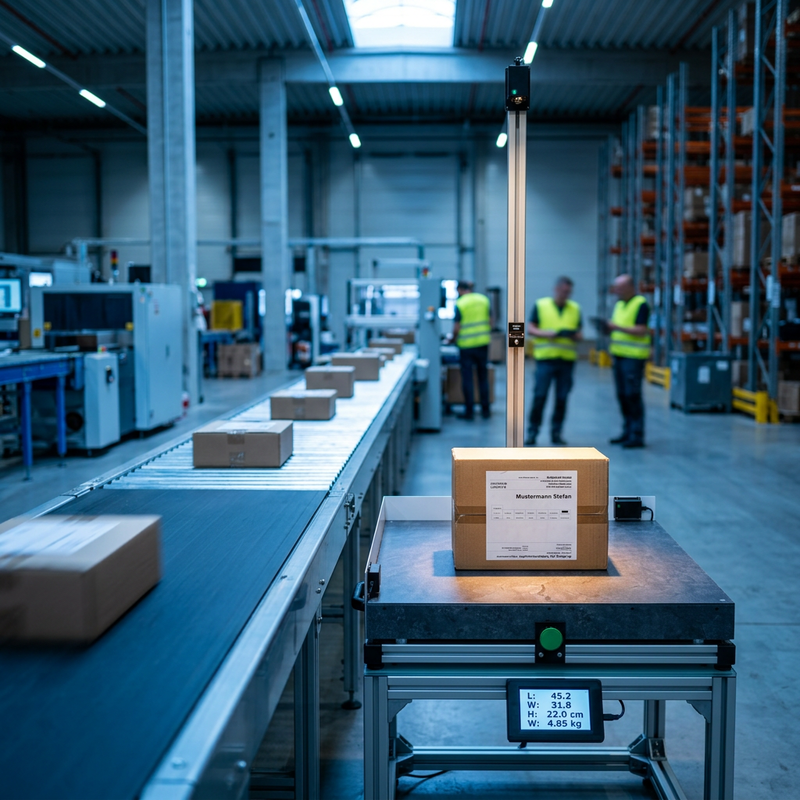
Whether a facility needs an inline solution or a separate measuring station depends primarily on shipment volume, process design, available space, and budget.
An inline solution is suitable when many packages travel along the same conveyor path and any additional handling step limits throughput. In this case, measurement becomes an integral part of the conveyor system and runs continuously as part of the process.
An offline solution is usually the best choice when shipments are packed, inspected, or processed manually on an individual basis. This applies particularly to shipping areas without a central conveyor line, to retrofit projects, and to companies that want to start with a more compact solution.
As a general rule: If you process several hundred packages per day, a stationary solution is often more cost-effective. For consistently high volumes and a clearly defined material flow, inline technology is the better choice.
Dynamic Measurement During the Conveyor Cycle

Dynamic package measurement is used in situations where shipments are not to be stopped individually. On conveyor lines, sensors detect the packages as they move and use this data to calculate their dimensions in real time.
A typical setup combines 3D sensors, weighing technology, and identification via barcode scanners. This allows dimensions, weight, and shipment assignment to be processed directly within the material flow. Such systems are designed for high throughput rates and are particularly useful in CEP hubs, sorting centers, and highly automated logistics facilities.
Key performance indicators here include not only speed and accuracy but also the read rate. The fewer shipments that require rework, the more stable the entire conveyor line operates.
Calculate Volume Weight and Shipping Weight
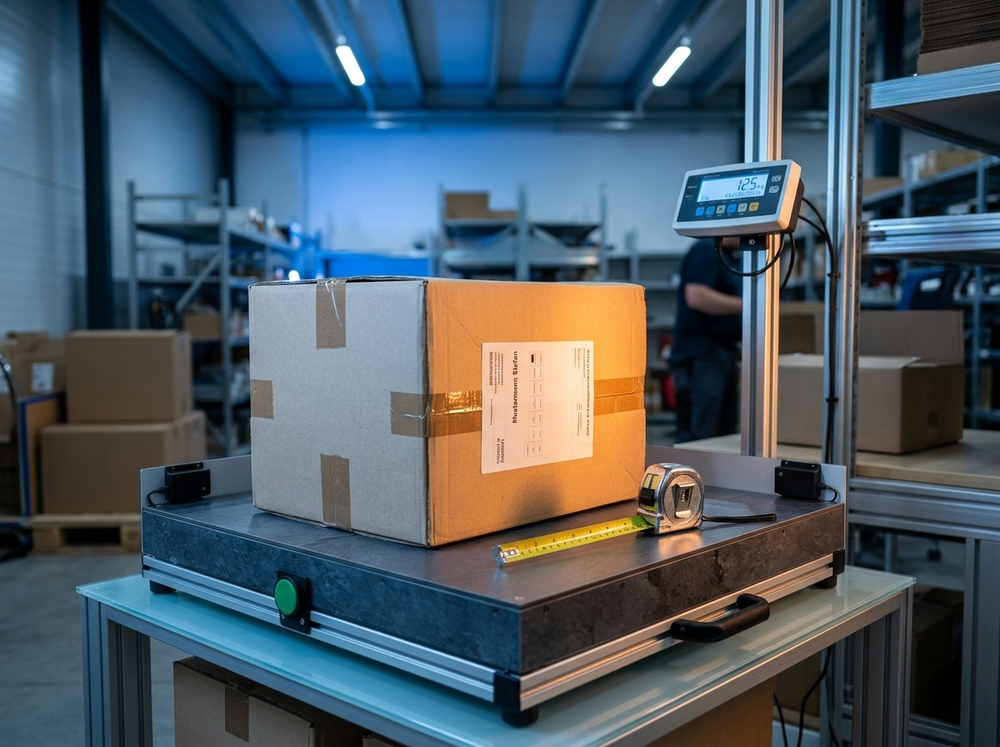
In shipping, the weight shown on the scale isn’t always the decisive factor. For many shipments, what counts is the volumetric weight—that is, the calculated weight based on the space the shipment occupies. Large, lightweight boxes, in particular, fall into this category.
To clearly distinguish between these terms: The actual weight is the value measured on the scale. The volumetric weight is calculated from the length, width, and height using a carrier’s formula. The shipping weight is the higher of these two values and typically serves as the basis for billing.
By clearly distinguishing between these three factors, you can calculate shipping costs much more reliably and make better-informed decisions about packaging.
Sample Calculation from Everyday Shipping Operations
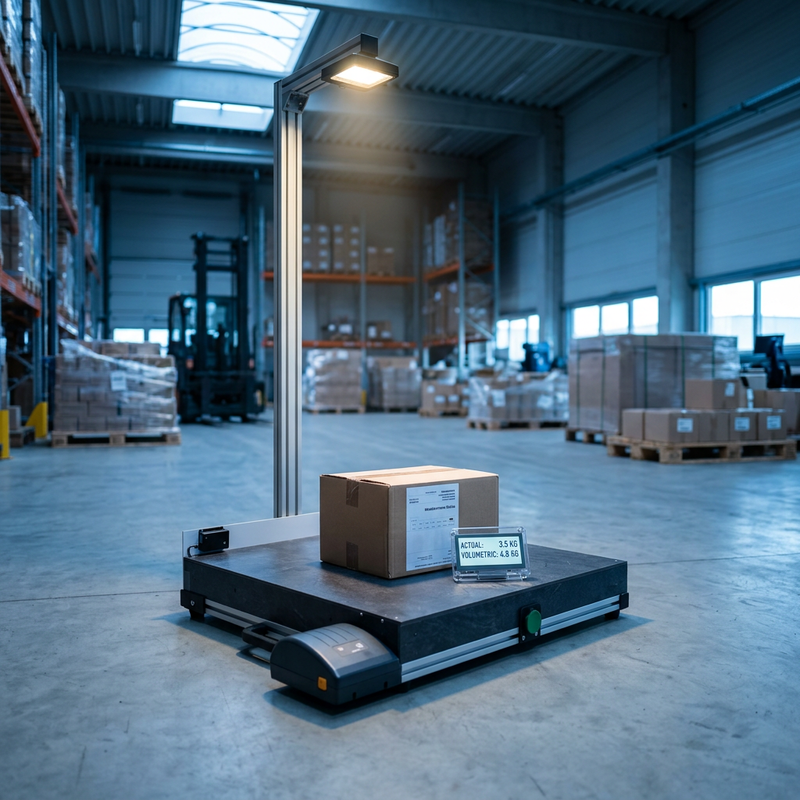
A package measures 40 × 30 × 20 cm and actually weighs 3.5 kg. Its volume is 24,000 cm³. If a DIM factor of 5,000 is used in the calculation, the result is:
24,000 ÷ 5,000 = 4.8 kg volumetric weight
Since 4.8 kg is greater than 3.5 kg, the billable freight weight is 4.8 kg. If the same contents were packed in a smaller box, the result could be different. This is precisely why choosing the right package size is often more important for shipping costs than it seems at first glance.
Formula for density by volume
The basic formula is:
Length × Width × Height ÷ DIM factor = volumetric weight
Dimensions are typically measured in centimeters. The result indicates the calculated weight of the shipment based on its volume. The smaller the DIM factor used, the greater the impact a large package has on the final calculation.
For shipping purposes, the comparison with the actual weight is then decisive. The higher value determines the shipping weight.
When Volume Weight Is More Important Than Actual Weight

Volume weight becomes a factor whenever a shipment takes up a lot of space but weighs relatively little. Typical examples include pillows, lightweight consumer goods, hollow items, large shoe boxes, or packages with a lot of packing material.
In such cases, the cost issue isn’t the contents, but the packaging. An oversized box can cause a shipment to be classified into a higher weight class for shipping rates, even though the actual weight remains low.
This is why it’s particularly worthwhile for e-commerce and fulfillment businesses to take a close look at the box sizes they use regularly. Reducing the amount of air in a package often improves both material efficiency and shipping costs.
DIM Factors at DHL, UPS, and DPD
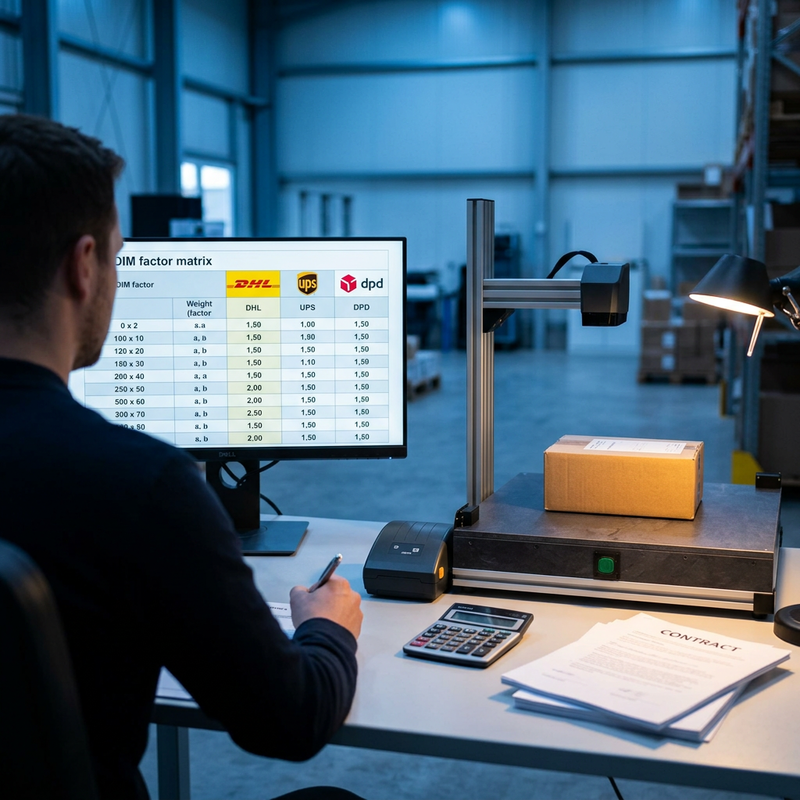
The headline suggests fixed values, but in practice the situation is more complex: DIM factors vary depending on the carrier, product, destination country, and in some cases even the contract model. For this reason, it is more technically sound not to specify blanket duration values for DHL, UPS, and DPD when these may vary depending on the rate plan.
Nevertheless, a simple matrix serves as a guide:
- DHL: The factor and rounding rules may vary depending on the shipping product and contract type.
- UPS: Volumetric calculations are highly dependent on the product and country, especially for international shipments.
- DPD: Here, too, the rate model, size rules, and rounding are decisive.
Therefore, what matters less is a single example value and more the systemic question: Does your shipping software use the current carrier rules, and does it accurately distinguish between actual weight and volumetric weight for every shipment? If you work with multiple carriers, you should check the applicable rate schedules directly with each carrier.
Package Measurement Technologies
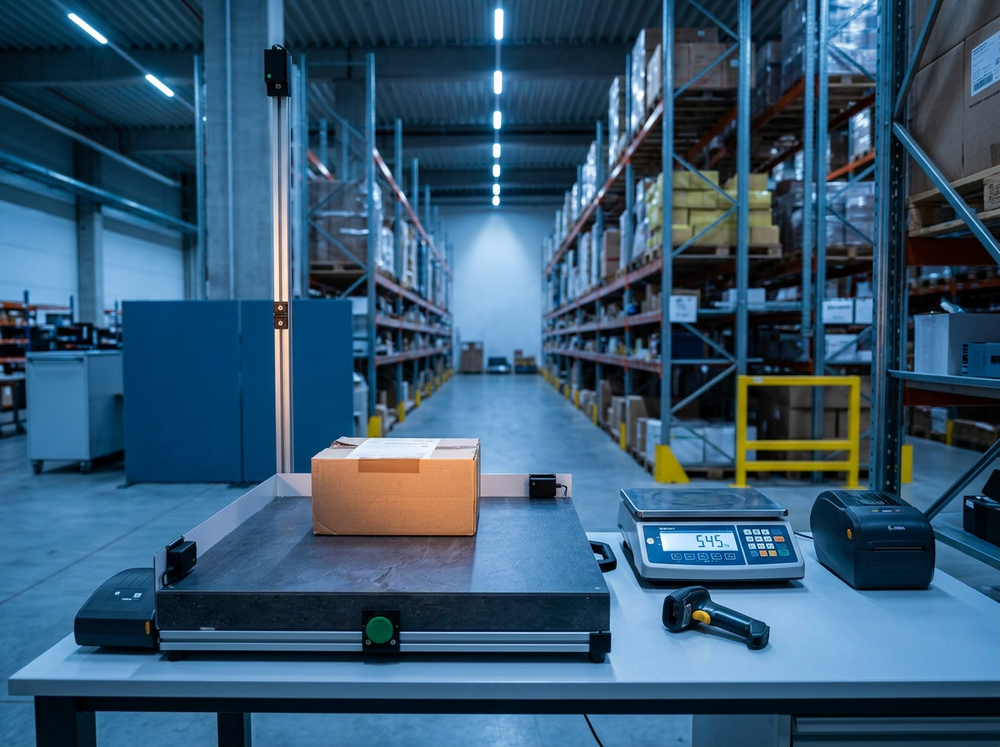
Today, four main technologies are used for package measurement: ultrasound, laser, 3D cameras with time-of-flight, and combined systems with scales and measuring tables. The right solution depends on the package mix, desired throughput, and environmental conditions.
To make the methods comparable, here is a brief overview:
- Ultrasonic: good for standardized cartons, less effective for soft packs and complex shapes.
- Laser: very precise for sharp edges and stable geometries, but sensitive to adverse ambient light and highly reflective surfaces.
- 3D camera / time-of-flight: flexible for various shapes, well-suited for automatic dimensioning and mixed package types.
- Volume scale: combines weight and dimension measurement in a single step and is particularly suitable for stationary packing stations.
What matters is not just the accuracy listed on the spec sheet, but the suitability for real-world shipment shapes: standard cartons, poly bags, soft packs, flat packages, shipping tubes, or reflective films all behave differently depending on the sensor technology used.
Laser-Based Cargo Measurement
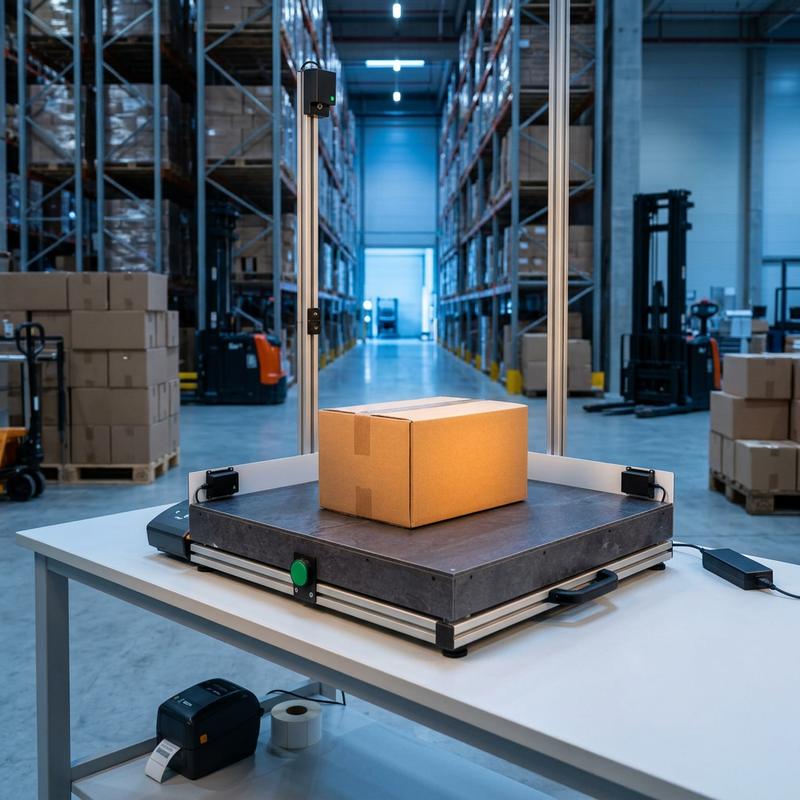
Laser-based systems are among the most precise solutions for cargo measurement. They capture edges and distances with a high degree of repeatability and perform particularly well with rectangular boxes that have clear outer contours.
For standard cartons and sturdy shipping boxes, lasers are often the first choice when high accuracy is required. With soft packs or flexible packaging, the geometry becomes more challenging because the outer shape is less well-defined. Reflective films and highly glossy surfaces can further complicate accurate signal detection if the measuring station is not properly configured.
Laser technology is well-suited for stationary precision measurement and, depending on the setup, also for dynamic applications. Controlled environmental conditions and stable calibration are prerequisites.
Ultrasonic Technology for Standardized Measurement Stations
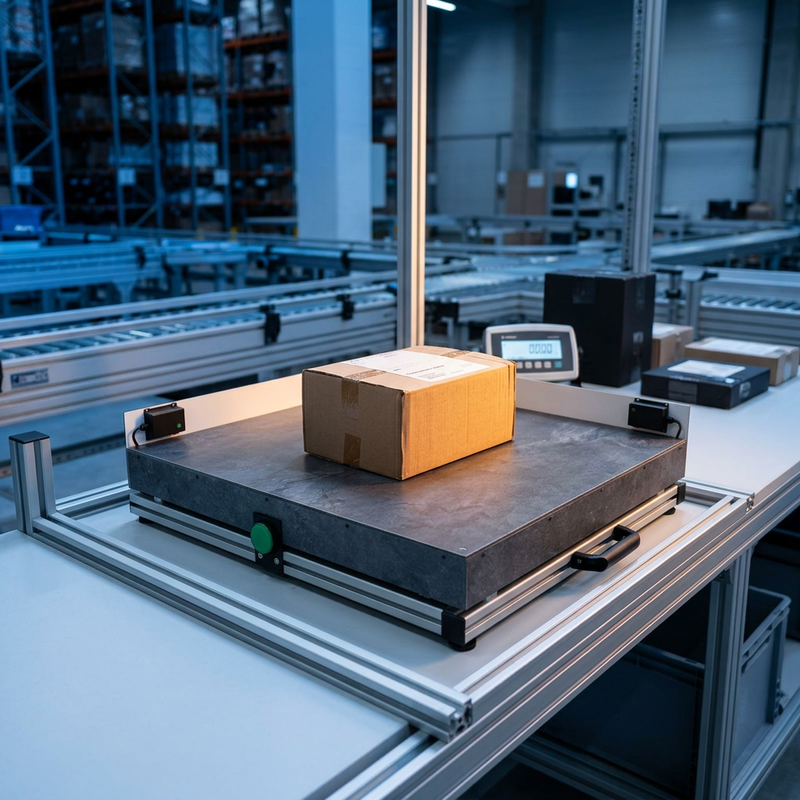
Ultrasound measures distances based on the travel time of sound waves. This method is well-suited for standardized measuring stations with a clearly defined range of cartons and organized processes.
The technology performs well with standard cartons, matte surfaces, and stable packages. Because color and print patterns play virtually no role, even dark packaging can be reliably detected. Ultrasound is less suitable for soft packs, poly bags, and very irregular contours, as soft or slanted surfaces do not always reflect sound clearly.
For companies handling uniform shipments, such a volume measurement system can be a cost-effective solution. However, when dealing with a wide variety of shapes, ultrasonic systems reach their limits more quickly than 3D-based methods.
Which technology is best suited for which use case?
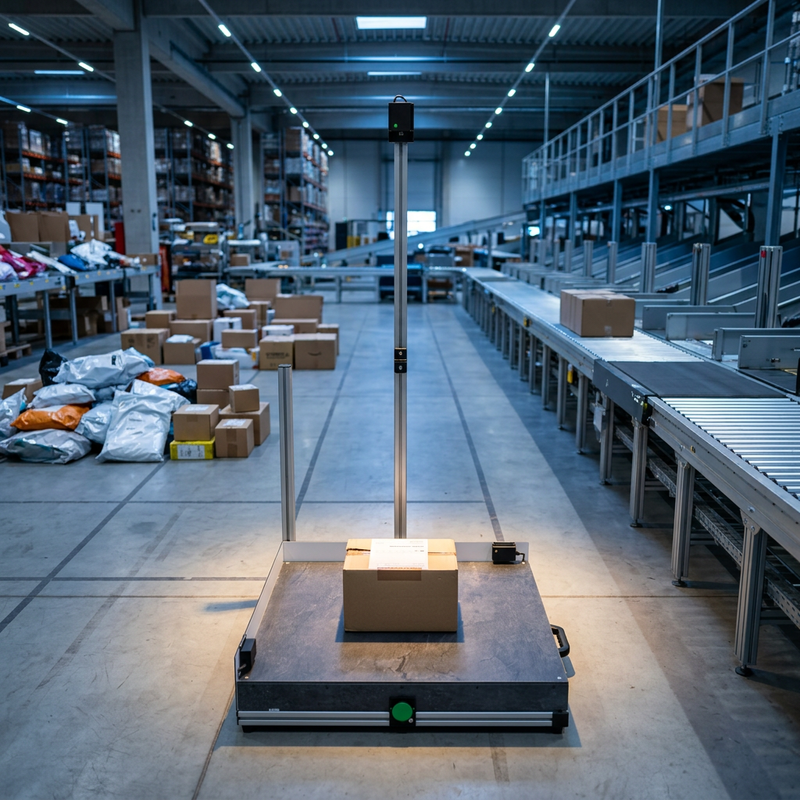
The options can be summarized into three typical scenarios:
- Small shipping area: static measuring station or volumetric scale, ideal for individual packages and manageable quantities.
- Mixed parcel mix: 3D camera or high-performance laser-based solution, suitable for soft packs, cartons, and varying formats.
- Hub or conveyor line: dynamic inline systems with 3D sensors or comparable high-throughput technology.
A quick decision-making matrix is as follows: low volume + manual processes = static; high variety of shapes = 3D-oriented; very high throughput = dynamic. In many projects, this classification is more helpful than simply looking at data sheets.
Scale with measuring table and volumetric scale
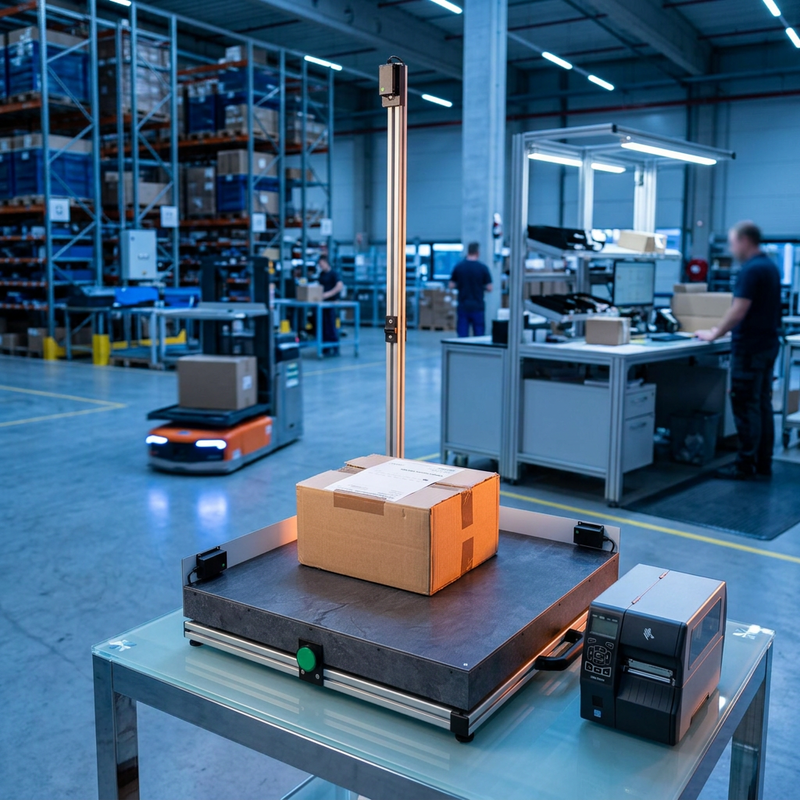
A volume scale combines weight and dimension measurement in a single compact system. Once the package is placed on the scale, its weight, length, width, and height are immediately available. For many shipping workstations, this is the most practical way to get started with professional package measurement.
Such systems are available with laser, ultrasonic, or 3D sensors. Which option makes the most sense depends primarily on the shipment profile. For processes that are predominantly cardboard-based, a classic measuring table is often sufficient. For heterogeneous shapes or a higher degree of automation, a 3D volumetric scale is frequently the more flexible solution.
The major advantage lies in its compact design. For those who want to capture weight and dimensions in a single step at the packing station, a 3D volumetric scale offers a particularly streamlined setup.
3D Camera and Time-of-Flight for Automatic Dimensioning
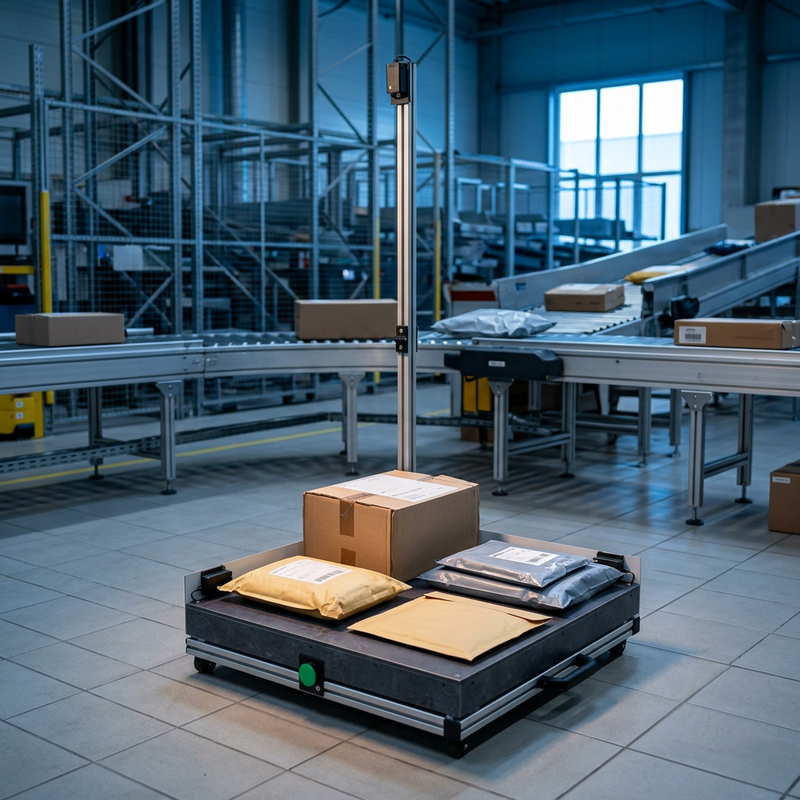
Time-of-flight 3D cameras capture not only individual edges but entire surfaces. A spatial model of the shipment is created from numerous depth points, from which the dimensions can be calculated.
This method is particularly flexible when dealing with a mixed parcel mix. In addition to cardboard boxes, it can also map soft packs, poly bags, flat parcels, and many irregularly shaped items more accurately than purely edge-based methods. This is precisely why this technology is frequently used for automatic dimensioning on conveyor lines.
3D sensor technology also demonstrates its strengths at high cycle rates. Where different shipment shapes pass by in rapid succession, it is often more robust than simpler measurement principles. However, strong infrared interference sources and unfavorable lighting conditions remain critical factors that must be taken into account during planning.
Key Technical Specifications and Selection Criteria
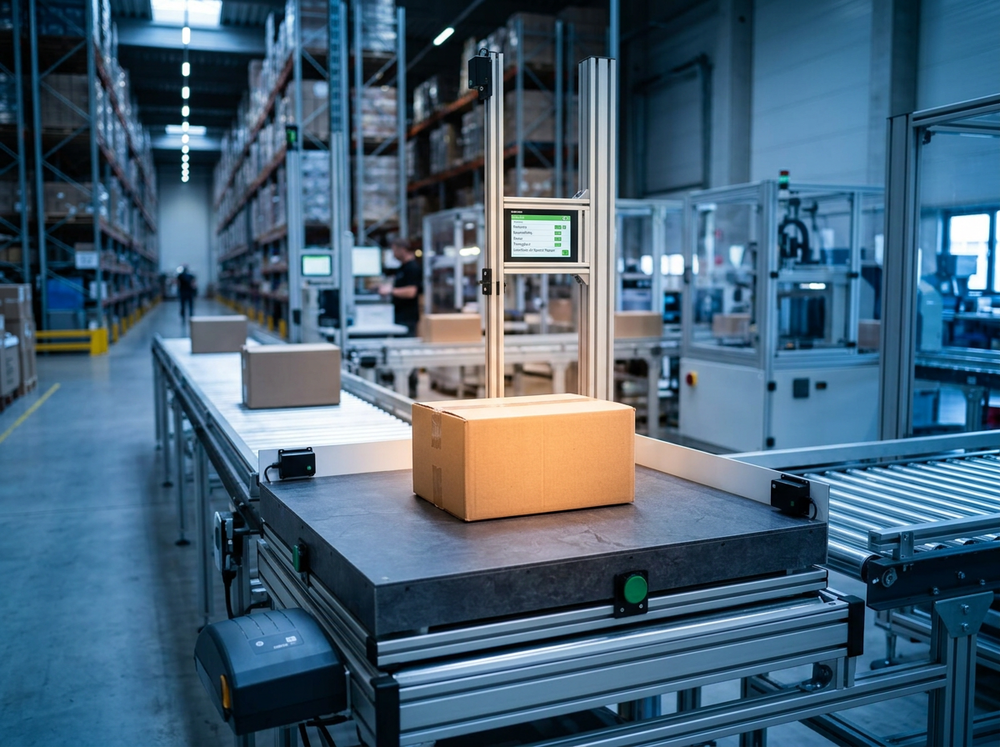
Anyone wishing to compare package measurement systems should focus on five evaluation criteria: measurement accuracy, repeatability, measurement range, throughput, and suitability for irregular shapes. Only when these criteria are considered in conjunction with actual operating conditions can a reliable picture be obtained.
A concise comparison framework is helpful:
- Accuracy: How close is the measured value to the actual dimension?
- Repeatability: How consistently does the system measure the same package?
- Measurement range and load capacity: Do package sizes and weights align with everyday operations?
- Cycle time: Is the throughput sufficient for peak periods?
- Special cases: Can the system handle soft packs, films, or tubes?
In addition, temperature, ambient light, installation space, calibration, and interfaces should always be part of the evaluation. A good measurement system proves its worth not only on paper but also in actual operation.
Measurement Range, Platform Size, and Load Capacity
A measurement system must be suited to the actual range of shipments. Key factors here are the minimum and maximum package dimensions, the size of the measurement area, and the scale’s weight capacity.
If the platform is too small, packages will extend beyond the surface and skew the results. If the weighing range is too narrow, the system’s practicality for heavy shipments is reduced. Conversely, a design that is too coarse can be unnecessarily imprecise for very small packages.
A good selection therefore takes into account both the standard range and typical outliers. Especially during seasonal peaks or when dealing with changing packaging formats, it’s worth allowing for some leeway in terms of surface area and load capacity.
Measurement accuracy, repeatability, and millimeter precision

Accuracy describes how much a measured value deviates from the actual dimension. In practice, however, repeatability is often even more important: If the system measures the same shipment multiple times with nearly identical results, this is usually more valuable for rate-determining processes than a single “ideal” value obtained in a laboratory.
Especially when it comes to package measurement, therefore, one should not only ask for millimeter specifications but also for reproducibility in continuous operation. A stable system delivers consistent results under the same conditions, even when shift work, changing operators, or different surfaces come into play.
When comparing quotes, you should request test measurements using typical shipments. Only then will it become clear how reliable the specified precision values really are.
Operating Conditions, Maintenance, and Certificates
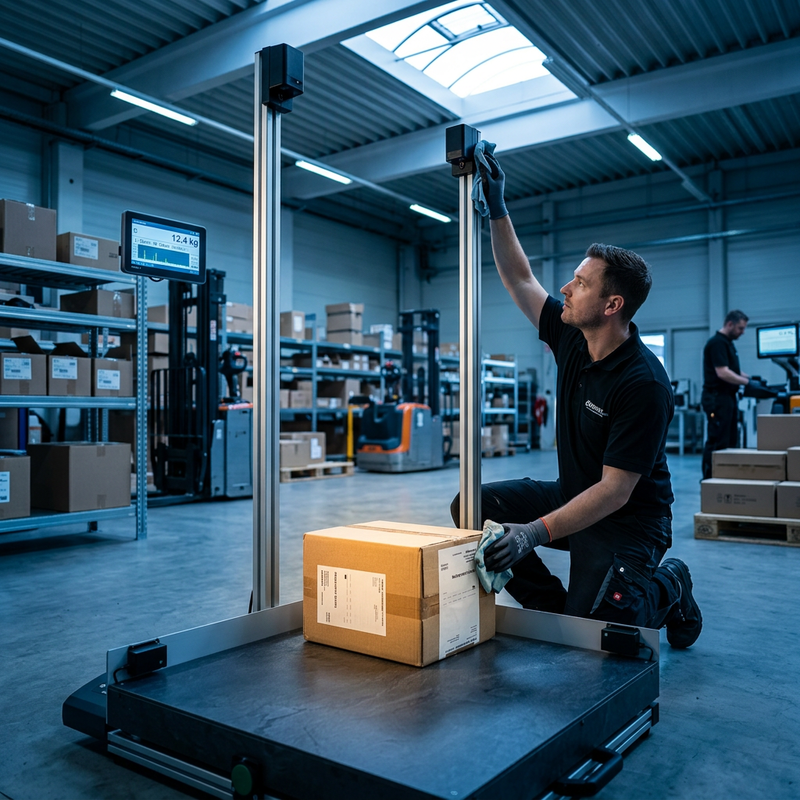
The operating environment also affects the performance of a package measurement system. Temperature, dust, mechanical vibrations, ambient light, and the overall robustness of the system play a greater role in daily operation than many data sheets suggest.
Maintenance primarily involves cleaning the sensors, performing regular inspections, and, if necessary, calibration at specified intervals. In high-volume shipping environments, it is also important to consider how quickly support is available and how downtime can be minimized.
If weights are used for billing-related processes, proof of calibration or traceable components may be required. This point should be clarified with the provider early on.
Object Forms, Special Cases, and Irregulars
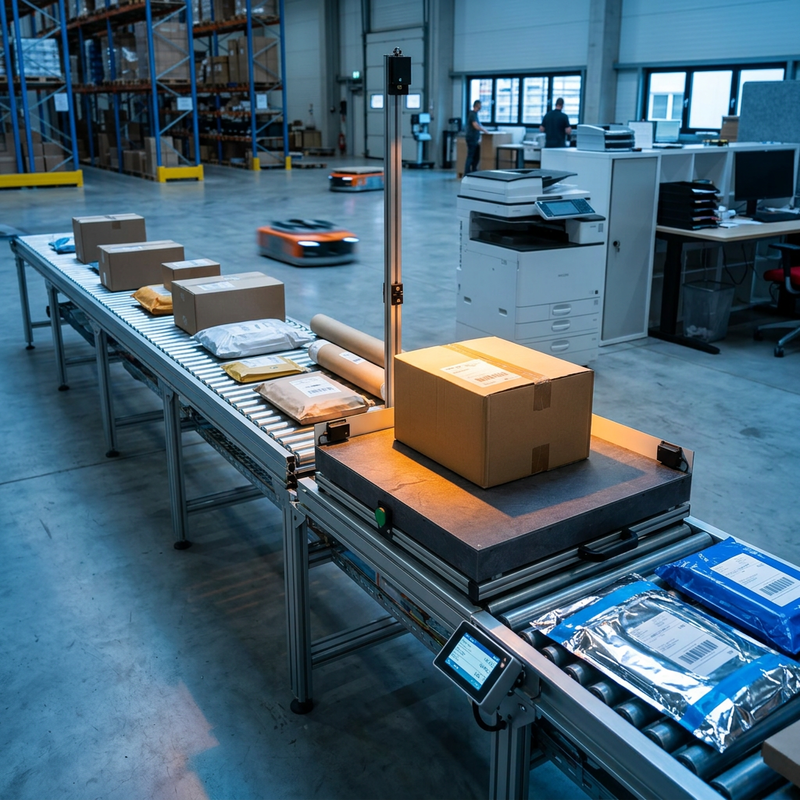
The greatest variation among the technologies is evident with difficult shipment shapes. Standard cardboard boxes are easily handled by nearly every method. Things become more complex with soft packs, poly bags, shipping tubes, very flat packages, and reflective films.
Soft packs and poly bags: 3D cameras with time-of-flight technology usually have an advantage here because they measure across the entire surface. Ultrasound and simple edge detection can become less accurate with flexible shapes.
Shipping tubes and round objects: Camera-based 3D methods or specialized algorithms are often more suitable than traditional edge-based measurement.
Flat shipments: Here, sensor resolution and precise calibration are key. Not every system is equally well-suited for very low heights.
Reflective films: Laser and optical methods must be appropriately designed for this; unfavorable lighting conditions can affect quality.
Those who handle many irregularly shaped packages should always test the technology with their own mix of packages and not select it based solely on standard values.
Measurement time and throughput in the process
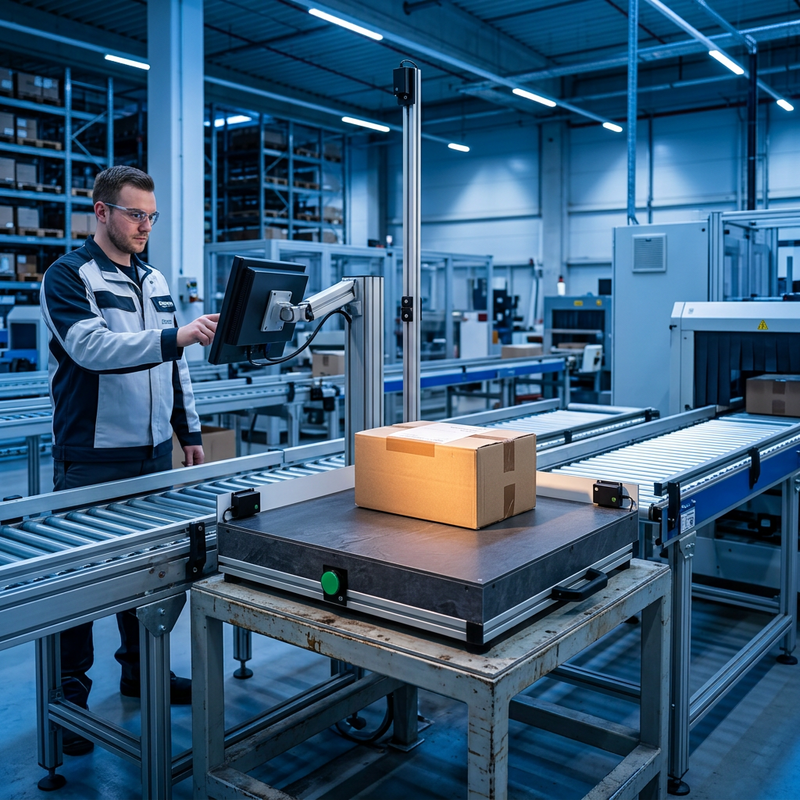
A system’s pure measurement time is only part of the story. What matters more is how many shipments per hour can be processed under real-world conditions. This includes placement, triggering, data processing, and transfer to downstream software.
At stationary testing stations, the cycle time is usually limited by operator handling. In dynamic systems, however, performance depends on conveyor speed, sensor frequency, and precise synchronization.
Therefore, the decisive factor in selection is not the fastest single measurement, but rather the system’s day-to-day performance. Those dealing with high peak loads should examine this point particularly closely.
Integration of Package Measurement into the WMS and ERP
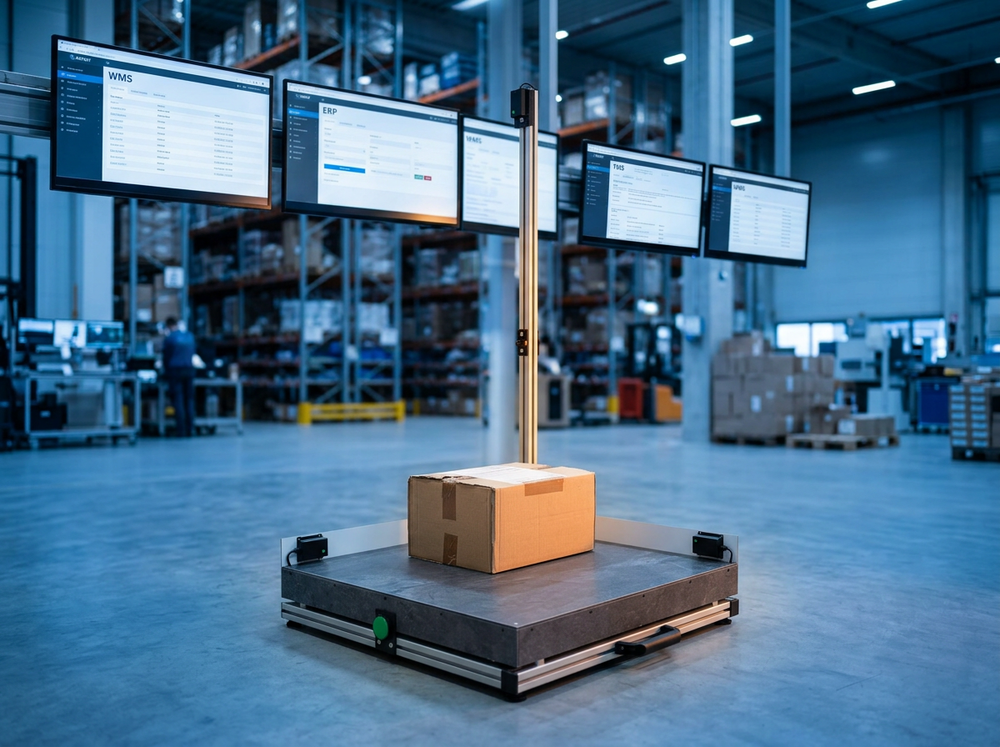
The value of package measurement increases significantly when the recorded data is fed directly into existing systems. Relevant targets typically include WMS, ERP, shipping software, TMS, or carrier integrations.
A clear separation of roles is essential here: First, the shipment must be uniquely identified; then the measurement values are transferred; and finally, processes such as rate verification or label printing follow. This keeps the integration straightforward and technically sound.
Typical transmission methods include CSV, API, REST, SQL, or serial protocols. The appropriate method depends on the existing IT infrastructure and the desired level of automation.
Barcodes, QR Codes, and Unique Identification
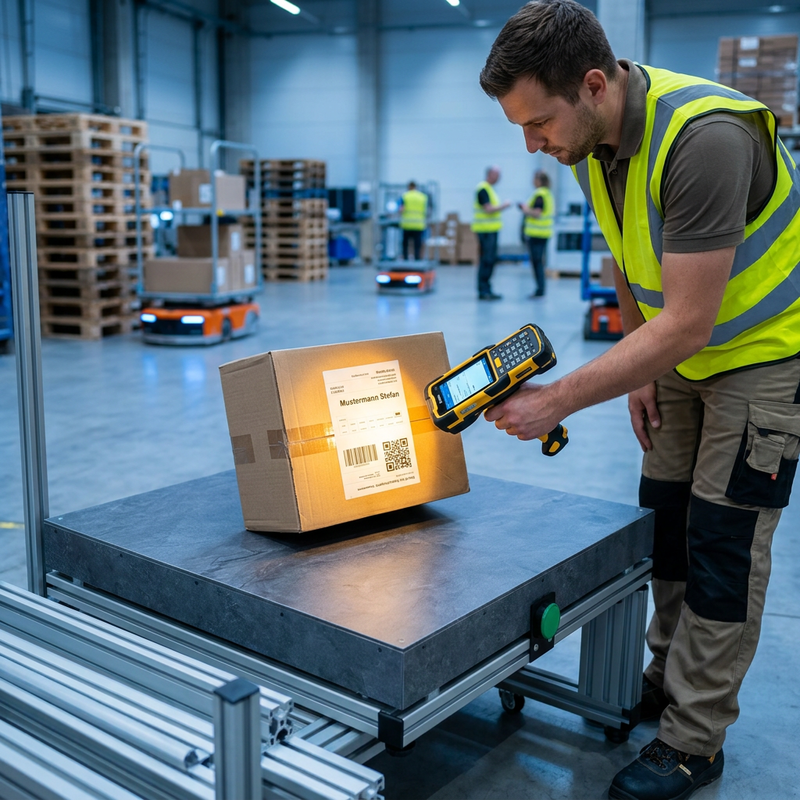
Before dimensions or weights can be processed effectively, it must be clear which shipment they belong to. This is ensured by unique identification via barcode or QR code.
The barcode links the measurement to the order, package number, or return process. QR codes offer greater information density and often remain easily readable even when labels are damaged. In practice, many systems support both formats simultaneously.
Without accurate ID mapping, even the best measurement data loses its value. That is why identification is not a secondary consideration, but a fundamental prerequisite for successful integration.
Integration with Inventory Management and Warehouse Management

In merchandise management and warehouse management, measurement data is primarily used for three tasks: maintaining item dimensions, controlling shipping rules, and validating orders. This makes package measurement an important data source for operational processes.
In the WMS, measured values can be compared with stored references. Deviations may indicate, for example, incorrect packaging, non-standard sizes, or master data errors. In the ERP system, the same information supports the calculation of shipping costs and the evaluation of logistics metrics.
The better these systems are integrated, the fewer corrections are required later in the process chain.
Interfaces: CSV, API, REST, SQL, and database

Several interface options are available for the technical integration of measurement systems. The most appropriate option depends on the system environment, IT resources, and the desired real-time capability.
- CSV: simple and widely used, well-suited for standardized imports.
- API / REST: ideal for modern systems with direct, event-driven data transfer.
- SQL / Database: useful when multiple applications need to access shared measurement data.
- Serial / Keyboard Wedge: practical for older environments and simple input forms.
Regardless of the technology used, the structure and field logic must be clearly defined in advance so that the data can be processed unambiguously in the target system.
Automate Label Printing and Shipping Data
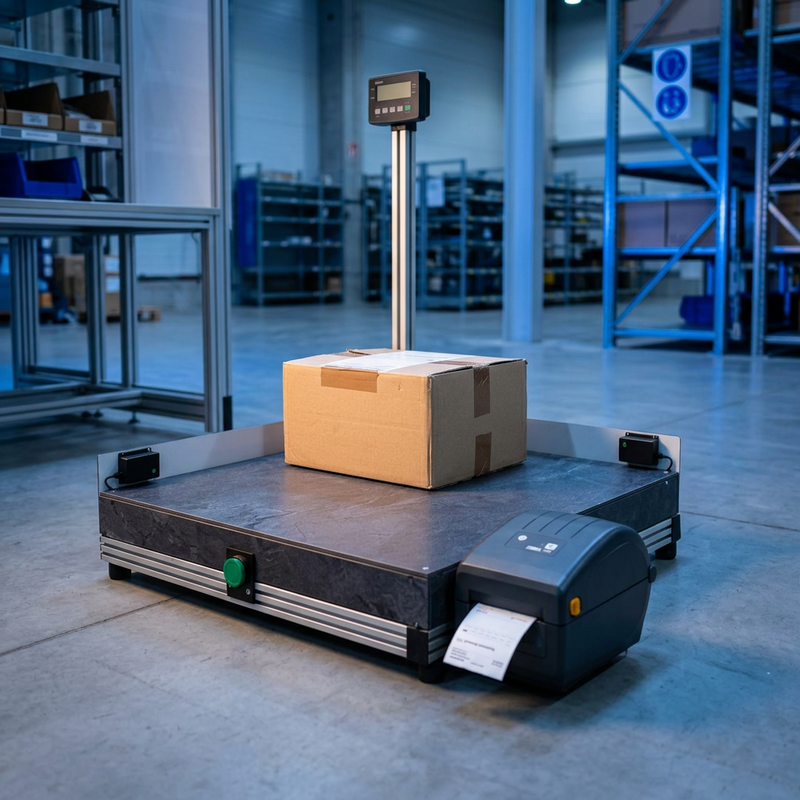
Package measurement is usually followed by shipping logic and label generation. The shipping software uses the dimensions and weight to determine the appropriate rate, select the shipping method, and generate the label.
This makes package measurement the trigger for downstream steps such as carrier selection, data transfer, and printing. This is particularly valuable in environments with multiple service providers or rate-based rules.
The more closely measurement and shipping software work together, the faster outbound shipments can be processed.
Applications of Package Measurement
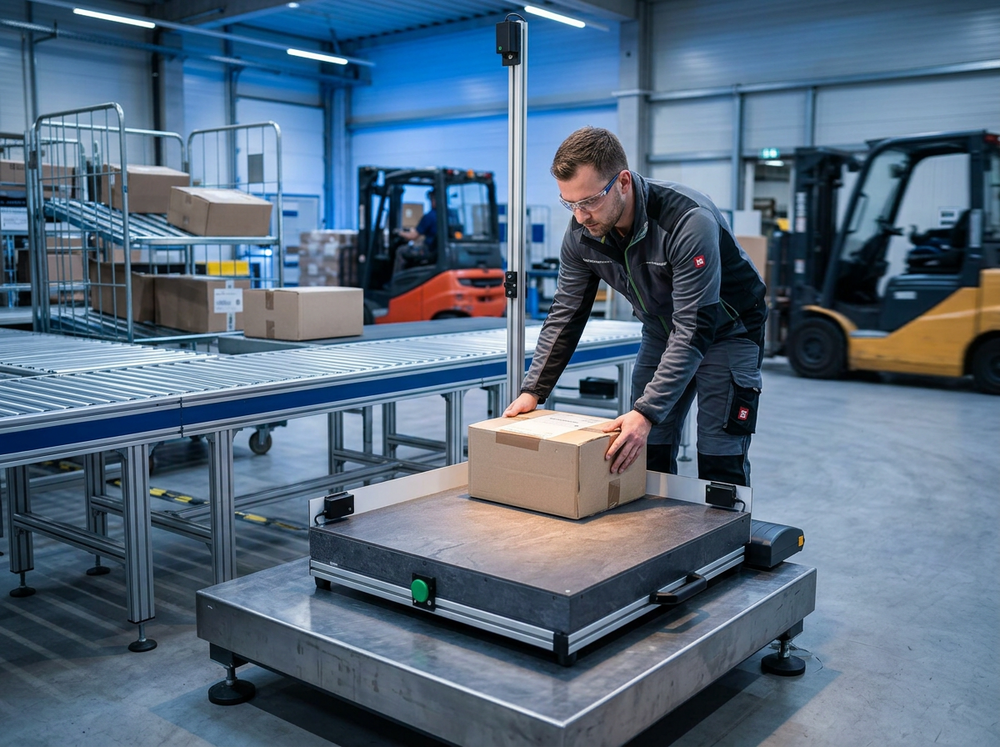
The requirements for package measurement vary significantly depending on the industry and process structure. While ease of use and robust cost control are the top priorities at an online retailer’s packing station, throughput and system availability take center stage at hubs and sorting centers.
Typical applications include shipping warehouses, e-commerce fulfillment, CEP service providers, returns management, and related logistics processes involving standardized packages. For larger loading units, however, the field of pallet measurement comes into play.
Which solution makes sense therefore always depends on the specific material flow and shipment profile.
Express, Parcel, and Courier (KEP) Service Providers and Hub Environments
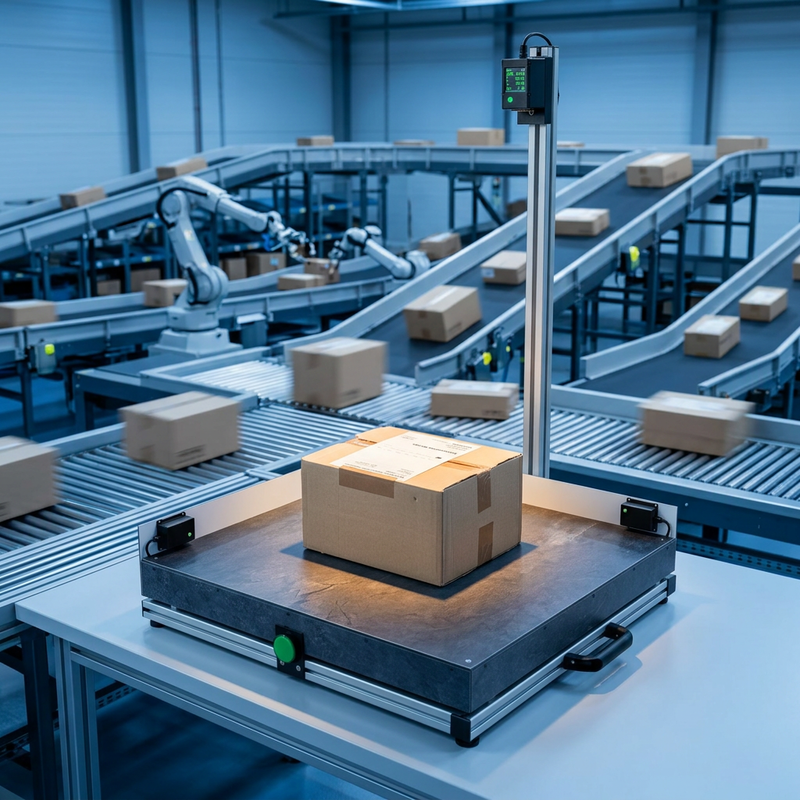
For CEP service providers and in hub structures, the ability to process a very large number of shipments without interrupting the workflow is paramount. Here, measurement must work in tandem with conveyor technology, sorting logic, and identification.
Dynamic systems with automatic dimensioning are the standard for this purpose. They process high cycle rates and deliver data in a timely manner for sorting, routing, and billing.
Key performance characteristics in this environment include read rates, availability, and stable operation even during peak periods.
Distribution Centers and E-Commerce Fulfillment

In distribution centers and e-commerce fulfillment, package measurement is primarily used to determine dimensions and weight directly at the shipping dock. This helps ensure accurate rate calculations and speeds up the process at the packing station.
At the same time, the measurement data provides valuable insights for packaging optimization. If certain items are regularly shipped in boxes that are too large, this can be quickly identified by analyzing the shipment dimensions.
Stationary measuring stations and volumetric scales are particularly common in these environments because they integrate well into manual or semi-automated shipping processes.
Distinction from Pallet Measurement
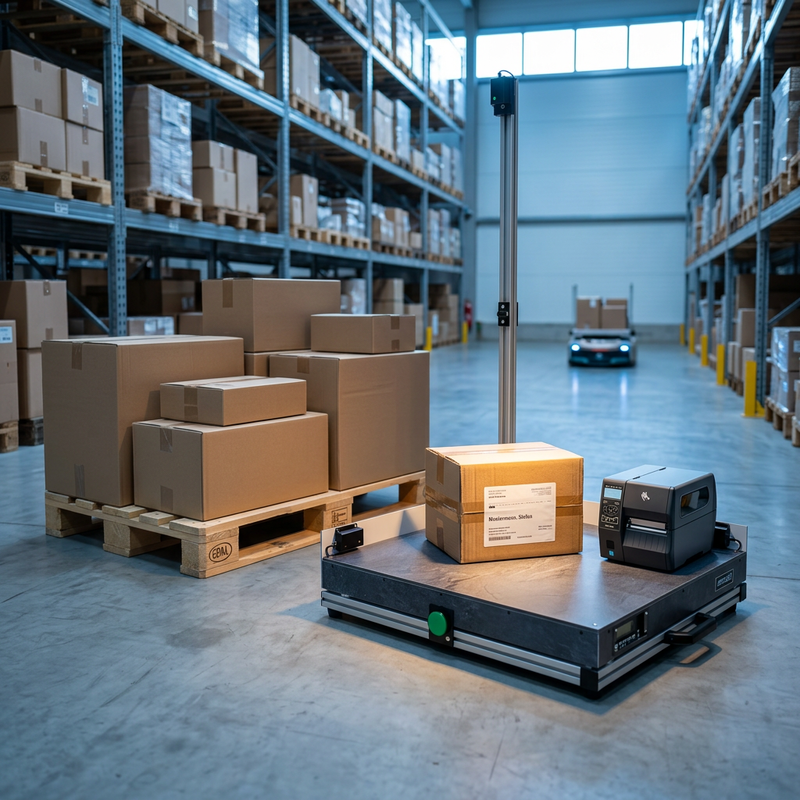
Traditional package measurement is designed for shipments in standard package sizes. When it comes to pallets, mesh boxes, or oversized loading units, the requirements for measurement range, load capacity, and sensor configuration change fundamentally.
Specialized pallet measurement systems are used for such applications. They employ different gantry or scanner designs and are engineered to handle significantly larger volumes and weights.
The distinction is therefore simple: when dealing with individual packages, soft packs, or standard shipping units, you remain within the realm of package measurement. For complete loading units, a different class of system is required.
Returns Management and Quality Control
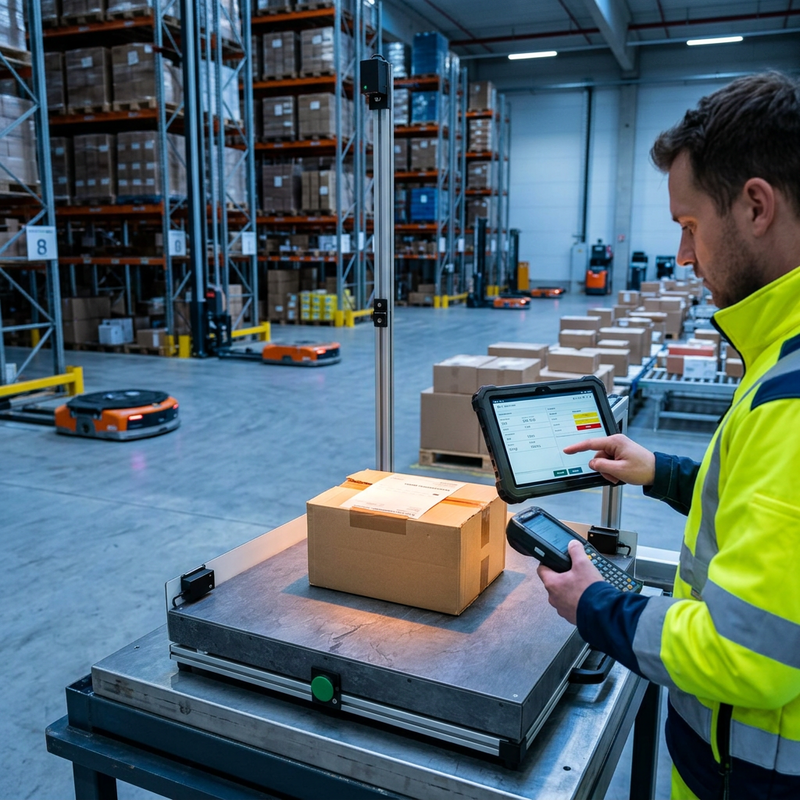
In returns management, package measurement is used not only for cost-related purposes but also for documentation and verification. The dimensions and weight of incoming shipments can be compared with previous shipping data, helping to identify anomalies more quickly.
Discrepancies may indicate missing items, damaged packaging, or incorrectly assigned returns. This is particularly useful when incoming packages need to be pre-sorted quickly or prioritized for more in-depth quality inspection.
In addition, the data can help verify existing item and packaging master data.
How Companies Choose the Right Volume Measurement System
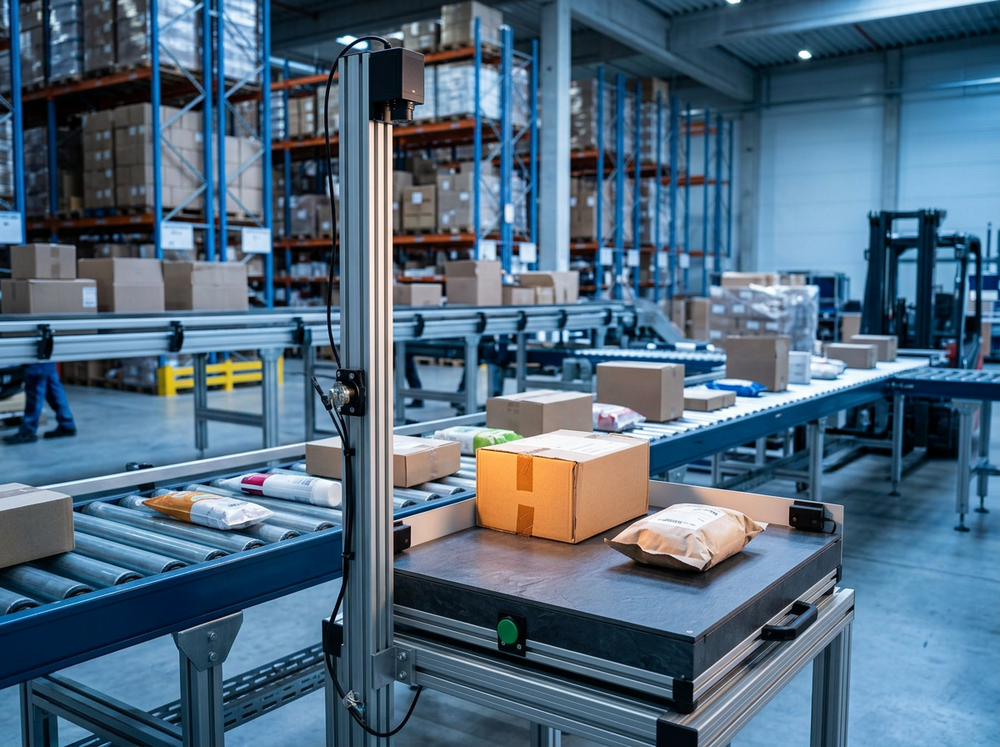
The best way to choose a volume measurement system is to follow these five steps:
- 1. Shipment volume: How many packages are processed per hour and per day?
- 2. Package mix: Are you dealing primarily with standard cartons, or also with soft packs, tubes, and irregularly shaped items?
- 3. Integration: Which systems need to be integrated—WMS, ERP, shipping software?
- 4. Space and environment: Is a stationary measuring station sufficient, or is conveyor technology available?
- 5. Budget and service: What investment is realistic, and how important are support, calibration, and scalability?
Following this sequence usually results in a solid shortlist. It’s not the theoretically best system that matters, but the solution that fits the actual process.
Questions to Consider Before Making a Purchase
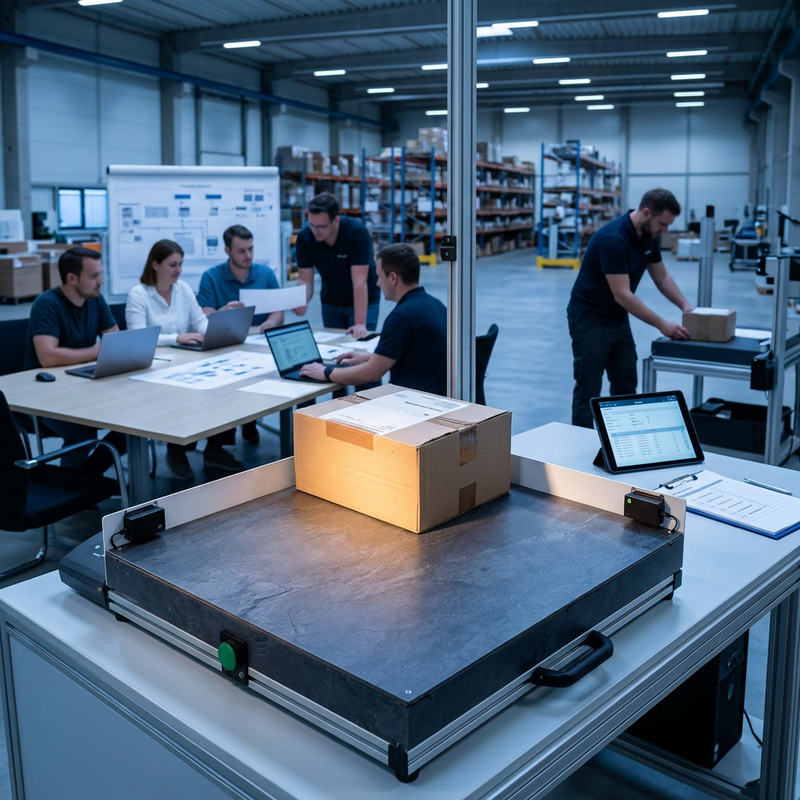
Before making a purchase, you should consider not only performance metrics but also the overall conditions for implementation. These include delivery time, installation, training, maintenance, support, and potential upgrades.
It is particularly important to consider how realistic integration into the existing IT infrastructure and processes is. A good measurement system is of little use if interfaces, installation space, or operating conditions have not been clearly defined.
It’s also a good idea to conduct a practical test using your own mix of products. Only then will it become clear whether the technology truly works under real-world conditions.
System Selection Checklist
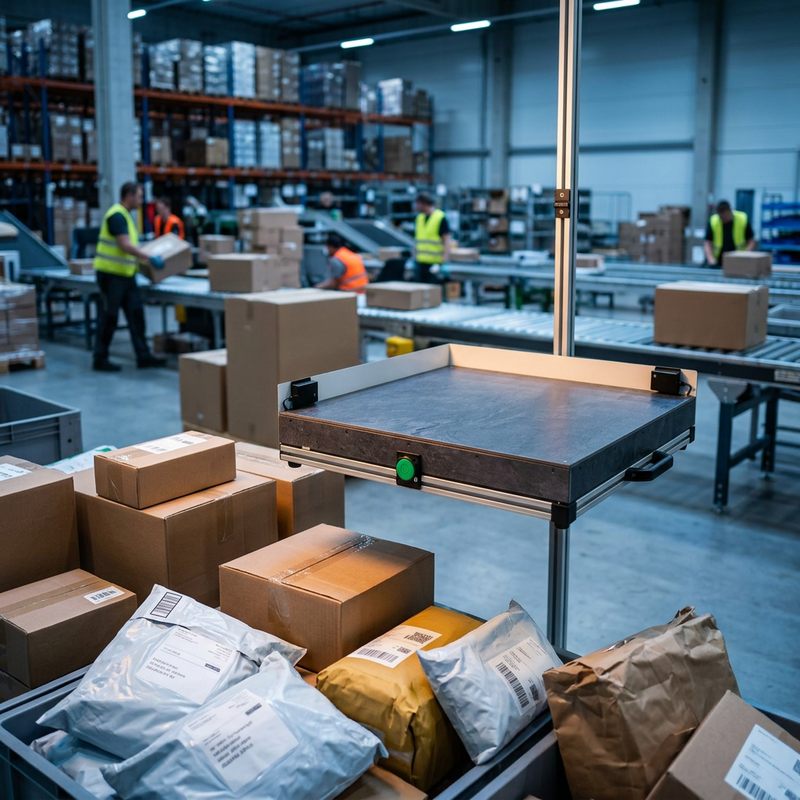
These questions can help you make a structured comparison:
- What are the smallest and largest shipments that need to be reliably tracked?
- What is the percentage of soft packs, poly bags, or irregular items?
- What throughput is required during peak times?
- How accurately must the system measure shipments for the carrier rates used?
- Which interfaces are technically preferred?
- How much space is available at the site?
- What are the service and calibration requirements?
The more clearly these points are answered before making a purchase, the easier it is to truly compare quotes.
Frequently Asked Questions About Package Measurement
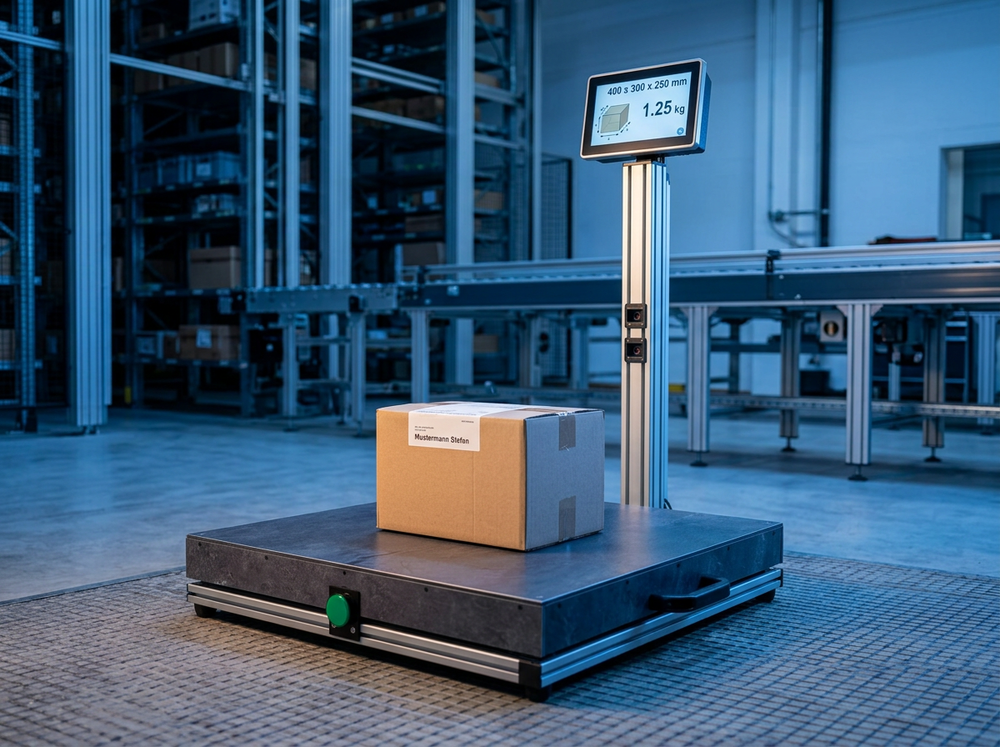
The most important practical questions about package measurement can be answered briefly:
How accurate is a volume measuring device? Depending on the technology, it’s usually within the millimeter range. What matters isn’t just the best reading, but how consistently the system measures under real-world conditions.
Can weight and dimensions be measured in a single step? Yes. Combined systems, such as a volumetric scale, are used precisely for this purpose.
Which systems are suitable for high throughput rates? Dynamic inline solutions on conveyor lines. They are designed for continuous shipment flows.
Can measurement data be transferred directly to the WMS? Generally yes, for example via CSV, REST, API, or a database connection.
Real-World Example: From Measurement to Shipping Label
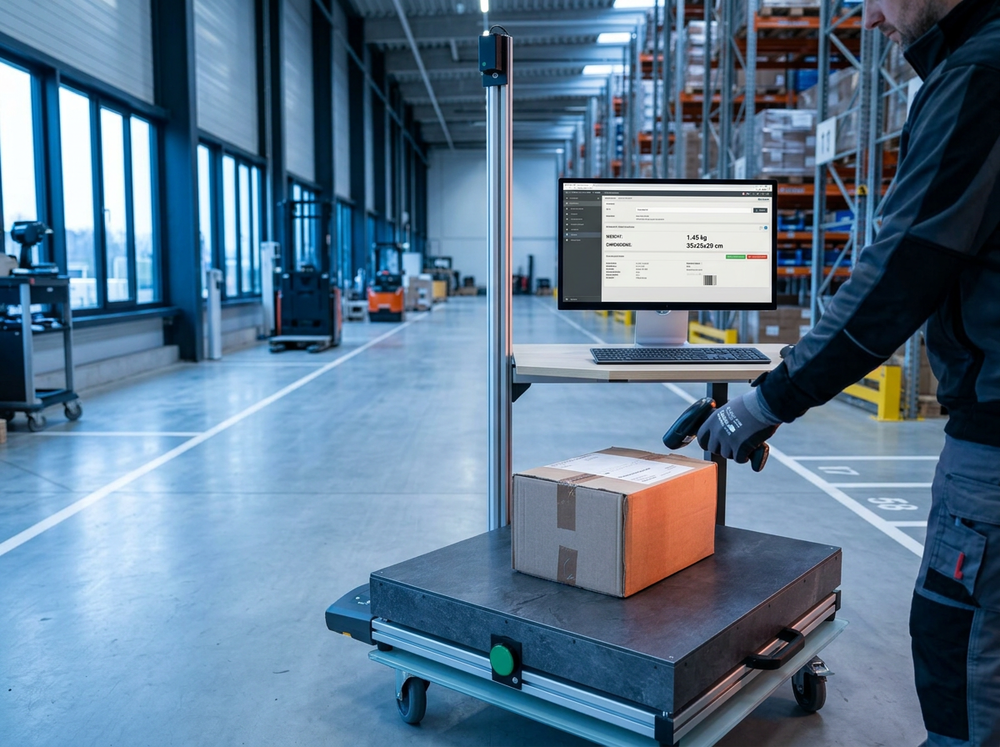
A typical process begins at the packing station: The fully packed package is placed on the measuring surface, the barcode is scanned, and the system records the dimensions and actual weight. The software then calculates the volume, volumetric weight, and the reference value used for billing.
This information is then sent to the WMS and shipping software. The WMS can verify reference values or update master data, while the shipping software applies rate logic and carrier rules.
In the final step, the shipping label is generated and printed directly. This turns a brief measurement process into an end-to-end shipping process with significantly fewer manual intermediate steps.
Is it possible to record weight and measurements in a single step?
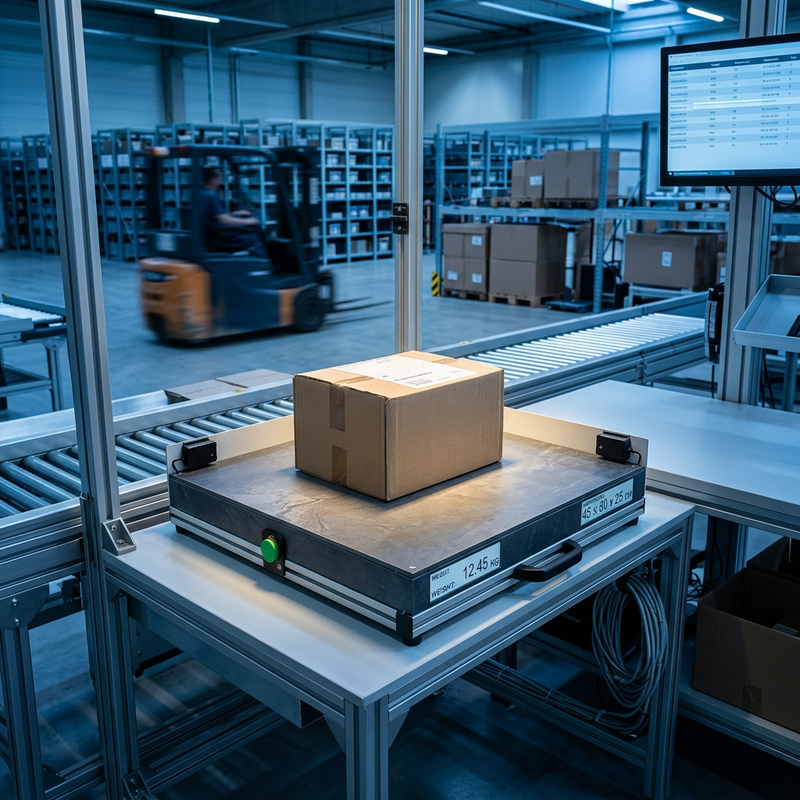
Yes. That's exactly what combined systems, such as a volumetric scale, are designed for. They measure weight and dimensions in a single step.
This saves time at the packing station and simplifies the further processing of the data in shipping software or warehouse management systems.
How exactly does a volumetric meter work?
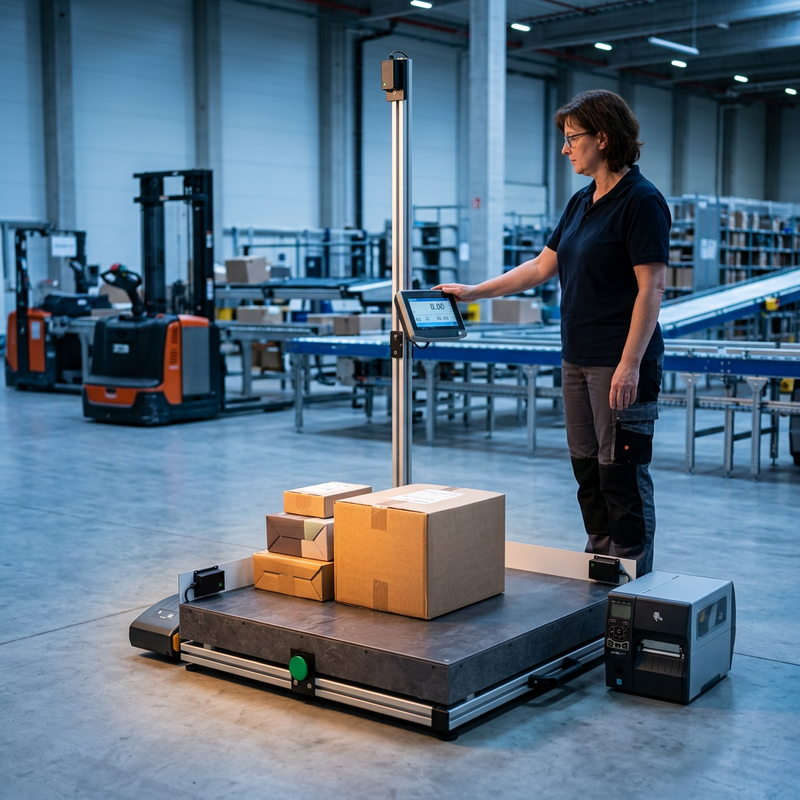
Depending on the technology used, a volume measuring device operates with a high degree of precision, often within a range of just a few millimeters. In practice, however, what matters most is how consistent the results remain when dealing with varying surfaces, lighting conditions, and package shapes.
Anyone evaluating systems should therefore not only compare data sheet specifications but also have measurements performed using their own shipments. Only then will the actual performance in everyday use become apparent.
Can measurement data be transferred directly to the WMS?
Yes, modern systems can generally be integrated directly with a WMS. Common interfaces include CSV, REST, API, and SQL.
Above all, it is important that the shipment is uniquely identified and that the field logic between the measurement system and the target software is properly aligned.
Which systems are suitable for high cycle rates?
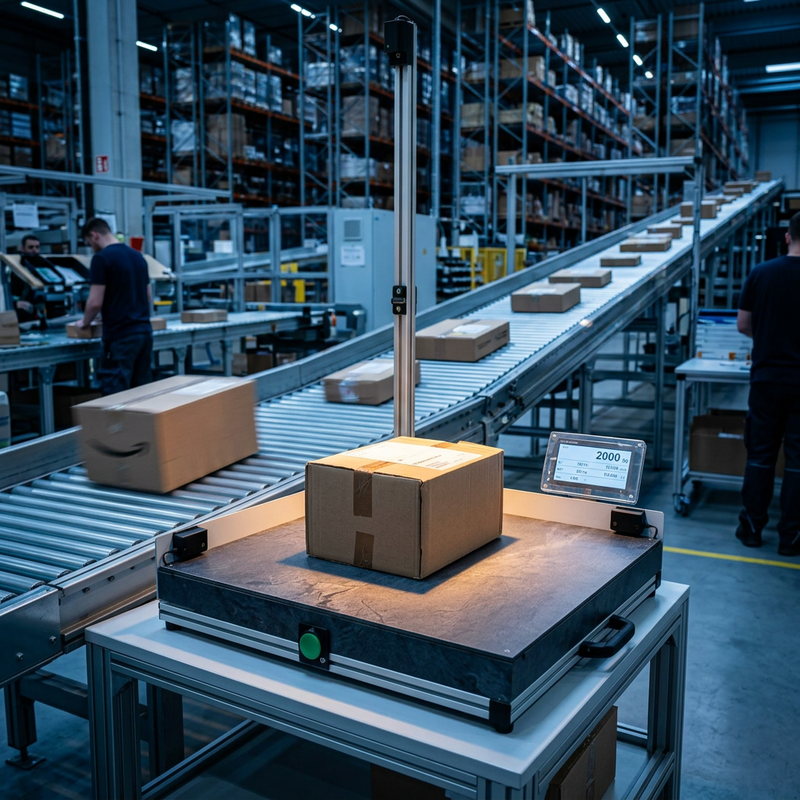
For high cycle rates, dynamic systems with automatic sizing are the right choice. They capture packages during the ongoing conveyor process and are designed for continuous material flow.
Stationary measuring stations remain a practical option when individual shipments are processed manually and the throughput is significantly lower.
Conclusion: Package Measurement as the Foundation for Efficient Shipping
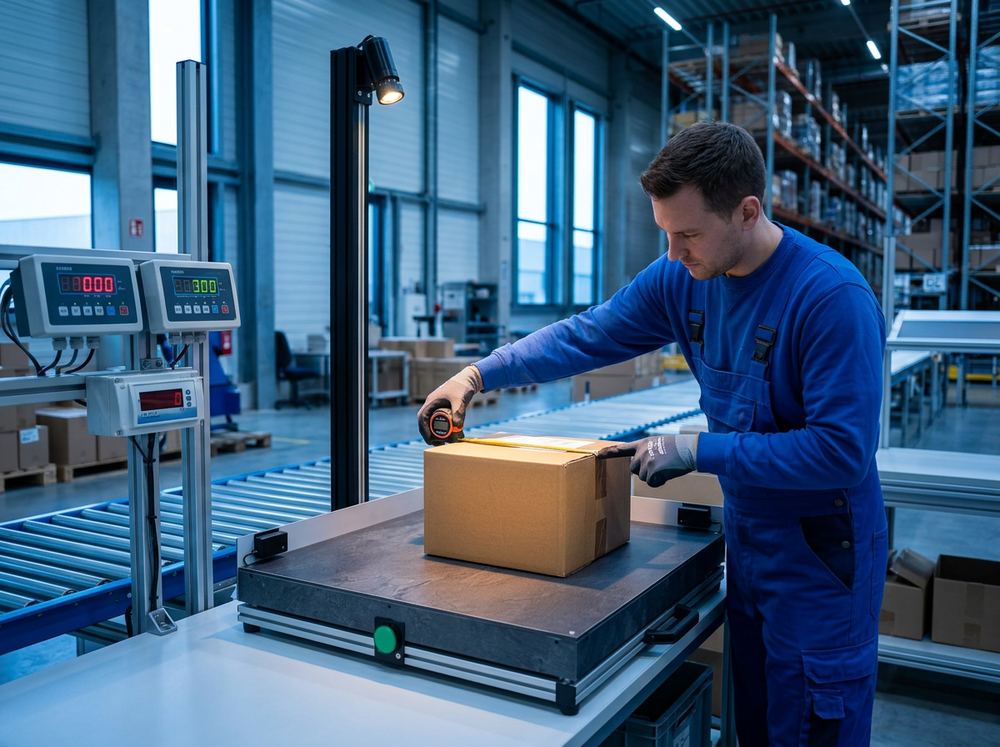
Package measurement provides the data foundation for accurate shipping costs, better packaging decisions, and stable outbound processes. Whether it’s a small shipping station or an automated hub, what matters most is that the dimensions and weight reliably align with your specific process.
A simple decision-making guideline is as follows: stationary systems for manual shipping workstations, 3D-oriented systems for mixed shipment types, and dynamic systems for high throughput on conveyor lines. For those who also want to consolidate weight and dimensions into a single system, a volumetric scale is an obvious starting point.
The next logical step is always to analyze your own parcel mix, shipment volume, and the necessary interfaces. Only then can you determine the right solution.
In which areas is package measurement used?
Applications range from fulfillment centers to express, courier, and parcel (ECP) service providers to returns management. In distribution centers, measurement systems enable automatic dimensioning during goods receipt, order picking, label printing, and shipping cost calculation. CEP service providers benefit from precise billing, improved load planning, and optimized sorting based on volumetric weight. In returns management, exact measurements help with recalculating costs, efficient returns processing, and the rapid re-use of undamaged packaging. The systems can be scaled as needed, from individual packing stations to complete cross-dock areas. Implementation promotes transparency, planning, and customer satisfaction. ([kom-tec.de](https://www.kom-tec.de/volumenwaagen-fur-pakete?utm_source=openai))
What are the benefits of package measurement?
Package measurement offers several advantages: greater billing accuracy through DIM weight; better utilization of cargo space, as volume is calculated more accurately; increased throughput through automatic measurement without manual measurement; improved data quality for WMS and shipping cost calculations; fewer calculation errors and rework; greater transparency in the supply chain; optimization of packing processes; easy scalability as shipment volumes increase; standardized measurements promote compliance; fewer returns. Overall, measurement increases efficiency, reduces operating costs, and boosts customer satisfaction. Additional benefits include improved returns management, location planning, better storage density, reduced material consumption, and a better environmental footprint. Companies can systematically monitor metrics such as turnaround time, error rates, deviations from target dimensions, and cost per shipment, and use this data to make strategic decisions. ([paketda.de](https://www.paketda.de/lexicon/index.ph
How do you integrate package measurement into the WMS? Integration with inventory management, barcodes, and label printing
Integration with the Warehouse Management System (WMS) is achieved through standardized interfaces and data exchange formats. Measurement data is typically transferred to the WMS as package data: dimensions, volume, weight, and shipment number. Barcodes and labels enable traceability and the automatic assignment of measurement values to individual shipments. APIs, EDI, or MQTT are often used for real-time data, along with event-driven messages that support throughput and scheduling logic. The data flow architecture includes an inbound scanner, a measurement station, a WMS adapter, and a label printer. Correct assignment reduces misrouted shipments, improves billing, and simplifies returns management. Clear documentation of the interfaces is crucial. Best practices include testing, versioning, error logging, and monitoring. ([mydhl.express.dhl](https://mydhl.express.dhl/content/dam/downloads/at/de/rate-guide/service_and_rate_guide_at_de_2026.pdf.coredownload.pdf?utm_sourc
How does a 3D volumetric scale work?
A 3D volumetric scale measures both the dimensions and weight of a package simultaneously. In practice, the system consists of a weighing bridge and one or more sensors. The package is moved into a defined zone; laser or ToF transmitters detect surface points, from which a three-dimensional geometry is calculated. Weighing takes place simultaneously. The software combines the data, calculates the length, width, height, and volume, and derives the DIM weight from these values. The process is optimized for high throughput rates and enables automatic routing to WMS or shipping processes without manual intervention. The measurement typically takes just a few seconds; calibration is required on a regular basis. ([bosche.eu](https://www.bosche.eu/media/46/59/cf/1740118957/Volumenwaage_3D_BA_de.pdf?utm_source=openai))
What types of surveying systems are there—examples?
There are several types of measurement systems: volumetric scales measure length, width, and height in addition to weight; 3D camera systems create volumetric models from images; ultrasonic systems use acoustic pulses to determine dimensions; combinations of these methods improve accuracy. Examples: integrated volumetric scales from logistics service providers, SIPI Parcelscan, UC2000-L2; 3D volumetric systems such as Parcelcube Vision or the BOSCHE 3D Silence volumetric scale. These systems vary in measurement principle, throughput, and level of integration. Applications range from shipping warehouses to CEP service providers. The choice depends on package shapes, material surfaces, and the desired level of automation. For initial projects, a phased expansion often makes sense, starting with basic equipment and later adding increased throughput, robust calibration, and integrated software. Interfaces should also be taken into account. ([kom-tec.de](https://www.kom-tec.de/volumenwaagen-fur-pakete?utm_source=open
What Is Volumetric Weight? Formula and Example
Volumetric weight, also known as DIM weight, is the theoretical weight of a package, calculated based on its volume and the carrier’s DIM divisor. Typical in Germany: DIM weight = (L × W × H) in centimeters divided by 5,000 kg per m³. Example: A package measuring 40 cm × 30 cm × 20 cm has a volume of 24,000 cm³; DIM weight = 24,000/5,000 = 4.8 kg. The higher value applies, even if the actual weight is 2 kg. Carriers use the higher value to calculate shipping costs. Differences exist depending on the carrier and region; check the current divisor for each service. Because rates can fluctuate, check delivery terms and rate information regularly over the long term. ([en.wikipedia.org](https://en.wikipedia.org/wiki/Dimensional_weight?utm_source=openai))
What is the difference between inline and offline measurement?
Inline measurement means that measurement takes place during the shipping process—for example, directly on the conveyor belt—while offline measurement occurs in the receiving or packaging area and usually involves a separate measuring station. Inline measurement offers higher throughput, reduces handling steps, and enables immediate price calculation. Offline measurement allows for more space, better calibration, fewer sources of interference, and often more thorough quality checks. In practice, both methods are often used: inline for quick basic data and offline for additional checks and fine-tuning. The choice depends on space, capital investment, maintenance costs, and the required precision. Additionally, the sensor technology influences the need for manual post-processing during operation. ([kom-tec.de](https://www.kom-tec.de/volumenwaagen-fur-pakete?utm_source=openai))
What is the difference between static and dynamic surveying?
Static measurement is performed manually or using a permanently installed system while the package is at rest or being positioned. Measurement data consists of individual dimensions, which are then entered into a system. Dynamic measurement, on the other hand, uses automated processes while packages move along conveyor belts or through inline systems. These solutions provide continuous measurement data, increase throughput, and reduce manual errors. Inline systems measure directly within the packaging flow, while offline systems operate outside the production process, often in the receiving area. The choice depends on the processes, required throughput, and warehouse layout. Dynamic, inline measurement is particularly well-suited for highly dynamic distribution centers with high shipment volumes. ([en.wikipedia.org](https://en.wikipedia.org/wiki/Dimensional_weight?utm_source=openai))
What measurement principles are used in package measurement?
Various measurement principles are used in package measurement: electronic sensors, optical detection, ultrasound, and 3D camera technologies. Ultrasound emits sound waves, measures echo times, and uses this data to calculate dimensions. Optical systems use cameras or time-of-flight (ToF) to directly reconstruct surface data and volume. 3D cameras provide dense point clouds or volume models; laser or LED lighting improves repeatability. Many systems combine multiple technologies to improve edge and profile measurements. The choice depends on package size, surface texture, and the desired throughput. Generally, the goal is to achieve robust, reproducible measurements within seconds. ([dimweigh.com](https://dimweigh.com/tools/calculator?utm_source=openai))
What Is Package Measurement? Definition and Why It's Important to Measure Length, Width, and Height
Package measurement refers to the systematic process of recording the dimensions—and often the weight—of a package. The goal is to obtain precise measurements from which volume, shipping weight, and costs can be calculated. Typically, measurement systems measure length, width, and height, and sometimes also thickness or key characteristics such as shape. The measured dimensions are used for shipping cost calculations, warehouse planning, and the optimal allocation of transport routes. Standardized measurements reduce stock shortages, returns, and manual rework. In modern logistics centers, this measurement is often automated—either inline at the packing station or at goods receipt—to increase throughput and accuracy. This forms the basis for fair billing and efficient optimization.
Future Trends in Package Measurement
Future trends in package measurement include edge computing, AI-powered quality control, and seamless robotics integration in receiving areas. Intelligent sensor technology combined with machine learning improves the detection of irregular shapes and surfaces, as well as throughput forecasting. 3D dimensioning is becoming more robust, faster, and more cost-effective, especially in high-volume centers. Companies are increasingly relying on open interfaces, APIs, and standardized data formats to make it easier to integrate dimensioning systems into WMS/ERP systems. Looming supply chain disruptions are driving investment in automation; payback analyses are becoming more realistic. Overall, accuracy, efficiency, and transparency are increasing, allowing for more accurate determination of shipping costs and better fulfillment of customer expectations. The industry expects fault tolerance and cost-benefit approaches. ([parcelcube.com](https://parcelcube.com/product/parcelcube-vision/?utm_source=openai))
How much time does it take to measure each package?
In practice, the measurement for each package often takes just a few seconds. Depending on the system type, throughput, and package size, the measurement time can range from 1 to 8 seconds; in highly automated lines, many systems achieve 2–4 seconds per unit. Inline stations minimize wait times, while offline stations sometimes have longer dwell times due to calibration or manual inspections. Modern systems use parallel sensors to perform measurement and weighing simultaneously. The total duration significantly determines portfolio throughput. For preliminary planning, it is recommended to consult manufacturer specifications, pilot tests, and process simulations. In addition, A/B tests and simulations enable better pricing planning and on-time delivery. ([paketwaage.com](https://www.paketwaage.com/en/landing-pages/volumetric-meter?utm_source=openai))
What is a volumetric scale, and how does it differ from traditional scales?
A volumetric scale measures not only weight but also the dimensions and volume of the package, often in combination with 3D or ultrasonic sensors. Unlike conventional scales, which measure weight alone, it also provides dimensions and the resulting DIM weight. Typically, the package is placed on a weighing surface; sensors measure length, width, height, volume, and watermarks. The data is fed directly into shipping or WMS systems. Volume scales improve cost control, as freight is often calculated based on volume. They require calibration, regular maintenance, and appropriate infrastructure to ensure throughput is not compromised. Proper placement and redundant sensors minimize disruptions. ([bosche.eu](https://www.bosche.eu/media/46/59/cf/1740118957/Volumenwaage_3D_BA_de.pdf?utm_source=openai))
What is the DIM factor (DHL, UPS, DPD)?
The DIM factor (Dimensional Weight) is the divisor used to convert the package volume into a weight equivalent. Carriers set different divisors, often 5,000 cm³/kg for European and many global services. DIM weight = volume in cm³ divided by the divisor. If the DIM weight is higher than the actual weight, the DIM value is charged. Examples: DHL, UPS, and DPD primarily use 5,000. In some cases, the divisor and thresholds vary depending on service class, zone, or weight. Always check the carrier’s documentation, as billing may depend on it. Correct application prevents over- or under-billing, minimizes follow-up inquiries, and enhances reliability. ([en.wikipedia.org](https://en.wikipedia.org/wiki/Dimensional_weight?utm_source=openai))
What does "Time-of-Flight" (ToF) mean in surveying?
Time-of-Flight (ToF) sensors use light pulses to reconstruct distances in three dimensions. In package measurement, ToF systems provide distance data that is converted into a point cloud or a volumetric model. Advantages include fast measurements, resistance to ambient light, and good performance on both smooth and irregular surfaces. Disadvantages may include sensor noise, limited resolution at close range, or the need for calibration. ToF is often used in conjunction with additional sensors or cameras to increase robustness. ToF modules support inline measurement, which enables high throughput and transmits final data to the WMS in real time. For developers, ToF provides clear, mass-market-compatible measurement data. Regular calibration is required. ([nti-measure.com](https://www.nti-measure.com/index.html?utm_source=openai))
Which providers/models are well-known? Examples.
Typical examples of manufacturers and products include volumetric systems such as SIPI Parcelscan, UC2000-L2, and Parcelcube Vision. Other options include BOSCHE’s 3D volumetric scales, such as the 3D Silence model, as well as combined package scales from Kom-Tec. Small businesses often use compact solutions such as package scales with integrated dimensioning. The choice depends on throughput, parcel variety, required accuracy, and IT integration. A good solution offers a clear API, robust calibration, reliable barcode integration, and support for label printing, so that measurement data can be fed directly into the WMS and shipping processes. Reference installations and real-world demonstrations help you make informed decisions. Compare costs. ([parcelcube.com](https://parcelcube.com/product/parcelcube-vision/?utm_source=openai))
What does the implementation process look like?
The implementation process begins with a needs analysis, the definition of objectives, an ROI estimate, and the selection of appropriate measurement solutions. This is often followed by a pilot phase in a section of the warehouse to test throughput, accuracy, and system compatibility. Based on the results, a vendor is selected, and interfaces, calibration plans, and data models are defined. This is followed by infrastructure and system integration, including WMS connectivity, barcode/label printing, and network and security configuration. Staff training, parallel testing, and a phased rollout minimize operational disruptions. The process concludes with the transition to regular operation, including monitoring, maintenance plans, and SLAs. After implementation, the focus shifts to audits and optimizations. ([kom-tec.de](https://www.kom-tec.de/volumenwaagen-fur-pakete?utm_source=openai))
What environmental factors affect measurement accuracy?
Measurement accuracy is affected by environmental conditions such as temperature, humidity, vibrations, and dust. The orientation of the package, its shape, material, and reflective surfaces also play a role. Calibration frequency, sensor placement, multiple measurements, and routine maintenance improve reliability. In cramped facilities, throughput and image/echo signal noise can degrade results; therefore, modern systems rely on redundant sensors, automatic error messages, and adaptive filtering. Best practice includes regular validation using reference samples and regular calibration in accordance with the manufacturer’s recommendations. Reliability is further enhanced through training, clear instructions, and a stable infrastructure. ([kom-tec.de](https://www.kom-tec.de/volumenwaagen-fur-pakete?utm_source=openai))
How Accurate Is Package Measurement? Measurement Accuracy, Boundary Conditions
Package measurement aims to produce reproducible readings, but accuracy depends heavily on boundary conditions. Typically, length measurements are reported in the range of a few millimeters to centimeters; volume and DIM weight depend on the divisor and the package shape. Factors such as irregular surfaces, package material, orientation, humidity, and calibration significantly influence measurement accuracy. Automated systems utilize calibration procedures, redundant sensors, and quality checks. In many cases, deviations are minimized through multiple measurements and reduced by software filters. In practice, this means: realistic expectations, regular maintenance, and clear service-level agreements with providers. The industry uses pragmatic target values. ([en.wikipedia.org](https://en.wikipedia.org/wiki/Dimensional_weight?utm_source=openai))
What data formats and interfaces does package measurement typically use?
Typically, measurement data is exchanged in standardized formats: dimensions, volume, weight, tracking number, and barcode information. Interfaces include REST/GraphQL APIs, EDI messages, MQTT, or OPC UA, depending on the system landscape. Barcodes enable the unique assignment of measurement values to shipments, while labels support printing processes on the package. Many systems provide raw data via JSON/XML, which can be used to establish stable integration processes. Effective integration requires clear data models, robust error messages, and monitoring. It is important that data be transmitted to the WMS in real time or near real time to optimize scheduling. Clean modeling reduces implementation risks. ([mydhl.express.dhl](https://mydhl.express.dhl/content/dam/downloads/at/de/rate-guide/service_and_rate_guide_at_de_2026.pdf.coredownload.pdf?utm_source=openai))