
A package scale is easy to purchase. Whether it is also approved for uses subject to calibration requirements in day-to-day business operations is another matter. That is precisely what a calibrated package scale is all about: not just technical accuracy, but the authorized use of measurement values in business processes.
For shipping companies, e-commerce retailers, and logistics departments, this issue becomes relevant whenever weights are used externally. If a package weight is used to calculate shipping charges, as a basis for weight-based sales, or for a check that determines whether a package is accepted, the rules of measurement and calibration law apply. Purely internal control weighings that are not related to billing must be distinguished from these.
This guide from PackageHERO® explains when a package scale must be calibrated, which deadlines must be met, what operators must do after commissioning, and how to identify a suitable scale when purchasing one. It also clearly explains the often-confused differences between legal metrology, calibration, and adjustment.
This allows you to reliably assess which scale is suitable for your shipping process—and where action is actually required.
Table of Contents
- What does “calibrated” mean when it comes to a package scale?
- When is a package scale subject to calibration?
- Legal Basis and Legal Consequences
- Verification, calibration, adjustment—the difference
- How to identify a calibrated or calibratable package scale
- Verification intervals and re-verification in practice
- Obligations of the operator of a calibrated package scale
- What Companies Should Consider When Purchasing a Calibratable Package Scale
- Conclusion: When a Calibrated Package Scale Is Required
- FAQ
What does “calibrated” mean when it comes to a package scale?

In the day-to-day operation of a package scale, “calibrated” does not simply mean “measures accurately,” but rather: The scale may be used for a purpose subject to calibration if all legal and metrological requirements are met simultaneously.
For new devices, this status does not begin with a traditional initial calibration, but with the EU conformity marking. Instead of an initial calibration, new scales are marked with the CE mark, a black “M” inside a rectangle along with the year, and the number of the notified body. For companies, it is therefore crucial to understand what this specifically implies: A scale is only permitted for uses subject to legal metrological requirements if the marking, the current validity period, the permitted range of use, and the intact condition of the device all align.
This also makes clear what is not sufficient: A technically high-quality scale or one that operates accurately internally does not, by itself, become a calibrated parcel scale. If the required marking is missing, the validity period has expired, weighing is performed below the minimum load, or unauthorized tampering with secured areas has occurred, the device must not be used for its regulated purpose.
Legal Implications in Day-to-Day Shipping Operations

When shipping, therefore, the entire scope of application must always be taken into account. It is not just the measurement result that matters, but also whether the specific device is approved for this process at the specific location and within the specific load range.
Conformity Assessment Instead of Initial Calibration for New Scales

New parcel scales intended for regulated use are placed on the market following a conformity assessment. Operators should therefore not look for an “initial calibration” upon receipt of the equipment, but rather verify that the required metrology marking is present on the device and that the other obligations following commissioning are being met.
When is a package scale subject to calibration?

The applicable rule is: A scale is subject to calibration as soon as its measurement serves as the basis for billing third parties. This also includes weighings whose results are contractually relevant, such as when acceptance of a delivery depends on them. Purely internal control weighings that are not related to billing are not subject to calibration.
For day-to-day operations, a simple test can help: If the measurement value remains exclusively within the company, there is usually no calibration requirement. If it is provided to carriers, customers, suppliers, or other business partners and is relevant there for pricing, billing, or decision-making, then a weighing point subject to calibration exists.
Key Considerations for Acceptance Decisions

Checkweighing is not automatically considered an internal process. If it is used to decide whether to accept or reject a shipment, the measured value is legally relevant and therefore subject to calibration.
Practical example: In the receiving department, a check is performed to determine whether a delivery matches the ordered quantity. If the weighing result leads to the delivery being accepted, rejected, or returned, this process must be carried out using a legally verified scale.
Purely internal control weigh-ins with no connection to billing

There is no calibration requirement for purely internal control weighings, as long as the measured value is not used in billing third parties and does not trigger any contractual decisions involving external parties.
Practical example: A warehouse team conducts random checks to verify whether packages are filled appropriately or whether weight deviations indicate picking errors. As long as these measurements are used solely for internal process control, a calibrated scale is not required.
Shipping Fees and Postage Based on Weight

The most common scenario in shipping is the calculation of shipping fees or postage based on weight. If a company records the package weight and this value determines the rate tier or the billing amount charged by a shipping carrier, a calibrated package scale is required.
Real-world example: An online retailer weighs each package at the packing station and transmits the weight to the carrier. Because this value affects shipping costs, the weighing station is subject to calibration requirements.
Sale by Weight

A calibrated scale is also required when selling by weight. In this case, the measurement result directly determines the price a customer or business partner pays.
Practical example: A company sells goods not by the piece, but by the kilogram. As soon as the measured weight determines the invoice amount, the company may not use a scale that is merely for internal use or is only calibrated.
Legal Basis and Legal Consequences

The legal basis is the Measurement and Calibration Act (MessEG) and the Measurement and Calibration Ordinance (MessEV). They specify when a scale is subject to calibration in commercial transactions and what requirements apply to its operation.
Important for businesses: Using a scale that is not legally verified in commercial transactions constitutes an administrative offense. This applies in particular to weighings used to determine shipping charges, sales by weight, or business transactions where the weight is a determining factor for acceptance.
The MessEG and MessEV as the Operational Basis

The MessEG and MessEV give rise to four main areas of inspection in everyday practice: permissible intended use, correct labeling of the device, compliance with the calibration period, and proper use within the approved measurement range.
Administrative Offense for Use Without Calibration

A violation occurs when a company uses a scale without valid legal status for a business transaction subject to calibration requirements. During an inspection, it must be verifiable that the device, its labeling, the calibration period, and its use are appropriate for the specific application.
Verification, Calibration, Adjustment—The Difference

These three terms are often confused in day-to-day operations, but they refer to different things. For companies with weighing processes subject to legal metrology requirements, this distinction is important because only a calibration—or a calibration that is currently valid —allows for legal use in commercial transactions.
Calibration is a documented comparison of measurements. Even a DAkkS calibration has no legal effect under measurement and calibration law. It is useful for quality management and test equipment monitoring, but it does not replace verification.
An adjustment is the technical setting of the scale to correct deviations. It, too, does not establish legal metrological validity and does not extend the verification period. In short: Calibration and adjustment can be useful, but they are no substitute for a verified scale when its use is subject to verification requirements.
Calibration: Legally Valid for Commercial Transactions

Calibration refers to the legally binding status for regulated applications. A weight value may only be used for billing purposes if it is accompanied by a valid calibration or a valid conformity mark within the current validity period.
Calibration: documented measurement comparison with no legal effect

Calibration involves checking how much a scale’s reading deviates from a reference value. The result is documented and is particularly useful for internal quality control systems.
The line is clear: Even a very well-calibrated scale must not be used for weighings subject to legal metrology requirements if it lacks legal validity.
Calibration: technical adjustment of the scale

An adjustment changes the device’s settings so that the display functions correctly again. This is a technical procedure and does not constitute official legal verification.
For scales used in regulated applications, no unauthorized interventions may be made to secured metrological areas.
How to Identify a Calibrated or Calibratable Parcel Scale

For purchasing, receiving, and operations, it’s worth following a straightforward three-step process: first, check the device’s labeling; second, read the measurement data; third, compare it with the actual process. This allows you to quickly determine whether a scale is actually suitable for its intended use or is merely described in general terms as “calibratable.”
“Calibratable” initially means only that the model can, in principle, be designed for the regulated range. Whether the specific weighing station may be operated with it is determined solely by the complete labeling and the technical limits of the individual scale.
EU Conformity Marking: CE + black M + year
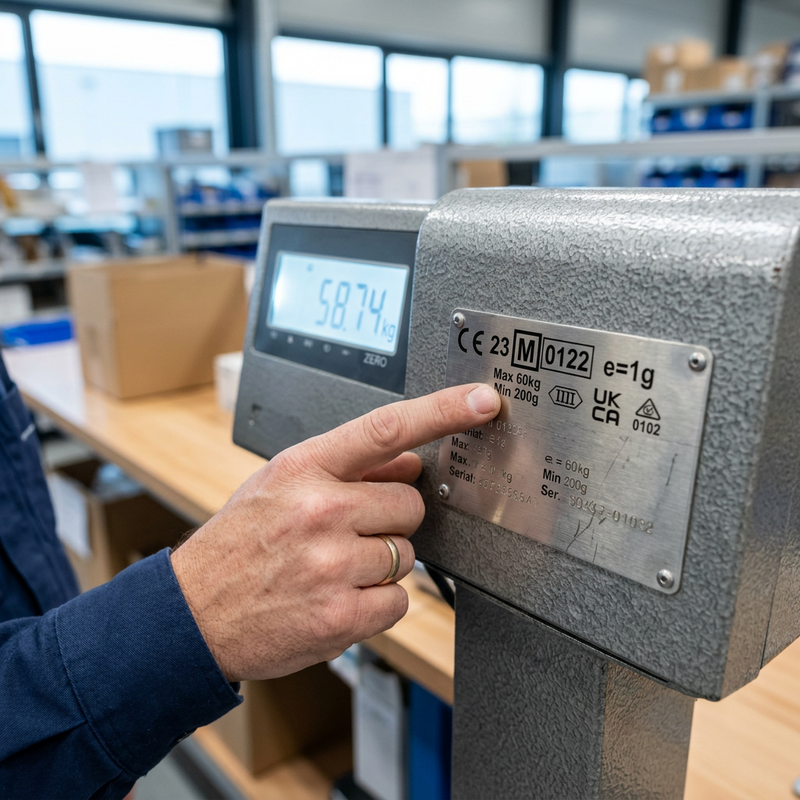
For new scales, the metrology markings must be fully present on the device itself: the CE mark, a black “M” with the year inside a rectangle, and the number of the notified body. If any of these elements is missing, this is grounds for exclusion from use subject to calibration.
Important for procurement and goods receipt: Product titles, data sheets, or marketing claims such as “calibrated” or “calibratable” do not substitute for a missing marking on the device.
Notified Body Number

The notified body's number does not belong in a side note, but rather in the marking checklist. Together with the CE mark, the "M" marking, and the year, it confirms that the scale has undergone the required conformity assessment.
Accuracy Class III and Minimum Load

Retail and parcel scales fall under accuracy class III. In addition, operators must pay attention to Max, Min, the calibration value e, and the minimum load. The minimum load, in particular, is often overlooked in everyday use: Measurement results below this value may not be used for calibration purposes.
In practice, this means that the lightest shipment that occurs regularly must exceed the minimum load, and the heaviest must fall within the “Max” range. Only then will the scale be suitable not only formally but also for the actual mix of shipments.
Calibration Intervals and Recalibration in Practice

For companies, the key factor is the strict deadline structure: 2 years for industrial scales with a maximum load of less than 3 t and 3 years for industrial scales with a maximum load of 3 t or more. For parcel scales, the two-year period generally applies.
In addition, the following applies to the calculation of time limits: Time limits of one year or more run until the end of the calendar year. In practice, this means that one should not rely on an arbitrary maintenance date, but rather on precise time limit management based on the calibration mark and service life.
Re-calibration is performed by the state calibration authorities (calibration offices). The application should be submitted well in advance of the deadline so that lead time, potential downtime, and a replacement process can be planned.
If the calibration period has expired, the scale may no longer be used in a business subject to calibration requirements. In that case, the weighing station in question must be taken out of service or switched to another valid device.
1 year for automatic or dynamic checkweighers

According to the knowledge base, the documented period is 2 years for industrial scales under 3 metric tons and 3 years for industrial scales of 3 metric tons or more. For this guide to package scales, it is therefore crucial to correctly classify the scale in use and to assign the verifiably applicable period to the specific device type.
Expiration of the Deadline and Request for Re-calibration

The calendar-year logic is often misunderstood: For calibration periods of one year or longer, the calibration validity does not expire according to an arbitrarily chosen internal schedule, but rather according to the statutory deadline logic at the end of the relevant calendar year. Nevertheless, the application for re-calibration should not be initiated only shortly before the end of the year.
The cost of calibrating or re-calibrating a scale depends on the type of scale, the state, and the time and downtime involved, and cannot be quantified as a flat rate.
2 years for static scales under 3 metric tons

This is typically the case for standard package scales at the packing station. Since these devices are often found in multiple locations within shipping and fulfillment, it’s worth maintaining a central schedule overview that includes the year of manufacture, location, and person in charge.
3 years for static scales with a capacity of 3 metric tons or more

The three-year deadline applies primarily to heavy-duty platform scales used in receiving areas or industrial logistics operations. These devices, in particular, are easily overlooked from an organizational standpoint, even though they may also generate measurement values subject to calibration requirements under the German Measurement Act (MessEG) and the German Measurement Ordinance (MessEV).
Obligations of the Operator of a Calibrated Parcel Scale

Simply purchasing the equipment is not enough. Operators must manage the weighing station properly from an organizational standpoint: submit user reports on time, operate only within the permitted measurement range, keep markings and safety devices intact, and maintain organized records.
The initial steps following commissioning are particularly important: New scales subject to calibration must be registered with the relevant state authority via eichamt.de within 6 weeks. This requirement is set forth in Section 32 of the Measurement Act (MessEG).
User notification within 6 weeks

According to Section 32 of the German Weighing Instruments Act (MessEG), new scales subject to calibration must be reported within 6 weeks of being put into service. The user notification is submitted via eichamt.de.
The actual date of commissioning is decisive, not the order or delivery date.
Observe the measurement range and minimum load

A calibrated scale may only be used within its approved range. The minimum load is particularly critical: Measurement results below this value may not be used for regulated transactions.
Anyone who changes their shipping mix should therefore regularly check whether lighter shipments still fall within the scale’s permissible range.
Ensure Proper Labeling, Documentation, and Calibration Validity

Markings on the device must remain legible, seals must not be damaged, and tampering with protected metrological areas is prohibited. In addition, scales must be installed, used, and maintained in a manner that ensures measurement accuracy and reliable readings. This is part of the operator’s obligations under Section 23 of the Measurement Ordinance (MessEV) and applies regardless of whether the scale is used at the packing station, in the receiving area, or within a production facility.
It is advisable to maintain an organized equipment file containing identification, location, user records, and documentation of re-calibration. This allows the status to be quickly verified during internal audits or regulatory inspections.
What Companies Should Consider When Purchasing a Calibratable Package Scale

When making a purchase, the product name is less important than the technical compatibility with the intended weighing point. For procurement purposes, the selection process should therefore follow a specific order: scale type, accuracy class, measurement range, calibration value e, minimum load, and only then factors such as design or interfaces.
The first fundamental question is: static or dynamic? A manual package scale at the packing station is a static weighing point. In conveyor or sorting systems, automatic or dynamic checkweighers are used, which must be classified differently and operated differently from an organizational standpoint.
For traditional commercial and parcel scales, accuracy class III applies. Next comes the calibration of the measurement data against the actual shipment mix: the minimum and minimum load must match the lightest regular shipment, the maximum must match the heaviest, and the calibration value e must be selected so that the resolution aligns with the process and the tariff weight tiers.
- Class III: The relevant standard for commercial and parcel scales in regulated use.
- Minimum load: The lightest shipment weighed on a regular basis must exceed this value.
- Min and Max: The scale’s actual operating range must cover the lower and upper load ranges of daily shipping operations.
- Calibration factor e: Determines the calibration-relevant division; it should be neither unnecessarily coarse nor inappropriate for the process.
- Static or dynamic: Manual weighing at the workstation must be evaluated differently than automated weighing in a continuous process.
Only once these core parameters are met is it worth considering ergonomics and integration. Digital package scales are often suitable for individual workstations. If weighing is to be integrated directly into the packaging process, a packing table with a scale may be a practical solution.
If, in shipping, not only weights but also dimensions determine the rate calculation, the solution should be considered as a complete system. In that case, volumetric weight, accurate package measurements, and the girth become relevant. For DWS processes, a calibratable volume measurement device or a calibratable volume scanner may be a more suitable choice than a single scale.
Select the design and integration into the shipping process

In addition to metrological data, the scale must also be ergonomically and technically suited to the workstation. Tabletop or compact scales are often suitable for manual packing stations, while platform solutions are better suited for bulky shipments.
Other important factors include display readability, data transmission, footprint, and integration with shipping software. This transforms a measuring device into a reliable process component.
Consider calibratable volume measurement as an extension

If shipping rates are based not only on weight but also on dimensions, the procurement process should be viewed as a comprehensive system. This involves the interplay of weighing, measuring, and data collection.
For DWS processes, a calibratable volume scanner or a combined solution may be more practical than a standalone scale. Especially when it comes to dimension and weight regulations relevant to package delivery services, it is therefore worth looking beyond the individual weighing station.
Clearly define the intended use before making a purchase

The starting point is not the model, but the intended use. Only once it is clear which weighing points are actually regulated and which operate only internally can the correct device category be selected.
This is especially worth considering when there are multiple workstations. This allows companies to equip mandatory stations specifically, rather than purchasing the same equipment for all stations across the board.
Check accuracy class III, calibration value e, and minimum load

For a standard package scale, accuracy class III, calibration value e, and minimum load are the most important purchasing criteria. They determine the range within which the scale can be used both practically and in compliance with calibration regulations.
A suitable device not only handles peak loads but, above all, the lower end of the everyday weight range. Anyone who ships many light packages should therefore first check whether these weights are well above the minimum load.
Conclusion: When a Calibrated Package Scale Is Required

A brief decision matrix is usually sufficient for operational classification:
- Packing station with weight-based carrier rate: Yes, subject to calibration. First, check: appropriate labeling on the device and appropriate load range for actual shipments.
- Sale of goods by kilogram: Yes, subject to calibration. Check first: Class III, as well as the appropriate calibration value and permissible range of use.
- Goods receipt with acceptance or rejection based on weighing results: Yes, subject to calibration. First check: whether the inspection point is operated with a scale intended for this purpose.
- Internal plausibility checks with no external impact: No, not subject to calibration. First, check: whether a calibrated process scale is sufficient for internal purposes.
This makes the selection process much easier: Not every package scale requires legal metrological validity, but every weighing point relevant to billing or decision-making requires the correct technical and organizational setup. PackageHERO® helps you choose the right solution between a single scale, a packing station solution, and a DWS system.
How can you tell if a new, calibrated package scale has a CE mark, a black "M," and an identification number?
You can identify a new, calibrated package scale by the EU conformity marking on the nameplate: CE, next to it the black “M” in a rectangle and the two-digit year of the marking, as well as the four-digit identification number of the notified body. For new scales, this combination indicates the legally required conformity assessment, which has generally replaced the former initial calibration since 2015. Important: The marking must be part of the scale and legible. Additionally, the scale should be designated as suitable for use subject to calibration, typically with Accuracy Class III as well as specifications for maximum load and minimum load.
Why doesn't a DAkkS calibration replace verification for a package scale subject to verification requirements?
A DAkkS calibration does not replace legal metrological verification because it only documents the measurement deviation but does not provide legal metrological approval for commercial use. For a package scale subject to legal metrological verification, measurement and verification regulations require a verified or conformity-assessed measuring instrument. Calibration therefore verifies accuracy but does not confirm legal suitability for weighings relevant to billing. Even a DAkkS certificate does not turn an uncalibrated scale into a calibrated one. In practice, this means: Calibration can be useful for internal quality or process controls, but for applications subject to legal metrology requirements, you also need valid legal metrology certification or a legally recognized conformity mark.
When is a checkweighing considered decisive for acceptance and therefore subject to calibration?
A verification weighing is decisive for acceptance if its result directly triggers a decision with external implications. This is the case when the weight determines whether a shipment is accepted, rejected, paid for, subject to a subsequent charge, or rejected due to a defect. Unlike a mere internal check, this is no longer just a matter of guidance, but rather a binding basis for action toward a third party. Typical examples include weight discrepancies in incoming goods or returns, which give rise to complaints or reimbursement issues. Whether the weighing is specifically called a “checkweighing” is irrelevant. The only determining factor is whether the result supports a business- or legally-relevant decision.
Why does using an uncalibrated package scale in business transactions pose a legal risk?
Using an uncalibrated package scale in business transactions is risky if its measurement results are used for legal or business-related purposes. In such cases, the measurement value lacks the necessary legal validity. This can not only trigger objections during inspections but also have practical consequences: invoices become vulnerable to challenge, complaints are harder to resolve, and the ability to provide evidence in the event of a dispute is compromised. Added to this are financial risks resulting from systematic over- or under-billing. Particularly in the shipping sector, where weights are often directly incorporated into downstream processes, non-compliant weighing can quickly impact customer relationships, billing accuracy, and the reliability of internal processes.
Is a package scale subject to calibration if it is used only for internal control weighings that are not related to billing?
No. A package scale is generally not subject to calibration requirements for purely internal control weighings. The key factor is that the result is used exclusively for internal control purposes—such as plausibility checks, warehouse processes, or preliminary checks—and has no external impact. However, as soon as the measured weight is used to calculate prices, determine shipping costs, bill for services, or make decisions regarding acceptance or rejection of goods in dealings with third parties, the legal classification changes. For companies, therefore, a clear organizational separation is particularly important: internal use on one hand, legally relevant use on the other. Even if calibration is not required, the scale should operate reliably from a technical standpoint to avoid process errors.
When is a package scale required to be calibrated if shipping charges or postage are calculated based on weight?
A package scale is subject to calibration requirements as soon as its weighing results form the basis for calculating shipping fees, freight charges, or postage owed to third parties. The decisive factor, therefore, is not commercial use alone, but rather its use for billing purposes in business transactions. A typical example: You weigh a package and use that weight to calculate the price for the customer or to settle an invoice with a shipping service provider. In that case, the scale must be used in compliance with calibration regulations. The legal basis for this is the Measurement Act (MessEG) and the Measurement Ordinance (MessEV). If, on the other hand, the weight is recorded only internally and has no impact on prices or fees, there is no calibration requirement for this purpose.
What does “calibrated” mean for a package scale in PackageHERO®’s day-to-day commercial shipping operations?
In the context of a package scale, “calibrated” means that it is approved for legally regulated use in commercial transactions and has been tested to ensure it falls within its permissible error limits. In the day-to-day shipping operations at PackageHERO®, this means: The scale may be used for weight-related, legally binding transactions if its labeling and calibration status are correct. For new devices, this is typically ensured through the conformity assessment; this can be identified by the corresponding marking on the device. Important: “Verified” is not the same as merely “calibrated” or “adjusted.” For businesses, “verified” is therefore primarily a legal and safety issue: reliable measurement results, traceable processes, and accurate weight data in commercial use.
What should companies look for when purchasing a calibratable parcel scale for shipping, packing stations, or DWS processes?
When purchasing a calibratable parcel scale, companies should first clearly define the specific application: Whether it’s for shipping billing, a packing station requiring legally compliant weight measurements, or integration into DWS processes, the scale must be precisely suited for that purpose. Therefore, the most important factors are a design suited to the actual shipments and stable integration into software, workstations, or conveyor systems. Equally important are clear device documentation, practical service, and the ability to continue operating the scale during routine operations without significant effort and to have it verified on schedule. A sound purchasing decision is therefore based not only on the measuring device itself, but on the entire process in which it is used.
Why is the minimum load capacity of a calibrated parcel scale so important in daily operation?
The minimum load is so important in daily operation because it marks the lower limit of the permissible operating range. If an item being weighed is below this limit, a value may still be displayed, but it is not reliable enough for legal purposes. Especially with very light shipments, bags, or small parts, this can easily give the impression of an accurate measurement, even though the scale is operating outside its suitable range. For companies, this has direct consequences for process reliability: incorrect weight specifications, unnecessary rework, and error-prone processes. Therefore, the scale should be selected so that its usable range matches the typical composition of the actual shipments being weighed.
What does accuracy class III mean for retail and package scales?
Accuracy Class III is the typical commercial class for non-automatic scales and, therefore, also for many package scales used in commercial settings. In practice, this means that the scale is designed for standard business weighing tasks where weight values must be recorded reliably and traceably. The class describes a legally defined accuracy framework, not an arbitrarily fine display resolution. Whether a scale is suitable for a specific application therefore always depends on how it is designed for the actual shipments. Companies should view Class III as a suitable standard for commercial applications, but should always assess its suitability in the context of the intended process and load range.
When and how must the user notification be submitted for a new parcel scale subject to calibration?
The user notification must be submitted within six weeks of putting a new parcel scale subject to calibration into service. The decisive factor, therefore, is the date on which the scale is actually put into use in a context subject to calibration. The competent authority is the calibration authority or the state calibration office in the location where the scale is used. In practice, the notification is often submitted digitally via the respective government portal. Companies should provide complete information on the essential device data and the location of use, and document the submission internally. This requirement is important from an organizational standpoint because it makes proper operation verifiable to the supervisory authority and helps avoid unnecessary follow-up inquiries during subsequent inspections.
How does the re-calibration of a package scale by state calibration authorities work in practice?
In practice, the operator submits an application for re-calibration to the competent state calibration authority or calibration office well in advance of the deadline. An appointment is then scheduled for the inspection—either on-site or at a testing facility, depending on the state. The scale must be in working order, clean, and accessible; suitable test weights or a load-bearing test environment are often required. The inspection covers the scale’s condition, markings, metrological properties, and compliance with permissible error limits. If the package scale passes the inspection, it is re-marked and may continue to be used. If defects are found, it must be repaired and resubmitted for inspection; until then, it may not be used in applications subject to calibration requirements.
If the calibration period for package scales is one year or longer, how long does it last?
For parcel scales with a calibration period of at least one year, the period does not end on a specific day in the middle of the current operating year, but generally only at the end of the calendar year in question. This simplifies matters in practice because companies can better plan their recalibrations from an organizational standpoint. What matters is when the period expires according to the calendar; if this date falls within a specific year, the scale may generally still be used until December 31 of that year. It is therefore important for operators not only to estimate deadlines based on months but also to keep track of the calendar-year expiration dates. This helps prevent downtime, scheduling issues, and unnecessary interruptions in the shipping process.
What is the calibration interval for scales with a capacity of 3 metric tons or more and for automatic checkweighers in sorting systems?
For scales with a maximum capacity of 3 metric tons or more, a calibration period of 3 years generally applies. This applies in particular to industrial scales and truck scales in this load range. For automatic checkweighers, such as those used in sorting systems, however, the general calibration period of 2 years generally applies, unless a specific exception applies. The legal basis for this is Section 34 of the Measurement Ordinance (MessEV). Important for practical application: For calibration periods of one year or longer, the period ends at the close of the calendar year. Older scales with type approvals issued on or before December 31, 2014, may be subject to different periods in individual cases.
What does the EU conformity marking on new parcel scales mean in place of an initial calibration?
The EU conformity marking on new parcel scales indicates that the legally required conformity assessment has been successfully completed and that the device meets calibration requirements when placed on the market. For operators, this means above all that the scale is not only usable after a subsequent initial calibration, but is already brought to market with the required legal certification. In everyday use, it is important to understand the marking as part of the device’s documentation and identity and to keep it legible. However, the one-time marking is not sufficient for long-term operation; the scale must subsequently be re-inspected within the prescribed timeframe if it is to continue to be used in a manner subject to legal metrological requirements.