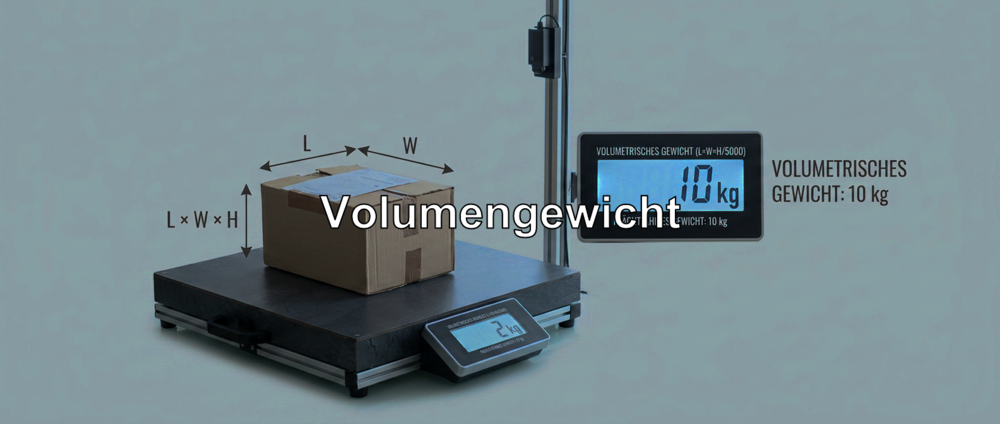
A package weighs only 2 kg on the scale, but 10 kg appear on the invoice. The reason is not a measurement error, but the amount of cargo space it occupies. That is exactly what volumetric weight is for.
In shipping, it’s not just mass that’s being moved—limited cargo space is also being utilized. Large, lightweight shipments often take up just as much conveyor space, storage area, and vehicle capacity as significantly heavier packages. That’s why carriers in many product categories calculate charges not solely by kilogram, but based on the ratio of volume to weight.
This is particularly relevant for bulky, lightweight goods such as pillows, lamps, home textiles, displays, toys, or assemblies with a lot of protective packaging. Those who can calculate volumetric weight can identify early on when box size, filler material, or packing height become cost drivers.
On this page, you’ll learn what volumetric weight is, how the volumetric weight formula works, which typical DIM divisors are used in the parcel and air freight sectors, when the calculated freight weight applies, and how shipping costs can be better managed through package measurement, cargo measurement, and automated data collection.


What is volumetric weight?
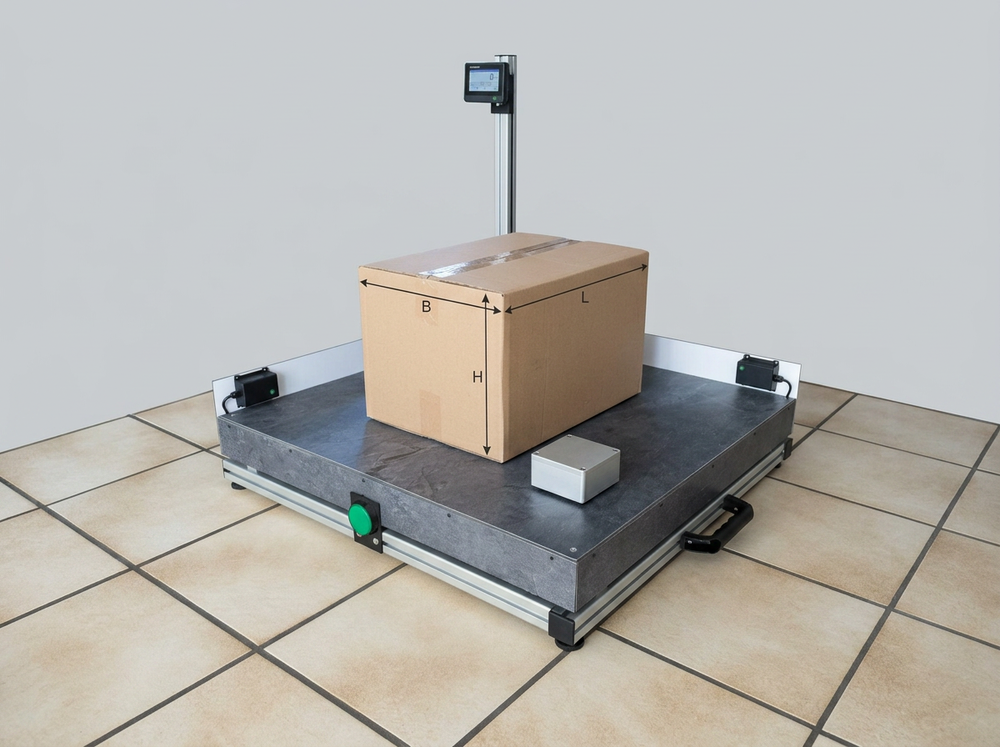
Volume weight is a calculated weight value based on the length, width, and height of a fully packaged shipment. It is also referred to as volumetric weight, dimensional weight, or cubic weight.
Unlike actual weight, it does not describe the actual mass measured on a scale, but rather the space it occupies in the transportation network. A large box with lightweight contents may therefore be considered heavier for billing purposes than a compact box with dense goods.
For shipping costs, the chargeable weight is the determining factor in many rate schedules. This usually refers to the higher of the actual weight and the calculated volumetric weight.
Important to note: The basis is always the external dimensions of the package ready for shipment. The box itself, padding, bulges, or strapping therefore directly affect the final shipping weight.
Weight Subject to Freight Charges: The "Max" Rule
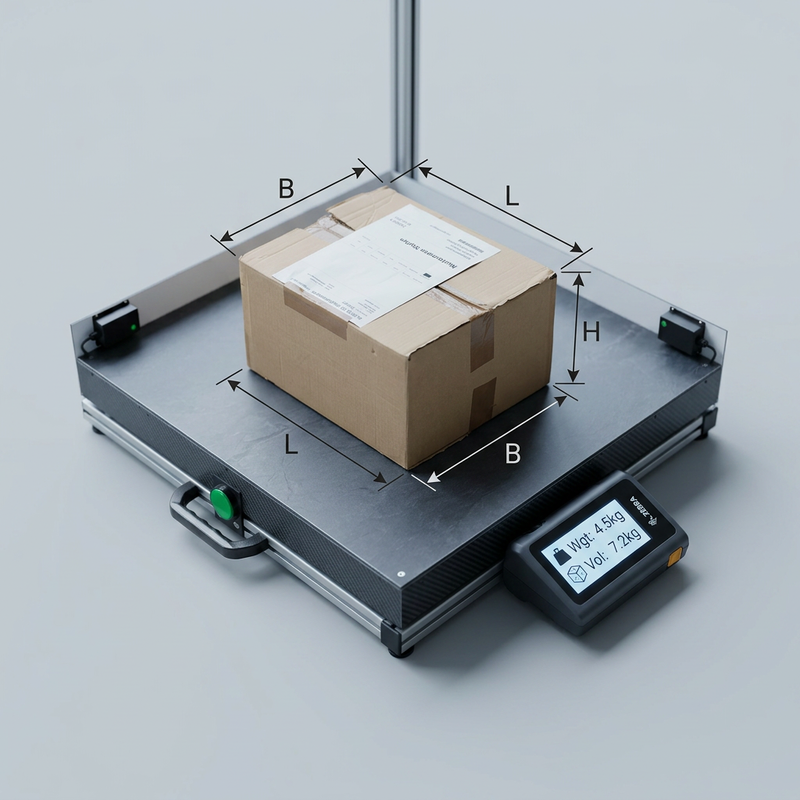
For shipping billing, two values are typically compared: the actual weight and the calculated volumetric weight. The weight used to determine shipping charges is typically the higher of the two values.
Here’s a simple example: A package weighs 3 kg, and its volumetric weight is 5 kg. In this case, 5 kg is usually charged. If, on the other hand, the actual weight is 8 kg and the volumetric weight is 5 kg, 8 kg is generally used as the basis for the rate.
The order of the checks is important here: First, record the dimensions; then apply the appropriate divisor; next, check the rate-based rounding; and only then compare it with the actual weight. Special dimensions such as girth, oversize, or bulky items are checked separately.
The “Max Rule” is thus the key mnemonic for freight weight: Not every large package automatically costs more, but every large package should be compared to its actual weight.
Why it's the cargo space that counts, not the actual weight
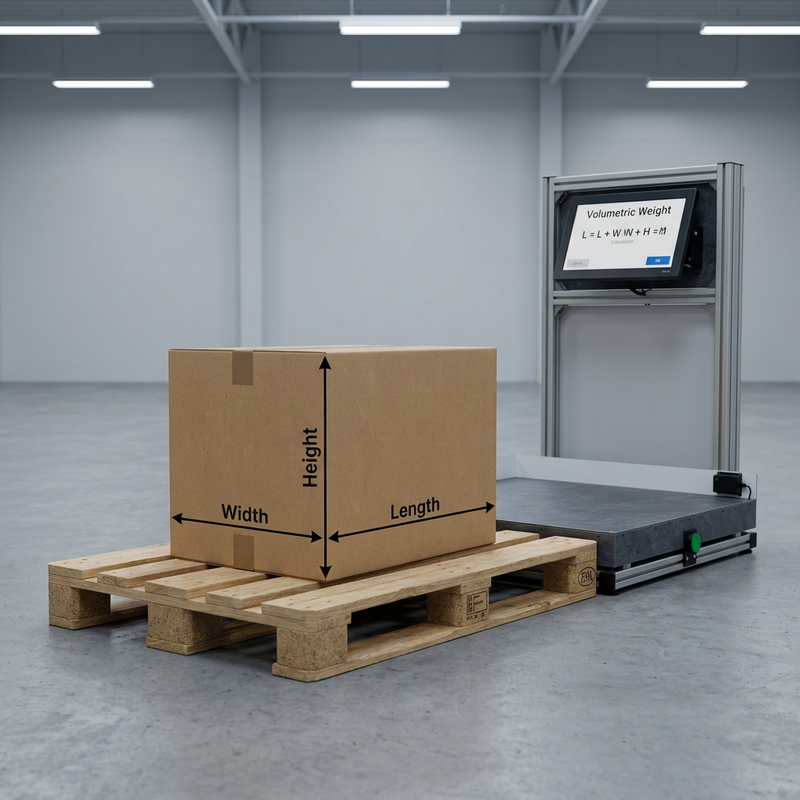
Carriers don’t just sell load capacity—they also sell usable cargo space. Conveyor systems, swap bodies, roll containers, aircraft capacity, and storage areas are all limited. As a result, a shipment can be economically costly even if it is surprisingly light.
This is exactly where volumetric weight comes into play. It converts the occupied volume of a package into a weight value so that bulky, lightweight goods are not treated the same as compact, space-saving goods.
For shippers, this means that the weight measurement alone is not sufficient. Only when combined with the external dimensions can one determine which basis is relevant for billing. Additionally, shape, transportability, oversize dimensions, or poor stackability can trigger further costs.
Anyone who wants to accurately calculate shipping costs must therefore always consider two factors together: mass and space requirements.
Calculate Volume Weight
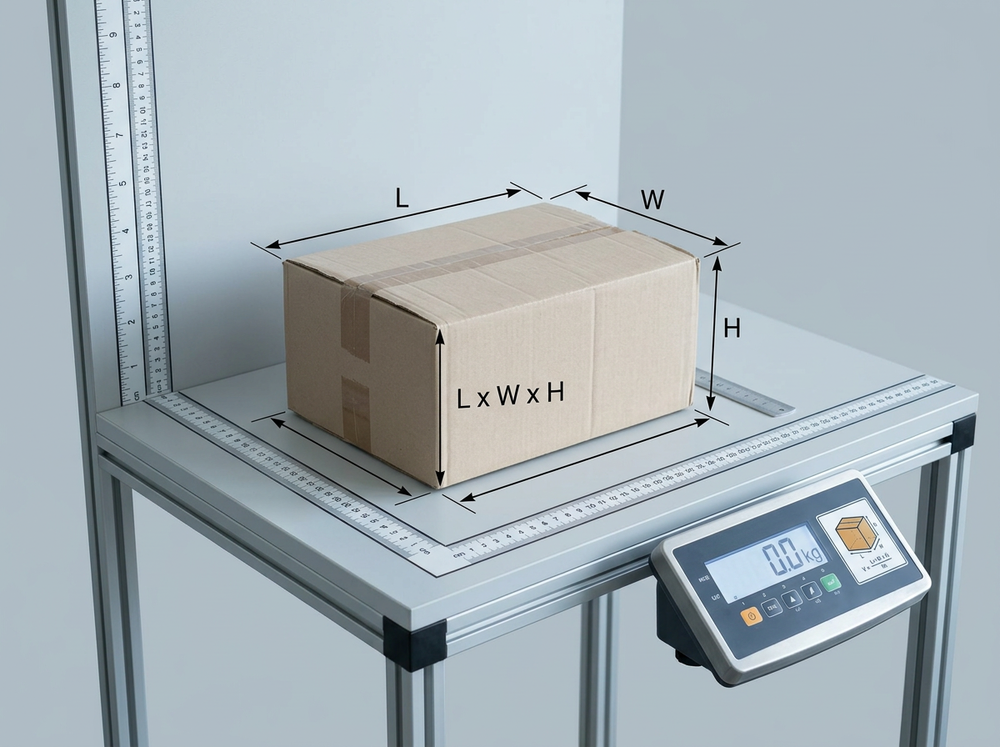
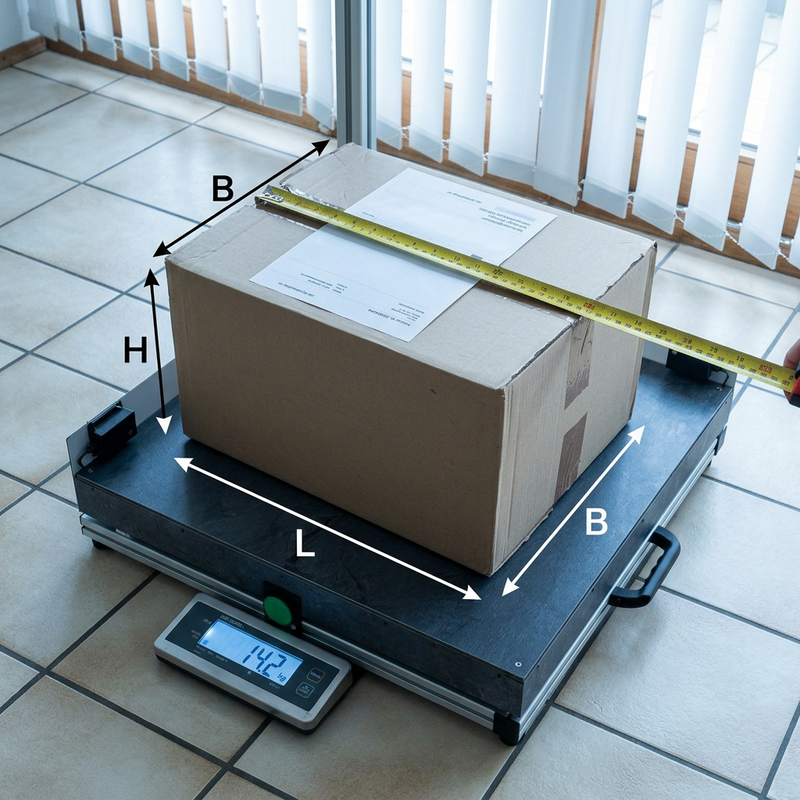
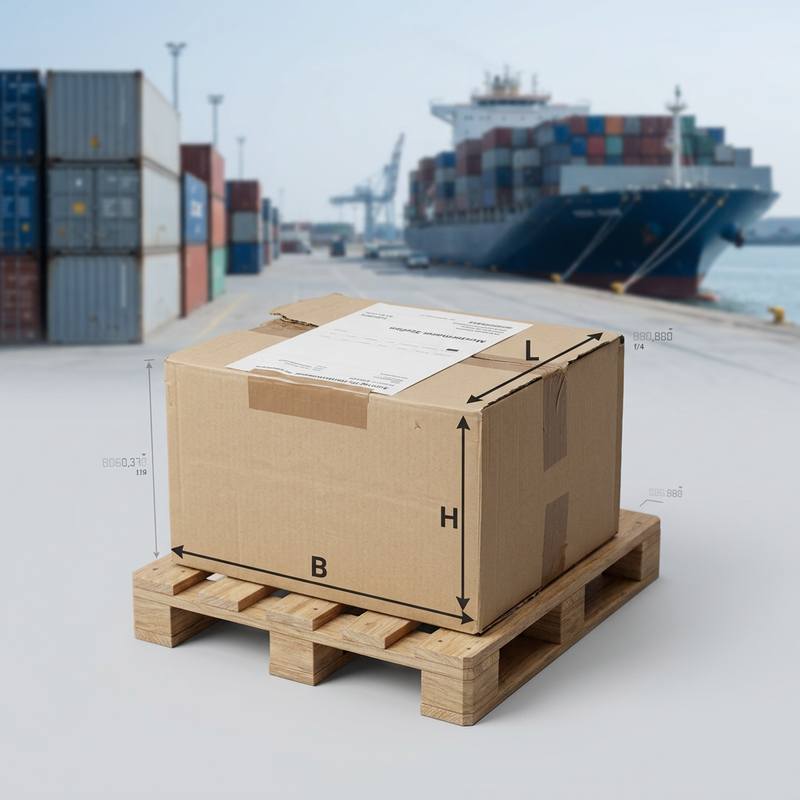
To calculate the volumetric weight, you need the external dimensions of the fully packed shipment: length, width, and height. Always measure the package as it is ready for shipment, including the box, packing material, and any bulges.
The basic formula is:
Volume weight (kg) = Length (cm) × Width (cm) × Height (cm) ÷ DIM divisor
First, the three dimensions are used to calculate a volume in cm³. This volume is then divided by the DIM factor or DIM divisor corresponding to the shipping item. The result is the calculated volumetric weight in kilograms.
Here’s a concrete example: A package measures 60 × 40 × 30 cm. The volume is 72,000 cm³. With a divisor of 5,000, this results in 72,000 ÷ 5,000 = 14.4 kg. If the actual weight of the shipment is only 10 kg, the higher volumetric weight is used as the basis in many rate plans.
Important for classification: Final billing amounts are always based on the valid rate and contract documents for the booked service.
Calculation Example Using Package Dimensions
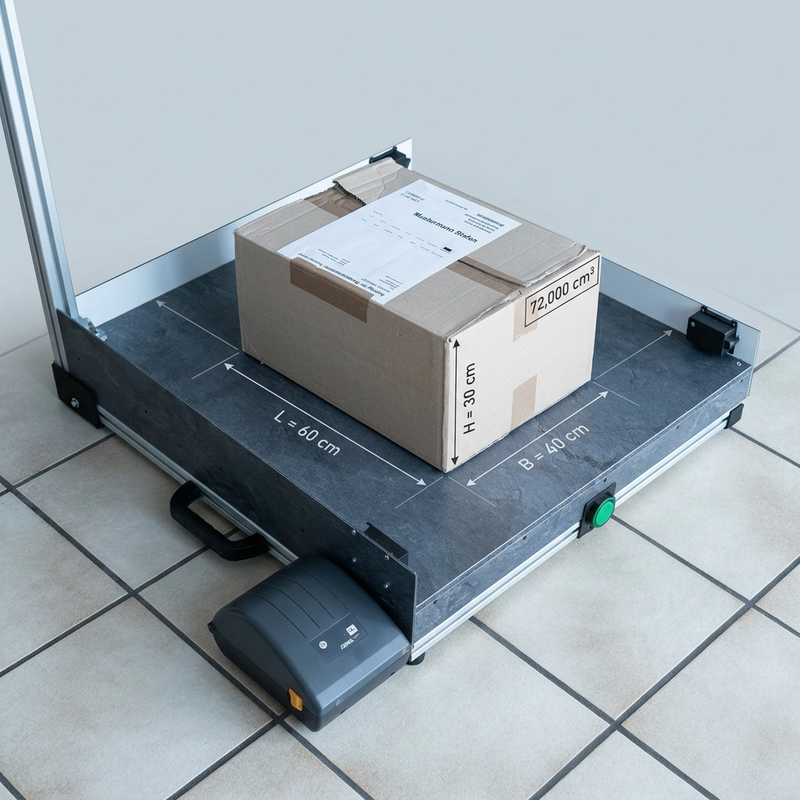
A real-world example illustrates how the DIM divisor affects the cost base. Let’s consider a package with external dimensions of 60 cm × 40 cm × 30 cm and an actual weight of 10 kg.
The volume is:
60 × 40 × 30 = 72,000 cm³
With a divisor of 5,000, this results in:
72,000 ÷ 5,000 = 14.4 kg
With a divisor of 6,000, the result is:
72,000 ÷ 6,000 = 12.0 kg
In both cases, the calculated volumetric weight exceeds the actual weight of 10 kg. Thus, the volumetric weight would typically determine the billing.
A second example shows just how much of a difference a few centimeters can make: An item with an actual weight of 8 kg is initially packed in a box measuring 50 × 40 × 25 cm. This results in a volume of 50,000 cm³ and, with a divisor of 5,000 , exactly 10.0 kg. If the height is reduced to just 20 cm, the volume drops to 40 ,000 cm³ and the calculated weight to 8.0 kg. A 5-cm reduction in packing height thus causes the same item to fall from the volumetric weight category back to its actual weight.
How to Do Math Without Mixing Units
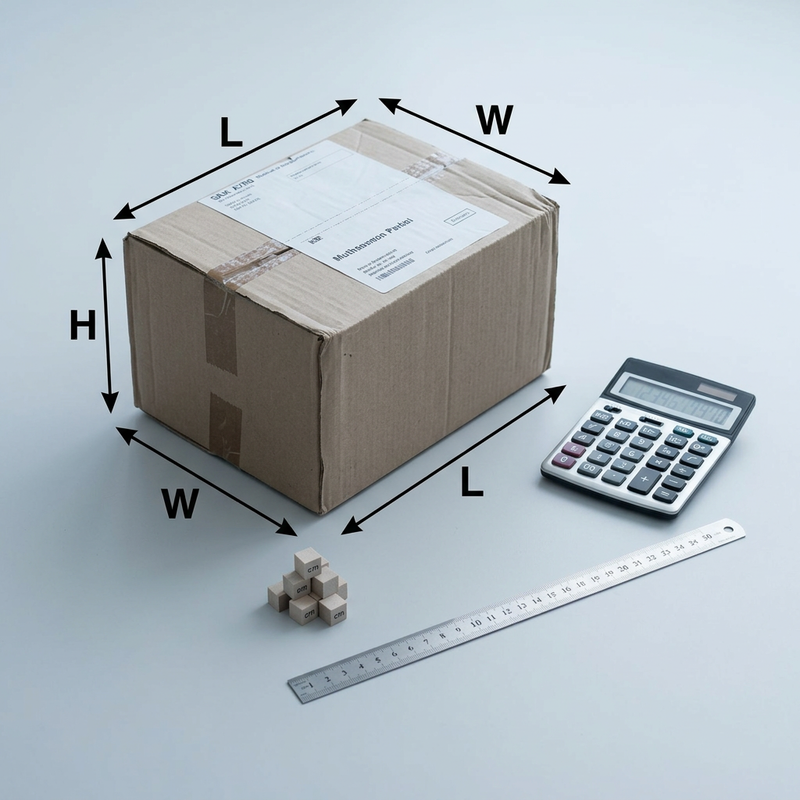
Most errors in calculating volumetric weight do not arise from the formula itself, but from the units. It is crucial that all edge dimensions be in centimeters when calculating with a cm-based DIM divisor.
- cm instead of mm: If millimeters are accidentally treated as centimeters, the result will be significantly too high.
- Converting m³ correctly: 1 m³ equals 1,000,000 cm³.
- Round in the right place: First calculate the volumetric weight, then round it according to the rate schedule, and only then compare it with the actual weight.
Especially in WMS, shipping software, and carrier interfaces, unit definitions should be clearly defined. Otherwise, correct measurements will be distorted by incorrect conversions.
The Volume-Weight Formula
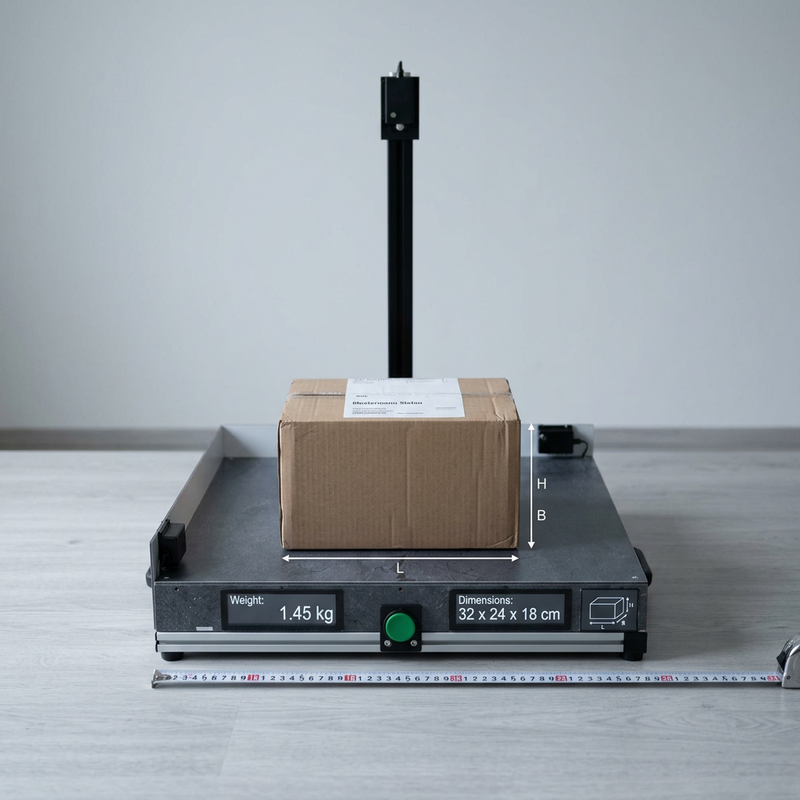
The volumetric weight formula boils down to a simple concept:
Volume weight (kg) = Length (cm) × Width (cm) × Height (cm) ÷ DIM divisor
The DIM divisor determines how much the volume factors into the calculation. A divisor of 5,000 means that 5,000 cm³ equals 1 kg of calculated weight. With a divisor of 6,000, the same box has a lower volumetric weight.
Rule of thumb: The smaller the divisor, the greater the impact of bulky dimensions on the result.
A Comparison of DIM Divisors
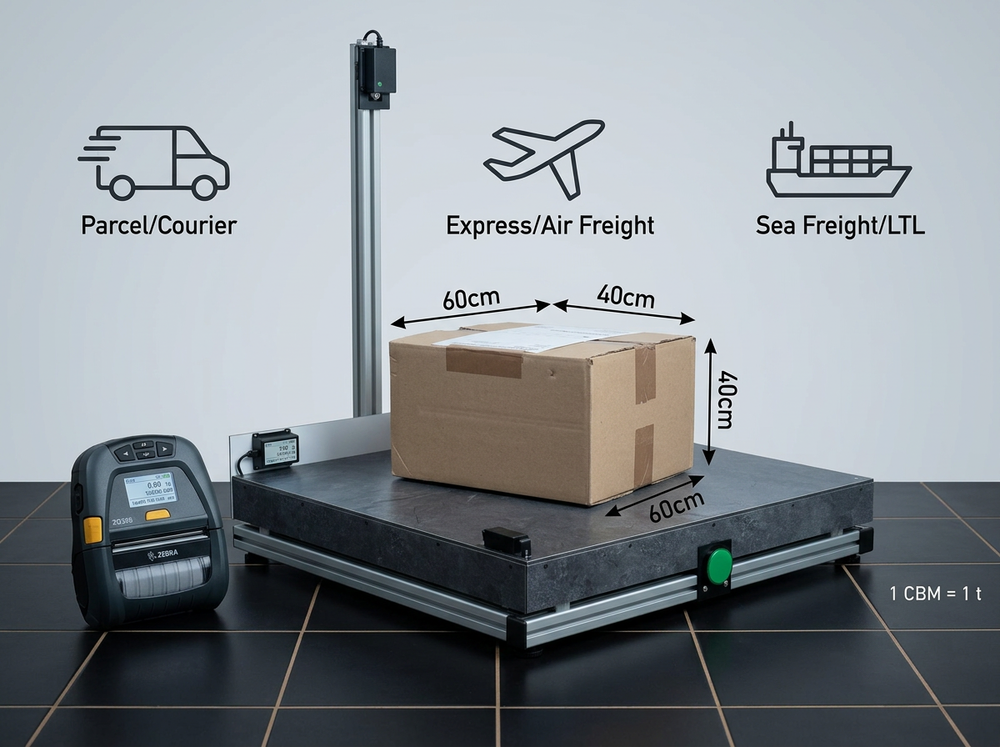
For a quick preliminary cost estimate, here’s a brief overview by shipping category:
- Package / CEP: often calculated based on centimeters, with a guideline value of 5,000.
- Express / Air Freight: often also based on centimeters, typically using 6,000 as a standard figure.
- Ocean freight / general cargo: usually not based on the classic DIM formula in cm, but rather on cubic meters (cbm) or metric tons (t), often following the principle of 1 cbm = 1 t.
This allows you to quickly classify a shipment: parcels tend to be around 5,000, air freight around 6,000, and freight forwarding rates are often expressed in cubic meters rather than cm³.
The Difference Between Packages, Air Freight, and Ocean Freight
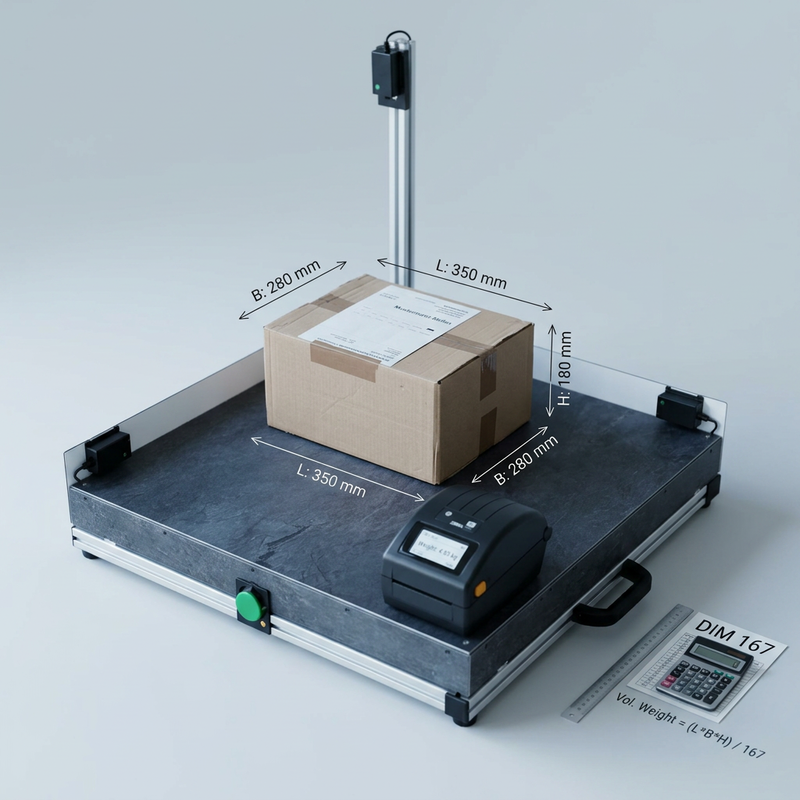
The calculation logic for volumetric weight varies significantly depending on the mode of transport. If you confuse parcel, air, and ocean shipping, you’ll quickly end up with the wrong calculation.
Packages and CEP: Here, external dimensions are usually given in centimeters. The volume is converted to kilograms using a DIM divisor. For preliminary calculations, 5,000 is a common guideline.
Air freight and many express services: Here, too, volume is often converted using a divisor, but 6,000 is frequently used. Additionally, rounding is particularly important because, depending on the rate, weights may be rounded up to the nearest half or full kilogram.
Ocean freight and some general cargo: In these sectors, calculations are frequently based on cubic meters. A typical approach is the cbm/metric ton logic, often following the principle of 1 cbm = 1 metric ton. This is less about a cm formula and more about the relationship between volume and weight on a m³ basis.
If you want to keep these distinctions clear, remember: parcel and express services usually calculate in centimeters with a divisor, while ocean freight and freight forwarding tend to use cubic meters.
Table: DHL, DPD, UPS, FedEx, DB Schenker
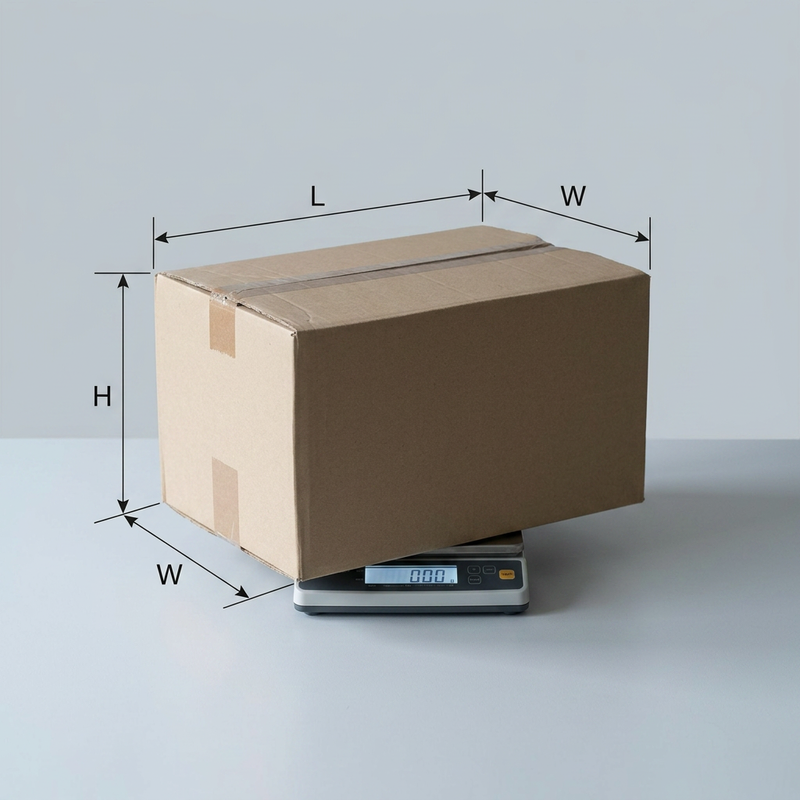
The following overview provides a concise guide to typical pricing models in the market:
- DHL | Parcel, Express, international air shipments | typical guideline: parcels often 5,000; Express/air shipments 5,000 or 6,000 depending on the service | Check rounding and size limits based on the product
- DPD | Standard package shipping / CEP | Typical guideline: often 5,000 | Evaluate oversize items, surcharges, and product limits separately
- UPS | Parcel, Express, international services | Typical guideline: often 5,000; differentiate based on service | Clearly separate the shipping product and destination
- FedEx | Express, international air freight, parcel | typical guideline: often 6,000 in the express/air context, sometimes 5,000 in the parcel context | Check rounding logic particularly carefully
- DB Schenker | Air freight, ground transport, general cargo, freight forwarding routes | Air often 6,000; general cargo/ground transport frequently uses cubic meter (cbm)-based rates | Clearly distinguish between air, package, and freight forwarding logic
For operational purposes: When dealing with DHL volumetric weight or comparable product lines, always determine the service type first. Parcel, express, air freight, and freight forwarding do not automatically follow the same calculation basis.
What is a DIM divisor?
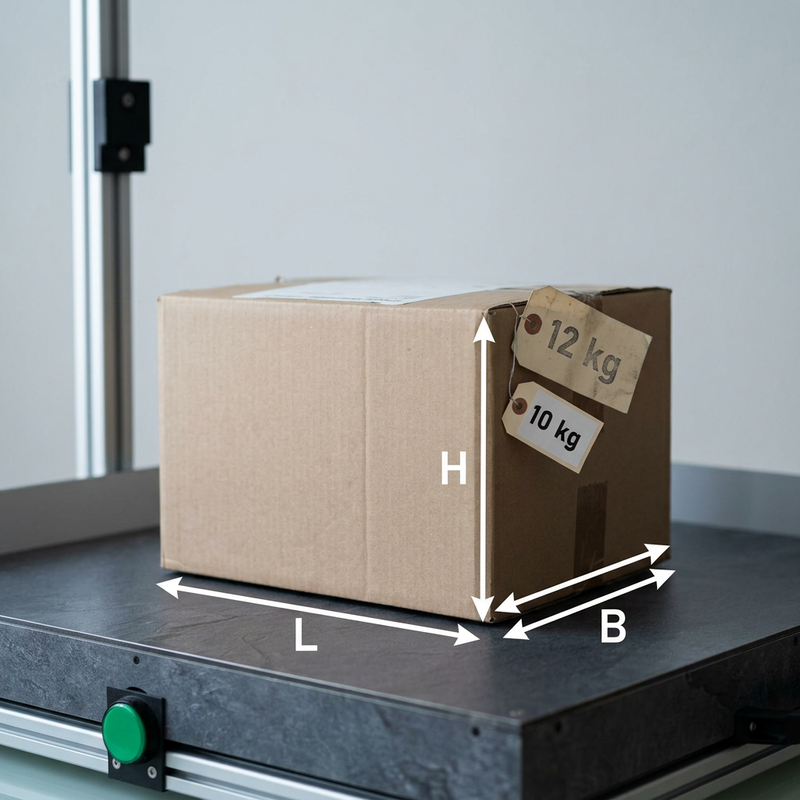
The DIM divisor is the denominator in the formula for volumetric weight. It determines how much volume corresponds to one kilogram of calculated weight. The smaller this value is, the higher the calculated result will be for the same package dimensions.
For example: A package with a volume of 60,000 cm³ weighs exactly 12 kg when the divisor is 5,000. With a divisor of 6,000, the same box weighs 10 kg. The package itself remains unchanged—only the rate calculation changes.
The term “DIM factor” is often used interchangeably in everyday language. For the actual calculation, however, the value by which the volume is divided is crucial. It is precisely this divisor that should reflect the same logic in the preliminary calculation as it does for the booked service.
For warehousing and shipping control, the divisor is therefore not a minor detail, but a direct cost driver. Even small deviations in measurements have a significant impact when dealing with large shipment volumes.
When is volumetric weight calculated?
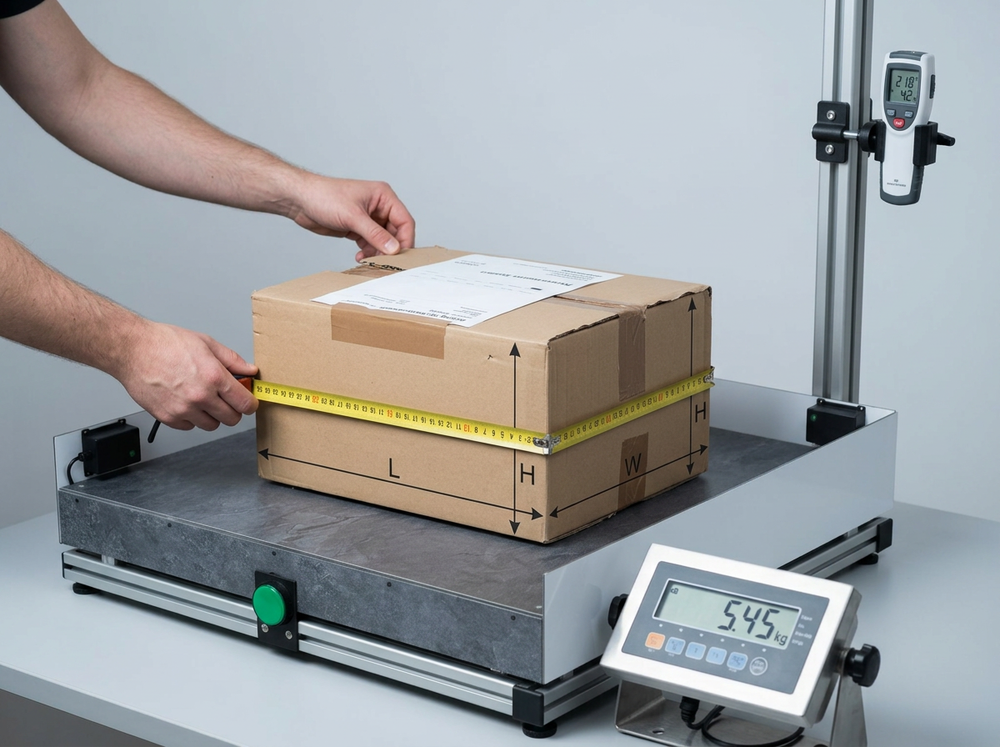
Volume weight becomes relevant whenever the volume calculated from the external dimensions exceeds the actual weight of the shipment. In practice, a simple threshold rule applies:
If length × width × height ÷ DIM divisor > actual weight, then the shipment is usually billed based on volume.
For day-to-day shipping, this quick decision guide is helpful:
- 1. Record the external dimensions: Measure the fully packaged parcel.
- 2. Calculate the volumetric weight: Convert the dimensions using the appropriate divisor.
- 3. Round to the nearest half or full kilogram, depending on the service.
- 4. Compare with the actual weight: the higher value is usually the one used for billing.
- 5. Then check size limits: Evaluate oversized, bulky, and girth-weight items, as well as any possible freight surcharges, separately.
A simple example: With a divisor of 5,000 and an actual weight of 6 kg, the volumetric weight becomes relevant as soon as the package volume exceeds 30,000 cm³. This is because 30,000 ÷ 5,000 = 6 kg. Every additional cubic centimeter raises the volumetric weight above the actual weight.
When a Freight surcharge Applies
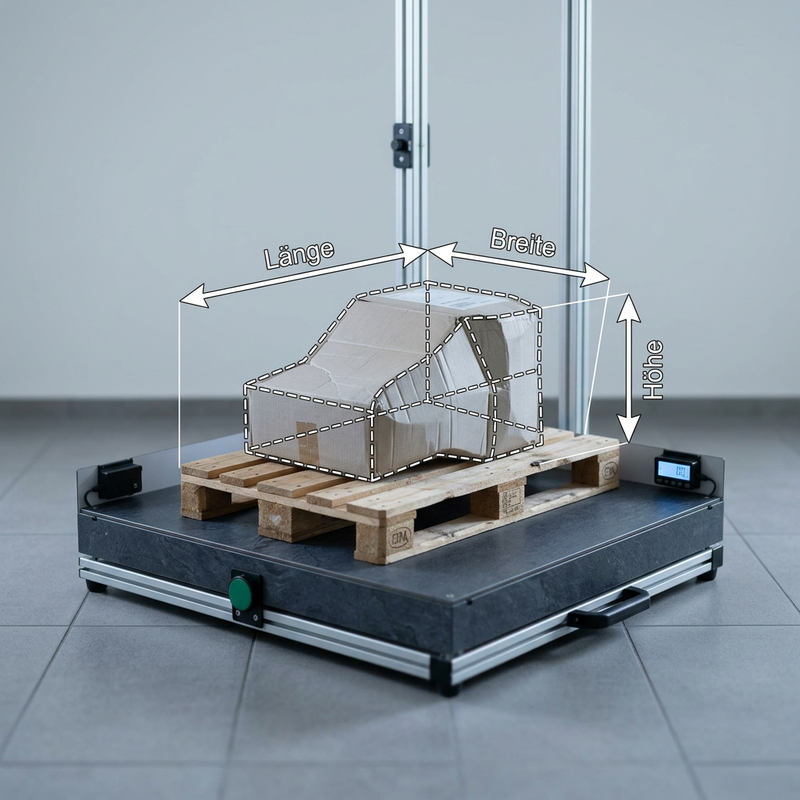
A freight surcharge isn’t just triggered by high weight in kilograms. In many networks, unfavorable dimensions, difficult handling, or unusual shapes are enough to trigger additional costs. Typical examples include long, flat, round, loose, or poorly stackable shipments.
Even a volumetric weight calculated correctly according to the rules does not protect against such surcharges. The reason lies in the operational effort involved: manual handling, special loading, poor stackability, or additional space requirements cause extra work within the network.
This is important for shippers because these additional costs often cannot be avoided simply by reducing the product’s weight. In many cases, improved packaging geometry has a greater impact than any reduction in weight alone.
Anyone who wants to minimize surcharges should therefore check not only the freight weight but also the shipment’s dimensional stability, conveyability, and dimensional limits.
Bulky Shipments, Thresholds, and Girth
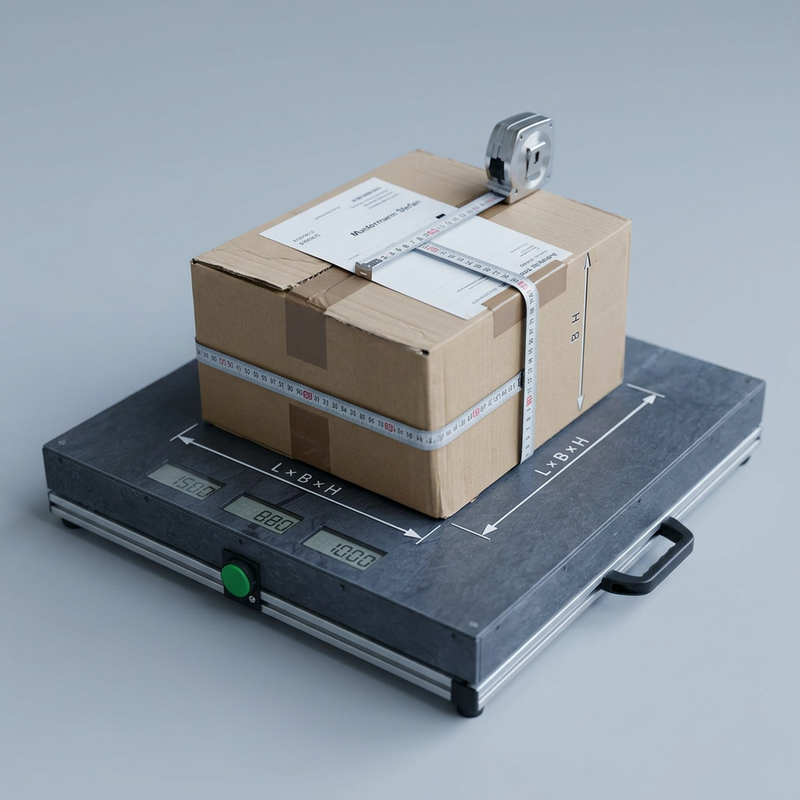
In addition to volumetric weight, many carriers check additional dimensional criteria. These include maximum edge lengths, combined limits, and the girth. These rules do not determine the formula itself, but rather whether a shipment still qualifies for the standard rate.
In the parcel industry, the girth is often calculated using this formula: length + 2 × width + 2 × height. If the permissible value is exceeded, the package may be subject to a special rate or excluded from the standard service.
Therefore, when evaluating large shipments, it is important to note:
- Volume weight = calculated volumetric value
- Dimensions = size limit for rate or product eligibility
- Oversized / Bulky Items = special rate classification
- Surcharge = additional costs due to shape, handling, or transportability
By distinguishing between these factors, you can more quickly determine whether a package is expensive due to its volume or because of a specific dimensional restriction.
Reducing Costs in the Distribution Center
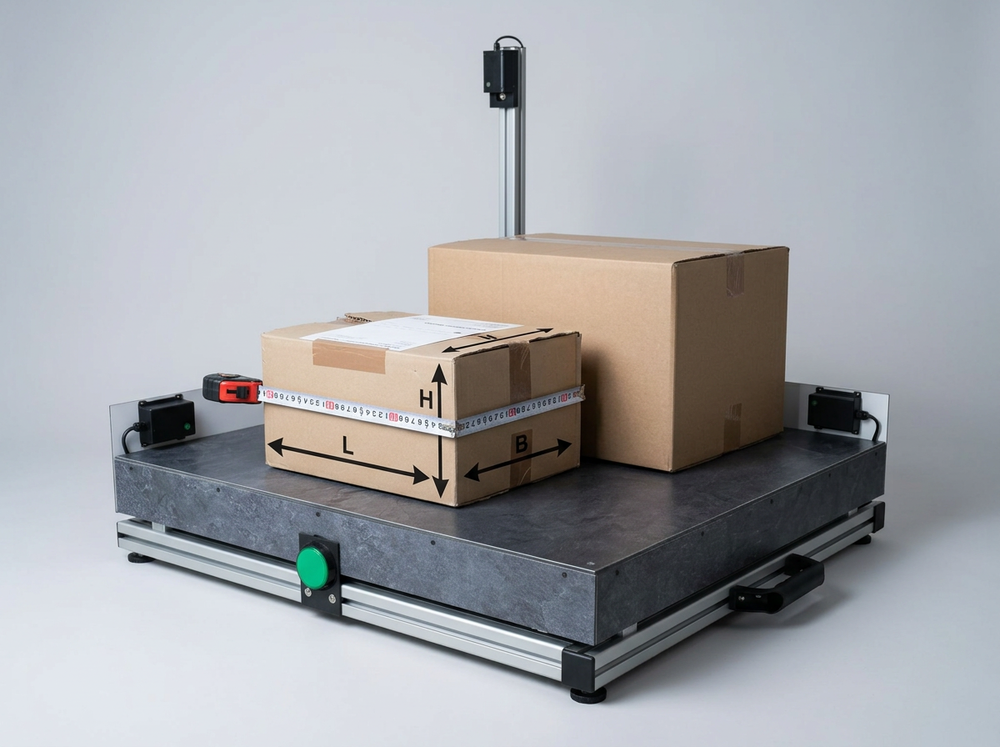
Anyone looking to optimize shipping costs should focus on three key areas: packaging, measurement accuracy, and data quality. Only by addressing these factors together can the issue of volumetric weight be effectively managed.
The greatest impact almost always comes from the choice of packaging. Standard boxes that are too large create empty space, which is directly factored into the billable weight. Even a reduction of just a few centimeters in height, width, or length can be enough to achieve a lower weight classification.
Equally important is precise data collection. Those who merely estimate dimensions or enter them manually risk discrepancies between their own calculations and the carrier’s billing. This is precisely where package measurement, freight measurement, and automated processes come into play.
The third lever is analysis. Only when dimensions and weights are systematically documented can problematic box types, inefficient packing routines, and recurring volume drivers be identified.
Before-and-After Example of Cost Reduction
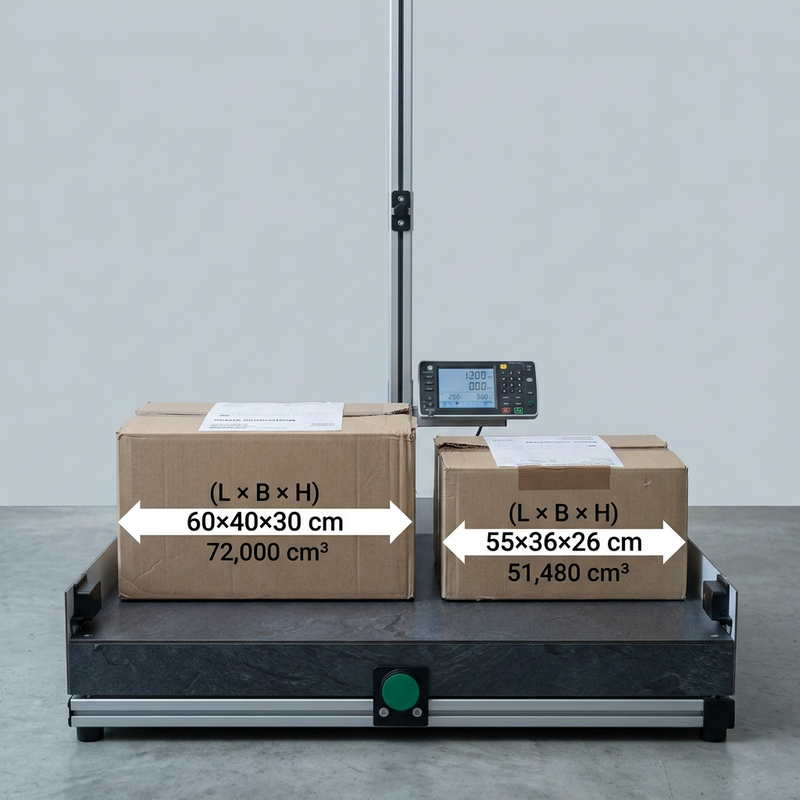
A direct comparison shows just how much of a difference a few centimeters can make. Let’s start with a product that weighs 4 kg and is packed in a box measuring 60 × 40 × 30 cm. That gives a volume of 72,000 cm³. With a DIM divisor of 5,000, the volumetric weight is 14.4 kg.
If the same item is packed in a better-fitting cardboard box measuring 55 × 36 × 26 cm, the volume drops to 51,480 cm³. Using the same calculation method, this results in a volume weight of only 10.3 kg.
The product remains the same, but the packaging does not. This is precisely what reduces the billable weight by more than 4 kg. With larger shipment volumes, this quickly translates into a noticeable cost savings.
This example illustrates why packaging optimization is often the quickest way to measurably reduce shipping costs.
Optimize Packaging Instead of Shipping Air
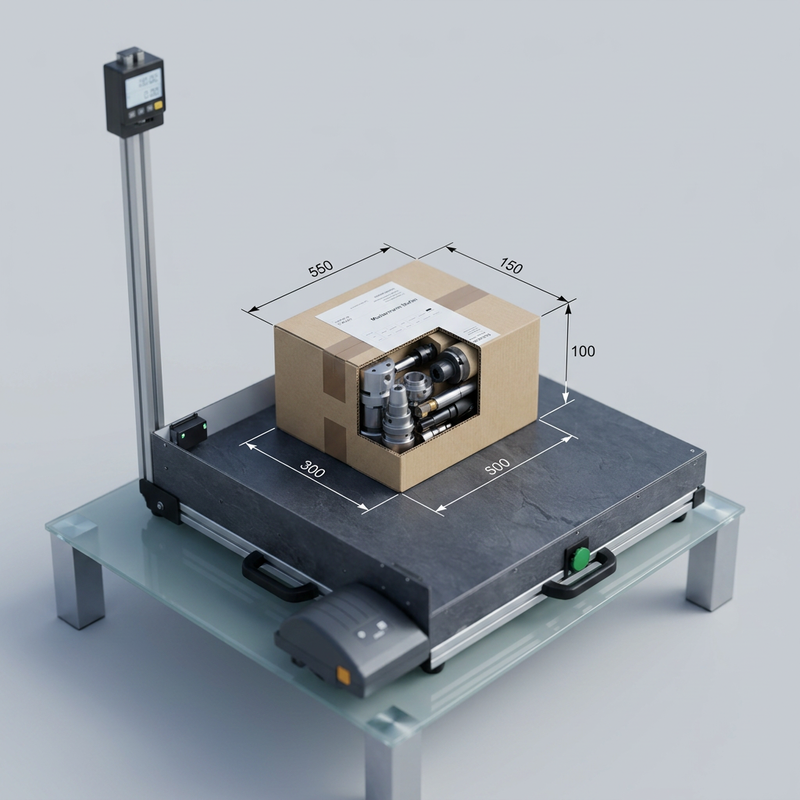
The most effective way to combat unnecessarily high volumetric weight is almost always to use a more appropriately sized box. When you ship air, you’re paying for unused space. That’s exactly why using smaller packaging often pays off more than any subsequent discussion about shipping rates.
In addition to box size, packing procedures also matter. If identical products are packed in different formats depending on the employee, volume and shipping costs fluctuate unnecessarily. Clear packing guidelines quickly create more consistency here.
Filling material also influences the outcome. Compressible solutions stabilize the goods without artificially inflating the package. Rigid or overly bulky cushioning, on the other hand, can directly impact the shipping weight.
Packaging optimization therefore means not only protecting the goods but also specifically managing the volumetric weight used for billing purposes.
Volume Scales and Volume Measuring Devices as a Solution
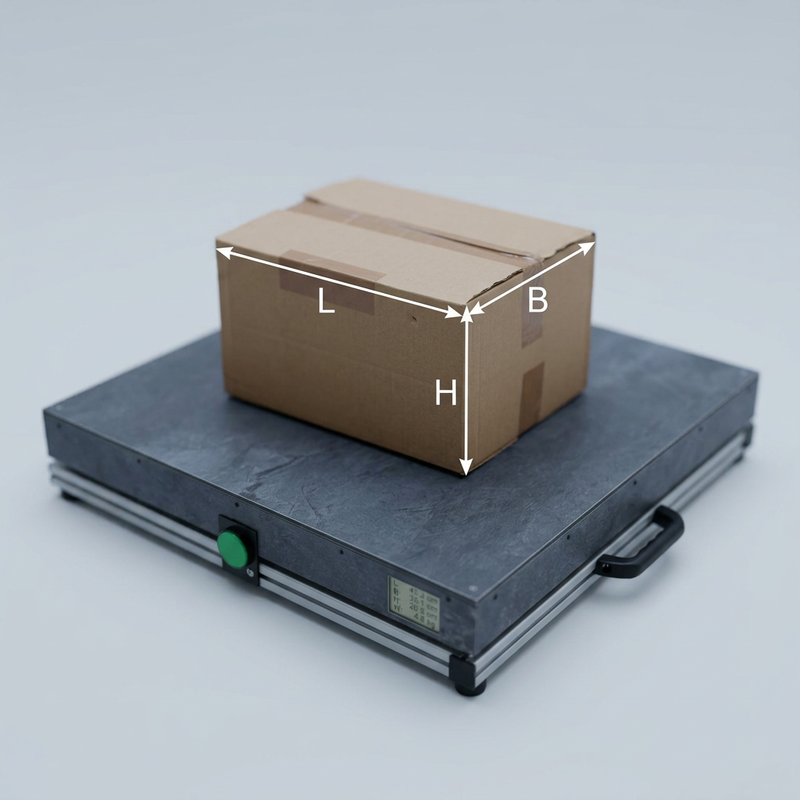
A volumetric scale combines weight and dimension measurement in a single step. This saves time, reduces data entry errors, and provides the exact values relevant for shipping billing: length, width, height, and actual weight.
As a volumetric measurement device, this technology is particularly useful in environments where large numbers of packages pass through the outbound area every day. E-commerce warehouses, fulfillment centers, and processes closely tied to the express, courier, and postal (ECP) sector benefit from it because manual measurements and data disconnects are significantly reduced.
In addition, the quality of data for analyses and complaint reviews improves. By automatically documenting dimensions and weights, you can more quickly identify which shipment types consistently result in excessively high volumetric weight. You can find more information under “Volume Scale.”
Automatic Package Measurement in the Shipping Department

Manual measurement takes time and leads to discrepancies. In the day-to-day outbound shipping process, this quickly results in incomplete or inaccurate shipping data. Automated package measurement establishes a consistent standard here: length, width, height, and weight are accurately recorded and directly integrated into the shipping process.
This not only helps with preliminary cost estimates. Precise dimensional data also makes it easier to reconcile carrier invoices and verify any subsequent charges. Companies that have their own freight measurement process under control are much better equipped to assess discrepancies.
This accuracy is particularly crucial for shipments that are close to volume or dimensional limits. Even small deviations can determine whether a package remains within the standard range or is classified into a more expensive tier.
Applications of Volume Weight
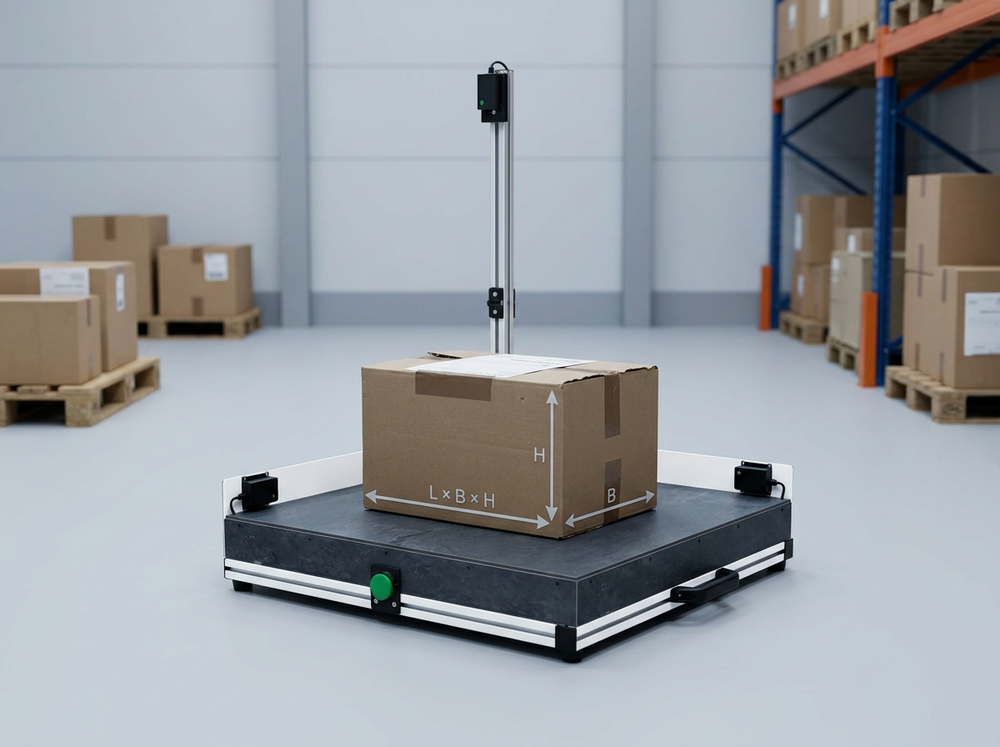
Volume weight is relevant whenever shipments are not only heavy but, above all, large. This is particularly evident in processes involving standardized rates, high shipment volume, and tight cost constraints.
In e-commerce, it directly affects the shipping margin for individual orders. For CEP service providers and fulfillment providers, it also serves as a control metric for billing and data quality. In air freight, it plays a particularly significant role because scarce cargo space is especially expensive there.
What all these areas have in common is this: those who focus solely on actual weight often underestimate the true shipping costs. Only by combining dimensional data, packaging, and rate logic can a reliable calculation be made.
Air Freight and International Shipping
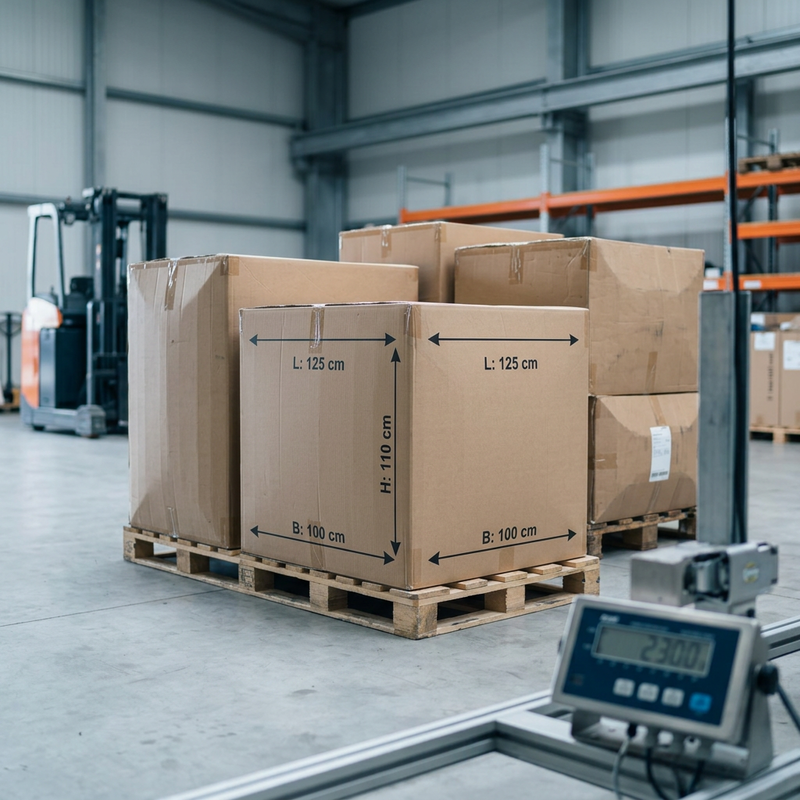
In air freight, volumetric weight has a particularly significant impact because cargo space is scarce and expensive. Even slight deviations in dimensions can lead to noticeable additional costs. International rates are correspondingly sensitive to bulky packaging.
In air freight calculations, 6,000 cm³ per kg is often used. For the same shipment, this usually yields a different result than in a system based on 5,000 cm³ packages. In addition, rounding can further alter the billing: Depending on the rate, the weight is rounded up to the nearest half or full kilogram.
For example: If the formula yields 12.1 kg, the rate may be calculated as 12.5 kg or 13 kg. This rounding should always be checked before comparing it to the actual weight, not after.
For international shipments, the choice of shipping product is also particularly important. On the same route, different services can lead to different calculation methods. For a reliable preliminary cost estimate, dimensions, shipping product, rounding, and weight limits must therefore be considered together.
Express, Parcel, and Courier (KEP) Service Providers and Fulfillment

For CEP service providers and fulfillment providers, this issue is particularly important from an operational standpoint. They must efficiently process high volumes of shipments while also providing reliable data for customer billing and carrier audits. Without accurate dimensional data, discrepancies arise that are difficult to resolve later on.
In addition, different clients often use very different packaging standards. As a result, dimensions, fill levels, and box qualities vary significantly. Systematic freight measurement ensures comparability and reduces the risk of incorrect master data or estimates.
For fulfillment operations, this is not just a cost issue but also a quality metric. Those who document freight weight —which is relevant for billing—in a traceable manner can present their case to customers with significantly greater transparency.
E-commerce and Online Retail
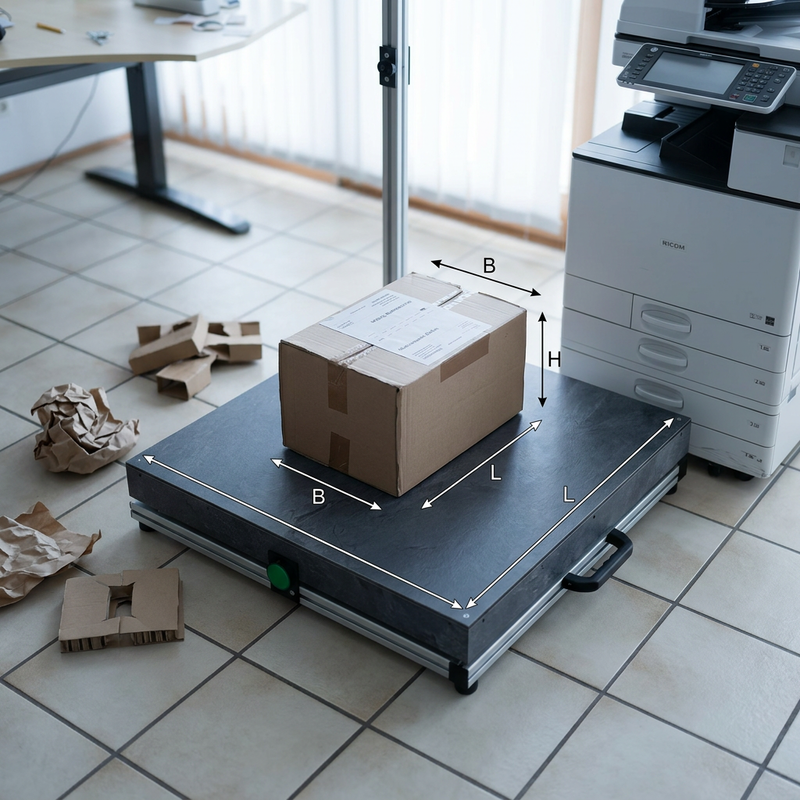
In e-commerce, volumetric weight is often a direct driver of profit margins. Many products are lightweight but require a lot of packaging space—such as home textiles, lighting fixtures, decorative items, toys, or sets with protective padding. If calculations are based solely on actual weight, shipping rates can quickly end up being too low.
This is particularly critical for small shopping carts or free shipping thresholds. In these cases, even a few centimeters in box height can determine whether an order remains profitable or results in a loss of margin.
Returns are also subject to the same space-related logic. A large return takes up the same amount of space in the network as the outbound shipment. Therefore, effectively managing packaging sizes in the online store also improves cost calculations for returns.
Frequently Asked Questions About Volume Weight
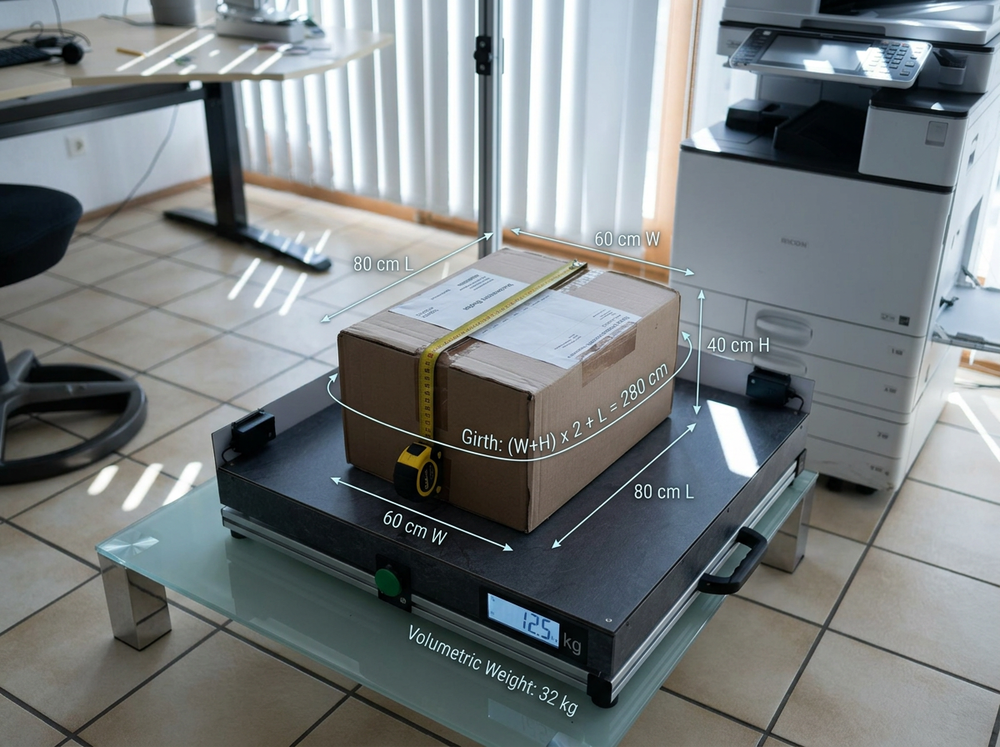
The most important remaining questions from real-world practice can be answered briefly:
- Is volumetric weight calculated for every package? Not necessarily as the basis for pricing. It is usually checked, but is only relevant if the volumetric weight exceeds the actual weight or if special rate rules apply.
- Is volumetric weight the same as the girth? No. Volumetric weight is a calculated value used for billing, while girth is a dimensional limit for product eligibility or surcharges.
- Why do our own figures differ from the carrier’s billing? Common causes include incorrect external dimensions, differing rounding rules, different service offerings, or unrecognized surcharges.
- What are the benefits of automatic measurement in day-to-day operations? It reduces estimation errors, provides reliable shipping data, and makes it easier to verify post-shipment billing adjustments.
What is the difference between volumetric weight and actual weight?
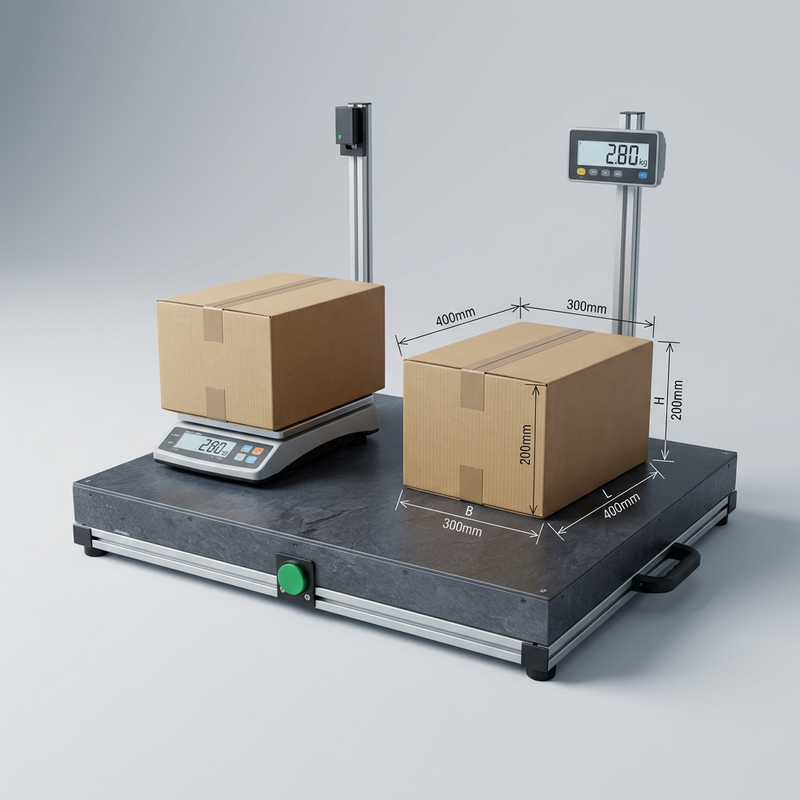
Actual weight is the weight shown on the scale. Volumetric weight is calculated based on the package’s external dimensions and represents the space it occupies in the cargo hold as a weight value.
The weight subject to freight charges—typically the higher of the two values—is usually the determining factor for billing. Compact, dense goods are therefore often billed based on actual weight, while large, lightweight goods tend to be billed based on volumetric weight.
How can freight costs be reduced by decreasing volume?

The most effective measure is almost always a smaller, better-fitting box. This is followed by standardized packing guidelines, compressible packing material, and precise measurements taken at the shipping dock.
This is particularly effective when combined with automated package measurement or a volumetric scale. This not only allows for more precise billing of shipments but also enables the systematic identification of the biggest cost drivers in the packaging process.
Which DIM factor applies to which carrier?
There is no universal DIM factor. The decisive factors are the carrier, service, destination region, contract terms, rounding, and measurement limits.
- Parcel / CEP: often 5,000 as a preliminary calculation value
- Express / Air Freight: often 6,000 as a typical calculation basis
- Freight Forwarding / Ocean / Certain Types of General Cargo: tends to use cubic meter (cbm) or metric ton logic rather than the classic centimeter formula
To ensure reliable results, the specific shipping product should therefore always be determined first.
What are the differences between the DIM divisors used by DHL, DPD, UPS, FedEx, and DB Schenker?
The DIM divisors vary significantly depending on the carrier and product. For package delivery services, a divisor of 5,000 is often used, meaning: length × width × height in cm / 5,000. For DHL, DPD, and UPS, 5,000 is often a typical guideline for package shipping. FedEx also frequently uses 5,000 or 6,000 depending on the service, particularly for international shipments or those involving air freight. DB Schenker also uses different factors depending on the product, general cargo, or air freight sector, often closer to 5,000 or 6,000. The key factor is always this: The higher weight—whether actual weight or volumetric weight—is used for billing. Therefore, you should check the applicable divisor in the specific rate schedule.
How do you correctly compare actual weight and volumetric weight?
You always compare two values: the actual weight (the weight shown on the scale) and the volume weight. You calculate the volumetric weight using: length × width × height in cm / conversion factor. Common factors are 5,000 or 6,000, depending on the carrier and shipping method. Important: Use only the same units and check the service provider’s applicable factor. Then the basic rule applies: The higher value is used for billing. This “chargeable weight” determines the shipping costs. Example: 50 × 40 × 30 cm / 5,000 = 12 kg volumetric weight. If the package actually weighs 8 kg, 12 kg will be charged. If it weighs 15 kg, the actual weight applies.
At what point do package delivery services start using volumetric weight instead of actual weight?
Volume weight becomes relevant whenever it is greater than the actual weight of the package. Parcel services therefore generally use the greater of the actual weight and the volumetric weight. This applies primarily to light but large or bulky shipments. It is usually calculated as follows: length × width × height in cm / conversion factor. Common conversion factors are 5,000 or 6,000, depending on the shipping carrier and shipping method. Example: A package measuring 50 × 40 × 30 cm has a volumetric weight of 12 kg when using a factor of 5,000. If it actually weighs only 8 kg, 12 kg will be charged. The rate rules of the respective provider always apply.
What is a DIM divisor, and how does it affect shipping costs?
A DIM divisor is the conversion factor used to convert a package's volume into volumetric weight. The formula is: Length × Width × Height (in cm) / DIM divisor. Common divisors include, for example, 5000 or 6000, depending on the carrier and shipping method. The smaller the DIM divisor, the higher the volumetric weight—and thus often the shipping costs as well. The higher weight—either the actual weight or the volumetric weight—is usually charged. Example: 50 × 40 × 30 cm / 5000 = 12 kg. If the package actually weighs only 8 kg, 12 kg is usually charged. This is particularly important for light but bulky shipments.
What role does the DIM factor play in calculating volumetric weight?
The DIM factor is the conversion factor in the formula for volumetric weight: Length × Width × Height / DIM factor. It determines how much space is calculated in relation to 1 kg. The smaller the DIM factor, the higher the volumetric weight—and thus often the shipping costs as well. Common values, depending on the carrier and mode of transport, are, for example, 5000 or 6000. Example: 50 × 40 × 30 cm / 5000 = 12 kg; with 6000 = 10 kg. The higher weight—either the actual weight or the volumetric weight—is then usually used for billing. That’s why the correct DIM factor is crucial for calculating costs.
How do you calculate the volumetric weight?
Volume weight describes how much space a package takes up during shipping. It is calculated using the formula: Length × Width × Height in cm / Conversion factor. Common conversion factors are 5,000 or 6,000, depending on the carrier and shipping method. Example: A package measuring 50 × 40 × 30 cm has a volume of 60,000 cm³. Divided by 5,000, this results in a volumetric weight of 12 kg. For billing purposes, the higher value between the volumetric weight and the actual weight is used. If the package actually weighs only 8 kg, 12 kg will be charged. This is particularly important for light but bulky shipments. Keeping the packaging as compact as possible often reduces costs.
What is the volumetric weight formula for packages and shipments?
The formula for volumetric weight is: Length × Width × Height (in cm) ÷ Conversion Factor. Common factors are 5,000 or 6,000, depending on the shipping carrier and mode of transport. Example: A package measuring 50 × 40 × 30 cm has a volumetric weight of 12 kg when using a factor of 5,000. For pricing purposes, the higher value between the actual weight and the dimensional weight is used—this is known as the chargeable weight. This is particularly important for light but large shipments. Important: The exact factor and any rounding rules vary by carrier, so always check the specific shipping terms and conditions.
Why do carriers often calculate volumetric weight rather than actual weight?
Carriers often calculate the volumetric weight because, in shipping, it’s not just the actual weight that counts, but also the cargo space occupied. Light but large packages take up just as much space as heavy shipments. That’s why volumetric weight is usually calculated using the formula: length × width × height in cm / conversion factor (typically 5,000 or 6,000, depending on the carrier and mode of transport). The charge is then based on the higher of the actual weight and the volumetric weight—the so-called chargeable weight. This ensures that costs are distributed more fairly and that limited space in airplanes, trucks, or warehouses is used efficiently. This is particularly relevant for bulky but lightweight goods.
How does the volumetric weight differ from the actual weight of a package?
The actual weight is the actual measured weight of a package on a scale. The volume weight, on the other hand, is a measure of how much space the package takes up during transport. It is usually calculated as follows: length × width × height in cm / conversion factor (often 5,000 or 6,000, depending on the shipping provider and mode of transport). For billing purposes, the higher value between the actual weight and the volumetric weight is generally used. That’s why light but large packages can be more expensive than small, heavy ones. Example: A large pillow weighs very little but takes up a lot of cargo space—this is exactly why volumetric weight is used.
What is volumetric weight, and why is it so important in shipping?
Volume weight is a calculated weight that reflects the space a shipment occupies. It is important because in shipping, it’s not just the actual weight that counts, but also how much space a package takes up in a vehicle or aircraft. It is usually calculated as follows: length × width × height in cm / conversion factor. Common conversion factors are 5000 or 6000, depending on the carrier and mode of transport. For billing purposes, the higher value between actual weight and dimensional weight is always used. Example: 50 × 40 × 30 cm / 5000 = 12 kg. Even if the package actually weighs only 8 kg, it will still be billed at 12 kg. This is particularly relevant for light but bulky shipments.
How does automatic package measurement help make shipping processes more efficient?
Automatic package measurement records the length, width, and height of each package in seconds and uses this data to directly calculate the volumetric weight using the formula L × W × H ÷ conversion factor. This makes it immediately clear whether the actual weight or the volumetric weight is used as the basis for calculating shipping charges. This eliminates the need for manual measurements, reduces data entry errors, and significantly speeds up shipping processing. At the same time, discrepancies can be identified early on—for example, if packaging is too large. This allows companies to optimize their packaging, avoid unnecessary shipping costs, and correctly apply the appropriate factor (such as 5,000 or 6,000), depending on the carrier. This makes processes faster, more transparent, and more cost-effective.
Why is volumetric weight particularly relevant for CEP service providers?
Express, courier, and parcel (ECP) service providers expect limited cargo space and high shipment density. That’s why volumetric weight is particularly important in this context: It’s not just the actual weight that incurs costs, but also the space a package occupies in a vehicle or aircraft. Otherwise, light but large shipments in particular would be priced too low. The calculation is usually: length × width × height in cm divided by a conversion factor, often 5,000 or 6,000 depending on the provider. The higher of the actual weight and the volumetric weight is then billed. In this way, CEP service providers ensure a fair, capacity-based pricing structure while also providing incentives to optimize packaging to save space.
What is the significance of volumetric weight in e-commerce shipping and fulfillment?
In e-commerce shipping and fulfillment, volumetric weight determines how much “space” a package takes up during transport. It is particularly important for lightweight but large shipments, because in such cases, it is often the volumetric weight—rather than the actual weight—that determines the cost. It is usually calculated as: length × width × height in cm ÷ conversion factor, often 5,000 or 6,000—depending on the carrier and shipping method. The higher of the actual weight and the volumetric weight is always used for billing. For retailers, this is relevant for shipping costs, warehouse management, and profit margins. By optimizing packaging, reducing air space, and packing items to fit precisely, you can significantly lower fulfillment costs.
What are some common mistakes made when calculating volumetric weight?
Typical errors in calculating volumetric weight mainly arise from incorrect dimensions, units, and conversion factors. Often, internal dimensions rather than external dimensions of the packaging are used, or length, width, and height are not measured correctly. Another common mistake: confusing cm and m or applying the wrong conversion factor, even though this varies depending on the carrier and mode of transport—for example, 5,000 or 6,000. Rounding rules are also often overlooked. Equally important: It’s not just the volumetric weight that counts, but always the higher value between the actual weight and the volumetric weight. If you ignore this, you’ll quickly miscalculate shipping costs—especially for lightweight but bulky packages.
How can companies optimize their shipping costs by optimizing packaging?
Companies can reduce their shipping costs by specifically reducing the volume weight. The higher of the actual weight and volumetric weight is usually the determining factor. Volumetric weight is calculated as: length × width × height / conversion factor; depending on the carrier, this factor is often 5,000 or 6,000. This makes light but large packages particularly expensive. In practice, this means: choosing more appropriate box sizes, avoiding empty space, reducing filler material, compressing goods, and standardizing packaging. Even a few centimeters less per side can lower the weight subject to freight charges. It’s also important to regularly check the factors and rounding rules of the respective service provider, as they directly affect billing.
When is it worthwhile to use a volume measuring device or have cargo measured at the shipping warehouse?
Using a volume measuring device or having your shipment measured is especially worthwhile if you send a lot of light but bulky shipments and the volume weight often determines the cost. Charges are generally based on the chargeable weight, which is the higher of the actual weight and the volume weight. This is calculated as length × width × height / conversion factor, often 5,000 or 6,000 depending on the carrier. Even small deviations in dimensions can significantly affect shipping costs. Measurement is particularly useful for high shipment volumes, varying package sizes, air freight, or when you want to avoid billing discrepancies and optimize packaging specifically.
What are the advantages of using a volumetric scale to determine volumetric weight?
A volumetric scale saves time and reduces errors because it automatically records dimensions and volumetric weight. Instead of manually measuring length, width, and height and calculating the appropriate conversion factor, it quickly provides a reliable value. This is particularly helpful for large volumes of shipments or for light but bulky packages, where the volumetric weight—rather than the actual weight—often determines shipping costs. In addition, a volumetric scale ensures consistent, traceable measurements and makes it easier to compare them with the actual weight. This helps prevent incorrect shipping costs, retroactive charges, and delays, and allows for targeted optimization of packaging.
How can accurate package measurement help avoid freight surcharges?
Accurate package measurement helps avoid freight surcharges, because for many shipping methods, it’s not just the actual weight that counts, but the volumetric weight. This is calculated as length × width × height in cm, divided by the carrier’s conversion factor, which is often 5,000 or 6,000. The higher of the actual weight and the volumetric weight is usually used for billing. Even small measurement errors, protruding boxes, or unnecessary packing material can place a package in a more expensive category. By measuring accurately, packing appropriately, and verifying the correct conversion factor, you can avoid incorrect classifications, retroactive charges, and surcharges for bulky but lightweight shipments.
What is the significance of the girth measurement in relation to volumetric weight?
The girth complements the volumetric weight because it limits the bulk of a package. It is usually calculated as length + 2 × width + 2 × height and serves as a size limit for standard packages for many carriers. Thus, even if a package has a moderate volumetric weight, it may still be too large for the standard rate class if the dimensional weight limit is exceeded. In such cases, bulky item, oversize, or surcharge fees often apply. Important: When determining the price, the chargeable weight—that is, the higher of the actual weight and the volumetric weight—is generally considered first. The girth also serves as a size and rate criterion and can increase shipping costs independently of this.
How is volumetric weight calculated for air freight?
For air freight, volumetric weight is calculated to determine the space required for a shipment. The formula is: Length × Width × Height (in cm) ÷ Conversion Factor. In air freight, 6000 is often the standard conversion factor, though 5000 may also be used depending on the airline or service provider. Example: 60 × 40 × 50 cm = 120,000 cm³. Divided by 6,000, this results in a volumetric weight of 20 kg. For billing purposes, the higher weight applies: volumetric weight or actual weight. If the package actually weighs only 12 kg, 20 kg will still be charged. This is especially important for light but bulky shipments. Dimensions and rounding rules should always be checked with the carrier.